
Consistent in Strengthening Finances, WSKT's Gross Profit Surges 12% in 2025
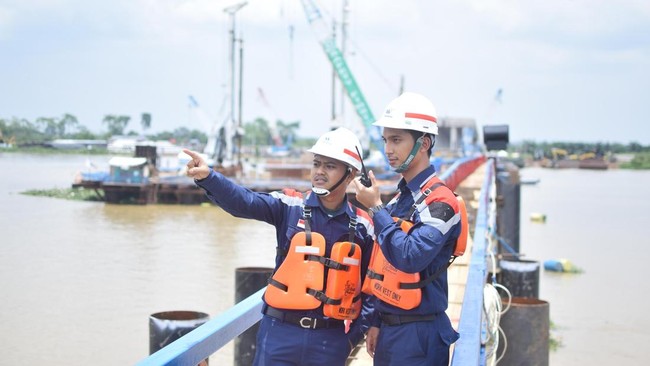
PT Waskita Karya (Persero) Tbk recorded total consolidated revenue of Rp8.85 trillion in 2025. This figure was supported by contributions from subsidiaries amounting to Rp3.1 trillion, while revenue from the parent company reached Rp5.75 trillion.
Waskita Karya’s Corporate Secretary, Ermy Puspa Yunita, stated that the company’s revenue was bolstered by several ongoing projects. Revenue by business segment came from connectivity at Rp3.3 trillion, Water Resources (SDA) at Rp1.4 trillion, buildings at Rp1.2 trillion, and others at Rp0.9 trillion.
The revenue recording, she continued, was largely obtained from various government projects. This strengthens Waskita Karya’s commitment to supporting several government programmes.
Ermy added that Waskita still recorded cost of revenue at Rp7.2 trillion, or 82% of operating revenue. In addition to new projects that must be completed according to contracts, the company is also continuing to complete outstanding old projects that still require cash to completion and targets all old projects to be completed in 2026.
Thus, in 2025, the company recorded gross profit of Rp1.58 trillion, up around 12% from Rp1.41 trillion in 2024. The company also recorded a Gross Profit Margin of 18% in 2025, an improvement from 13% in 2024.
The increase in gross profit was achieved by Waskita through operational efficiency strategies implemented in projects. Not only in the parent company but also in subsidiaries, Ermy explained in an official statement on Thursday (2/4/2026).
To create efficiency and effectiveness in project execution, Waskita has implemented lean organisation and continues to carry out digital transformation in various fields. In operations, the company has integrated the Core System ERP SAP S/4 HANA with Building Information Modelling (BIM) and Last Planner System (LPS) planning.
There are also several other digital innovations, such as the use of Artificial Intelligence (AI) WISENS (Waskita Intelligent Sensing System) technology in some of its project constructions, to improve work effectiveness and efficiency. Two of them are AI Pavement Crack Detection, which aims to help Waskita detect road damage, as well as a target of no failures in the construction process or zero defect.
Through the use of this AI, the calculation of the number and type of damage can be done automatically more efficiently, thus supporting toll road asset inspection and supervision. The inspection time that can be made more efficient reaches 40 percent faster, Ermy explained.
She continued, transformation on the side of strengthening Information Technology (IT) governance has also been carried out. Waskita has developed several information systems, including the creation of an Integrated Management Dashboard and several improvements to the company’s financial system, to support Internal Control Over Financial Reporting (ICOFR).
Overall, the ultimate goal of Waskita’s transformation is to create sustainable operational excellence. We will always strive to complete projects with the best quality, on time, and at efficient costs, she stated.
This company with the stock code WSKT then recorded operating expenses or Operating Expenses (Opex) of Rp1.7 trillion, of which 76.6% are cash operating costs. The remaining 23.4% are non-cash such as depreciation and amortisation expenses of the company’s assets.
Overall, Ermy continued, in 2025 the company succeeded in reducing liabilities by Rp2.21 trillion. She added that management’s current focus is to reduce liabilities through several strategic plans, including accelerating toll road divestments and asset optimisation. Both steps are Waskita Karya’s strategy to return to its core business as a pure contractor.
In 2025, Waskita has completed several share release actions, such as the divestment of 94.7% of PT Waskita Sangir Energi (WSE) through its subsidiary PT Waskita Karya Infrastruktur (WKI) in September. Then the release of 35% shares of PT Cimanggis Cibitung Tollways (CCT) carried out by PT Waskita Toll Road in November, she explained.
Next, in December 2025, Waskita through its subsidiary PT Waskita Karya Realty (WKR) officially divested 20% shares of PT Waskita Modern Realty (WMR). This step aims to optimise the investment portfolio and strengthen WSKT’s financial liquidity.
During 2025, we also continued to add new contracts but more selectively, such as those with monthly payments and avoiding turnkey projects. Through the Construction Management Committee, the company ensures that the projects to be managed do not burden finances and are low risk, Ermy stated.
Meanwhile, Waskita’s total New Contract Value (NKB) reached Rp12.52 trillion, a significant increase from Rp9.55 trillion in 2024. The acquisition was dominated by government projects, ranging from irrigation networks, Sekolah Rakyat (SR), to the construction of Regional General Hospitals (RSUD) in various regions to support the Best Quick Results Programme (PHTC).
The execution of these projects is a manifestation of Waskita’s contribution in succeeding efforts to alleviate poverty and improve welfare, which is the current president’s focus. We will continue to encourage and assist the success of government programmes, she emphasised.
From the operational activities side, as of 31 December 2025, Waskita manages 63 projects in various regions in Indonesia with a total contract value of Rp31.7 trillion. Ermy emphasised that Waskita Karya’s current main focus is to reduce total debt. Among them is the Master Restructuring Agreement (MRA) and Working Capital Credit Guarantee (KMKP) 2021, which was approved by 22 bank creditors in October 2024, with a total outstanding value of