
Congratulations! Today the JCI Finally Ends the Long Curse
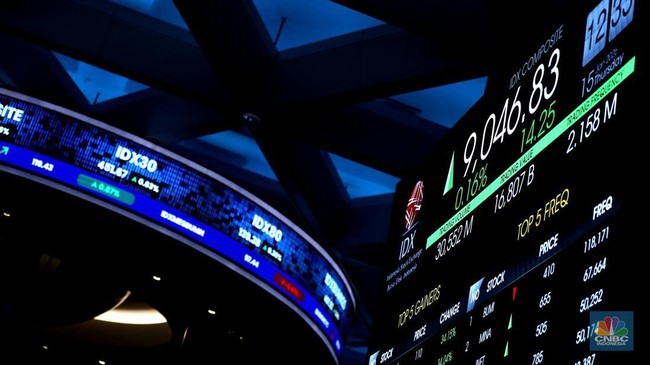
Jakarta, CNBC Indonesia - The Composite Stock Price Index (JCI) managed to strengthen amid intensifying geopolitical pressures in the Middle East today, Wednesday (25/3/2026). This gain represents an anomaly in the performance of Indonesia’s capital market on the first trading day following the Eid al-Fitr holiday.
The JCI closed in positive territory today despite facing numerous negative sentiments, particularly from global geopolitical tensions.
The escalating Iran-Israel-United States (US) conflict, surging oil prices, and hawkish tones from the US central bank, the Federal Reserve (Fed), were initially feared to cause the JCI to plummet.
Based on history, the movement of the Composite Stock Price Index (JCI) on the first trading day after the long Eid al-Fitr holiday shows balanced probabilities. However, in the two previous years, 2024 and 2025, the JCI suffered severe collapses.
According to data from the Indonesia Stock Exchange (BEI) for the period 2016 to 2025, the JCI recorded gains five times and declines five times when the market reopened.
Fundamentally, the index’s movement at the start of trading post-holiday is a form of price adjustment (price-in). While the domestic market is closed, global macroeconomic dynamics continue to unfold.
Various external sentiments, economic data releases, or international policies that emerge during that period will be responded to by the market simultaneously on the first trading day.
For example, on the weak side, at the market opening post-Eid 2025, the JCI recorded a correction of 7.90%. This decline was the market’s response to the announcement of US import tariff policies that surfaced during the long holiday.
A similar situation occurred in 2022, where the index fell 4.42% as an adjustment to the US central bank’s (Fed) decision to raise its benchmark interest rate.
On the other hand, strengthening trends were also recorded when dominant positive catalysts were present. In 2016, the JCI closed up 1.96%, driven by positive responses from domestic and foreign market players to the enactment of the Tax Amnesty law.
This historical data indicates that the direction of the JCI’s movement after the Eid holiday is more dictated by macroeconomic sentiments and fundamental conditions than seasonal factors.
Therefore, monitoring regional market movements, commodity prices, and global data releases during the domestic market’s holiday is a relevant step to gauge the market opening direction and determine asset allocation strategies.
Ten-year data shows the JCI always collapsed heavily in the last two years post-Eid. The JCI is now challenged to end the curse.
Unfortunately, the JCI will face a tough test tomorrow, Wednesday, especially from external factors. Developments in the Iran war, soaring energy prices, and a more hawkish Fed stance are expected to shake the JCI.
As is known, the US central bank, the Federal Reserve (Fed), again maintained interest rates at 3.50-3.75%. The Fed is also projected to cut rates once this year, more pessimistic than the previous projection of twice.
The Fed announced the interest rates on Wednesday US time or Thursday early morning Indonesian time (19/3/2026) while Indonesia was still on Eid holiday. This means the Fed’s impact has not yet been factored into the movements of Indonesia’s financial markets.
The following is a summary of the JCI’s performance on the first trading day post-Eid holiday (2016-2026).