
Confirmed! Rice and Cooking Oil Aid Distribution Extended Until April
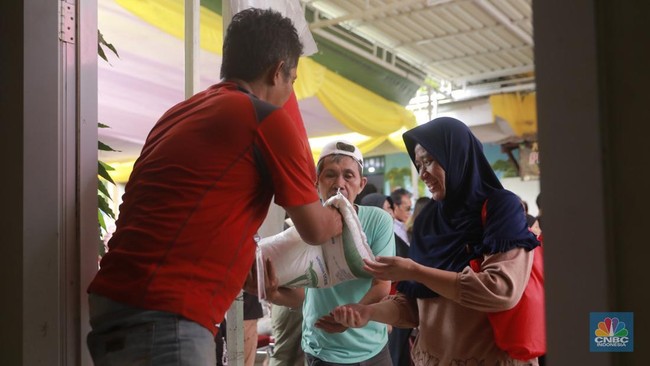
The Indonesian government has extended the distribution period for rice and cooking oil food aid until April 2026. Originally, this aid forms part of the first-quarter 2026 economic stimulus programme, which was set to conclude in March 2026.
Deputy for Food Availability and Stabilisation at the National Food Agency (Bapanas), I Gusti Ketut Astawa, stated that extending the programme’s implementation is necessary to ensure that all 33.2 million low-income individuals can benefit from one of the government’s presence initiatives.
“For the rice and cooking oil food aid, due to preparations and other matters handled by Bulog, this is currently underway. The distribution will take place from March to April. There is an extension, and we at Bapanas have already prepared for that extension,” Ketut explained, quoted from a press release on Tuesday (21/3/2026).
Bapanas records indicate that, based on the realisation of rice and cooking oil food aid distribution by Perum Bulog as of 25 March, it has reached 382,529 recipients across 24 provinces. In terms of quantity, 7.65 million kilograms (kg) of rice and 1.53 million litres of cooking oil have been distributed to the public.
The government, he assured, will continue to urge Perum Bulog to accelerate the distribution of rice and cooking oil food aid. The extension of the programme until April is expected to support the acceleration of realising this economic support initiative.
“This must be carried out by Bulog as soon as possible in April, so that within this one month, the entire target prepared earlier can be distributed for the rice and cooking oil food aid,” Ketut stated.
As is known, the rice and cooking oil food aid programme has an allocated budget of Rp 11.92 trillion. This is for the allocation of distribution to 33.2 million food aid recipients throughout Indonesia.
The assignment for rice and cooking oil food aid for February and March is based on the letter from the Head of Bapanas number 204/TS.03.03/K/02/2026 dated 11 February, which states that the distribution for those two months should be carried out simultaneously after the budget is issued in the Budget Implementation List (DIPA) of Bapanas.
This assignment is based on the results of the 2026 High Level Meeting of the Central Inflation Control Team (HLM TPIP), led by the Coordinating Ministry for Economic Affairs, and a letter from the Minister of State Secretary conveying the approval of the President of the Republic of Indonesia for the economic stimulus in the form of transportation discounts and food aid.
With the total number of recipients dramatically increased to 33,244,408 throughout Indonesia, this represents a rise from the previous total of 18,277,083 food aid recipients.
The resumption of this food aid programme is one of the government’s efforts to maintain prices of strategic staple foods. Moreover, domestic production of rice and cooking oil is sufficiently adequate, so the public should be able to feel its benefits.
“Therefore, to maintain the stability of food supply and prices, the National Food Agency is implementing strategic measures, one of which is the distribution of 10 kg of food aid and 2 litres of cooking oil for two months to 33.2 million Beneficiary Families,” explained the Head of Bapanas, who is also the Minister of Agriculture, Andi Amran Sulaiman, on a separate occasion.
For the previous realisation of the rice and cooking oil food aid programme that has been completed, it reached 18,167,117 recipients throughout Indonesia. The rice and cooking oil food aid that was completed as of 31 January 2026 has successfully distributed 363.3 thousand tonnes of rice and 72.6 thousand kilolitres of cooking oil.
The criteria for recipients of the non-cash food aid programme (BPNT) are the National Socio-Economic Single Data (DTSEN) or DTKS, with priority for poor/vulnerable families in Deciles 1-4.
The general criteria for aid recipients include being registered in the DTKS of the Ministry of Social Affairs, falling into the low decile (deciles 1 to 4), and not being members or family of civil servants/TNI/Police or state apparatus or government employees, regular pensioners, or recipients of APBN/APBD salaries.
Meanwhile, the specific criteria are poor/vulnerable families without main PKH components, focusing on fulfilling basic food needs, and priority for Deciles 1-4, with a special balance for staple goods spending at E-Warong.