
Complete! Key Points of Prabowo's Speech in the DPR: Economic and Mining Targets
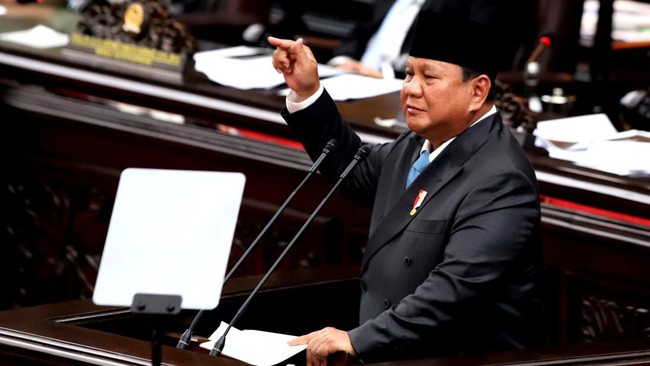
Jakarta, CNBC Indonesia - President Prabowo Subianto delivered a speech on the broad direction of Indonesia’s economic and fiscal policy at the 19th Plenary Session of the Indonesian DPR on Wednesday, 20 May 2026. The speech was delivered as part of the introductory debate on the RAPBN 2027. Prabowo stressed that the APBN is not merely a financial document of the state, but a tool in the fight to protect the people, strengthen the national economy, and ensure that Indonesia’s wealth is truly enjoyed by the people.
Amid global geopolitical pressures, wars in several regions, and the risk of leakage of national wealth, the government emphasised the need for stronger economic governance, particularly in the management of natural resources, exports, export proceeds (DHE), food, energy, and industrialisation.
For macroeconomic baseline assumptions for 2027, the government targets continued higher growth with controlled inflation, while the rupiah exchange rate and energy prices are kept within realistic ranges amid global uncertainty.
Meanwhile for development targets in 2027, the government aims to improve people’s welfare reflected in reductions in poverty, unemployment, and inequality, as well as improvements in human resource quality, farmers’ welfare, and the creation of formal jobs.
Here are the key points of President Prabowo Subianto’s speech in the DPR.
Big Direction of the APBN and Global Challenges
Indonesia is facing geopolitical and geo-economic challenges characterised by conflict, tension, and uncertainty.
The wars in Europe and the Middle East continue to have a major impact on Indonesia’s economic life, even though they are geographically distant.
The APBN is not merely a state budget document but a tool to protect the people and to strengthen the foundations of the national economy.
The APBN serves as an instrument to ensure that every citizen can live in greater prosperity.
The direction of economic and fiscal policy needs to be conveyed directly because the global situation demands greater national preparedness.
Back to Article 33 of the 1945 Constitution
Article 33 of the 1945 Constitution provides the essential basis for the direction of the national economy.
Natural resources must be owned by the state and used as much as possible for the welfare of the people.
The economic system should not allow wealth to be enjoyed by a powerful few while the majority are left behind.
The land, water, and natural wealth of Indonesia must truly benefit all of the people.
The people’s expectations are simple: a decent life, enough to eat, the ability to educate their children, access to health services, and employment with adequate income.
Natural Wealth and Low State Revenue
Indonesia possesses vast natural resource wealth, ranging from palm oil, coal, nickel, copper, rare earth metals, to marine wealth.
Three strategic commodities, namely palm oil, coal, and ferro alloy, generate foreign exchange of around US$65 billion or around IDR 1,100 trillion per year.
Indonesia’s state revenue remains too low compared with other countries, despite being a G20 member and possessing large natural resources.
The revenue ratio is around 11-12% of GDP.
That ratio is lower than Mexico’s around 25%, India’s around 20%, the Philippines around 21%, and Cambodia around 15% of GDP.
Indonesia needs introspection because its large natural wealth has not been fully reflected in state revenue.
Leakage of National Wealth
Leakage of national wealth occurs through practices such as under-invoicing, under-accounting, transfer pricing, smuggling, and the flight of export proceeds.
These practices cause Indonesia’s wealth not to remain fully within the country.
The estimated potential leakage that could be recovered is up to US$150 billion per year.
This leakage is one of the reasons state revenue remains suboptimal, even though Indonesian exports are large.
The discrepancy between export values reported domestically and data recorded in destination countries is one of the issues highlighted.
New Rules on Export of Natural Resources
The government issued new rules related to the governance of natural resource exports.
The sale of natural resource commodities such as palm oil, coal, and ferro alloy will be required to go through a state-owned enterprise designated by the government as the sole exporter.
The policy aims to strengthen export supervision of commodities.
Under-invoicing, transfer pricing, and export earnings flight will be eradicated through tighter oversight.
The policy aims to optimise tax revenue and state revenue from the natural resources sector.
The state must know in detail exactly how much natural resources are sold and their true value.
Strengthening Export Earnings
The export earnings policy (DHE) will be strengthened, especially from the natural resources sector.
The proceeds from Indonesia’s commodity exports must provide greater benefits to the domestic economy.
Natural wealth must no longer be managed without adequate oversight and control.
Export earnings must not merely be large on paper, but must truly return and circulate within the domestic economy.
Role of the Private Sector and the Middle-Ground Economy
Strengthening the state’s role in natural resources does not mean rejecting the private sector.
The private sector remains needed as a dynamic, innovative engine of the economy, ready to take risks, and with strong managerial capacity.
The middle-ground economy is suitable for Indonesia.
This model combines the state’s role, equity, market mechanisms, innovation, competition, and the spirit of gotong royong.
The private sector’s role should be expanded, but with proper governance that does not harm national interests.
The business climate must be improved so that entrepreneurs are not impeded by slow and convoluted bureaucracy.
Credit, Himbara, and Young Entrepreneurs
- The Himbara banks are asked to be more patriotic and not only to