
Companies Late in Reporting Mergers and Acquisitions Face Fines Up to Rp25 Billion
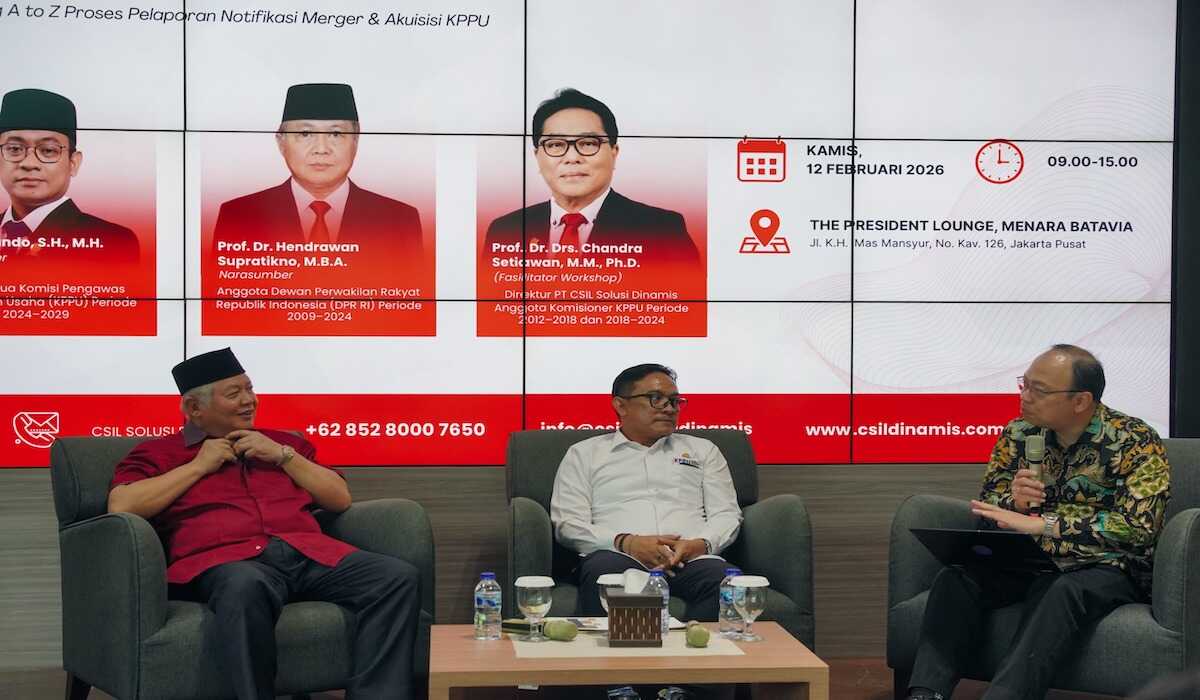
Many companies are late in reporting mergers and acquisitions (M&A) to the Business Competition Supervisory Commission (KPPU), potentially facing administrative fines of up to Rp25 billion. This was a key focus during a seminar and workshop held by President Development Center (PDC) President University in collaboration with PT CSIL Solusi Dinamis.
Chandra Setiawan, Director of PT CSIL Solusi Dinamis, stated that delays in M&A notifications are often caused by companies’ lack of awareness regarding their obligations. “Many companies are late in notifying KPPU because they don’t yet understand this obligation, even though administrative fines can reach Rp1 billion per day with a maximum limit of Rp25 billion,” said Chandra.
He also highlighted that current regulations have not fully accommodated the characteristics of the digital industry, such as intangible assets owned by technology-based companies. “KPPU needs to update the law to remain relevant to the dynamics of the digital industry and maintain healthy business competition,” he added.
In response, Deputy Chairman of KPPU Aru Armando acknowledged that delays often occur due to lack of awareness without malicious intent, similar to late payment of electricity bills. “To minimise this risk, KPPU is working with the Ministry of Law and Human Rights to synchronise company legal data, which is expected to accelerate verification and monitor changes in corporate structure,” explained Aru.
Aru also emphasised the need for amendments to the business competition law, particularly regarding digital assets and company market capitalisation. According to him, protection of Indonesian consumers should be a priority, given the large number of active social media users. “If not protected, we become merely a market for other countries,” he stated firmly.
KPPU is also anticipating potential cartels based on artificial intelligence (AI) and the phenomenon of “killer acquisitions,” where large companies acquire competitors merely to reduce competitive potential. Aru Armando cited the example of Google’s acquisition of Waze in 2013, which halted the application’s further development. “This practice is common in Europe, especially among startups with small transaction values but with high-value intangible assets,” said Aru.
During the discussion session, Member of Parliament Hendrawan Supratikno also addressed the sanction mechanism in the KPPU law. He explained that the formation of legislation is based on three aspects: justice, usefulness, and providing certainty. However, each law typically has more weight on one aspect. The KPPU law, in his view, is weighted more heavily towards its usefulness—whether it can be executed or not. Hendrawan also supported the implementation of “unlimited” sanctions based on the profits gained by offending businesses, to create a maximum deterrent effect.
“This mechanism is important to create a deterrent effect and ensure the law can truly be executed,” he said. Without this scheme, he continued, businesses might prefer to pay fines rather than stop violating practices.