
Coal Prices Suddenly Ignite Again
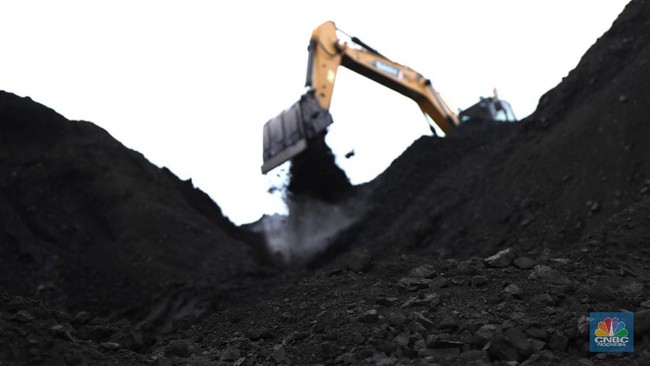
Jakarta, CNBC Indonesia - Coal prices have already surpassed the US$140 per tonne level and are close to reaching US$150 per tonne, impacted by the intensifying war in the Middle East.
According to Refinitiv data, at the close of last Friday (27/3/2026), the benchmark ICE Newcastle coal price stood at US$143.85 per tonne, up 1.30% in a single day, marking two consecutive days of gains and reaching the highest level since October 2024.
Since the beginning of the year, coal prices have soared more than 35%, making this year a golden period for coal after three years of continuous declines.
The reasons behind the rise in coal prices are inseparable from two factors: supply and demand.
Supply Pressure from Indonesia
On the supply side, coal has been quite tight since the beginning of the year, one of which was triggered by the Indonesian government’s plan to cut production.
The government had set a national production target for 2026 at 600 million tonnes, down around 190 million tonnes or nearly 24% compared to the 2025 realisation of 790 million tonnes.
However, in developments up to 27 March 2026, the Ministry of Energy and Mineral Resources has only approved RKABs with a total production volume of around 580 million tonnes. This means that the actual potential supply entering the market could be lower than the initial target, thereby strengthening the tight supply sentiment.
Nevertheless, the government has also opened room for flexibility. The Minister of Energy and Mineral Resources, Bahlil Lahadalia, stated that there would be relaxation of production quotas adjusted to market conditions.
If global coal prices continue to strengthen, production quotas could potentially be increased again to optimise state revenues. This makes the supply side dynamic, but still tending towards tightness in the short term.
At the same time, the government is also tightening the Domestic Market Obligation (DMO) policy to ensure domestic energy resilience.
The DMO target for 2026 is set at 247.9 million tonnes, with plans to increase the mandatory domestic supply portion from the previous 25% to above 30%. This increase aligns with the decline in total national production, thus making the portion of coal available for export even more limited.
Rising Demand as a Substitute for Oil and Gas
On the other hand, demand for coal is also increasing due to the impact of the heating up war in the Middle East that has spread to the LNG crisis.
It started in Qatar, due to drone/missile attacks from Iran hitting the Ras Laffan Industrial City area, the world’s largest LNG complex. This facility is the heart of global LNG production as it houses dozens of trains (liquefied gas processing units).
The attack damaged crucial components such as the cold box (gas cooling system), causing several production units to be halted. As a result, Qatar’s LNG export capacity dropped significantly.
In this situation, the state energy company, QatarEnergy, was forced to declare force majeure status on their LNG contracts.
The problems did not stop on the production side. The situation worsened when Iran increased pressure in the Gulf region, including threats to energy shipping routes.
The Strait of Hormuz, a vital route through which around 20% of the world’s LNG trade passes, became the main risk point. With rising military threats, many tanker ships chose to delay or halt shipments due to security risks.
Therefore, demand for coal is still expected to remain high as a substitute for LNG.
One of the clearest examples comes from Japan. Amid uncertainty in LNG supplies, Japan has begun signalling an increase in the utilisation of coal-fired power plants (PLTUs) to secure domestic electricity needs.
A similar situation is occurring in China, which has long been known as the world’s largest coal consumer. China tends to increase domestic coal consumption to maintain energy resilience, especially when global gas prices become too volatile and expensive.
On the other hand, European countries that previously heavily relied on gas are also starting to reopen space for coal use as an alternative energy source, even though it contradicts their energy transition agendas.
The World Turns Back to Coal
Coal prices have surged after many countries returned to using the black rock as a replacement for rising oil prices.
India has delayed plans to operate coal-fired power plants (PLTUs) at lower output levels when solar power production peaks. This delay is due to uncertainty regarding compensation schemes for PLTUs that must operate at minimum levels.
India, which still relies on coal for around 60% of its electricity generation, has recorded rapid growth in solar capacity in recent years and plans to increase that capacity fourfold by 2035.
In line with efforts to increase the contribution of solar energy in the electricity mix, the government is considering reducing PLTU output through a coal flexibility scheme.
However, PLTUs need compensation if their utilisation rate is reduced from 55% to 40%. To date, the government has not found the right mechanism. On the other hand, industry is also concerned about operational safety aspects at low levels, as well as the additional investment needed to convert PLTUs into flexible generation facilities.
As a result, India has delayed the “flexible coal” plan for one year, as there is no regulation yet regarding compensation for retrofits and maintenance costs if PLTUs are forced to operate at 40% utilisation.
Meanwhile, Japan is considering increasing coal-fired power generation again amid the LNG supply crisis that has caused price spikes.
According to a proposal from the Ministry of Economy, the 50% utilisation limit for PLTUs is likely to be lifted in the new fiscal year starting in April. This step could potentially increase