
Coal Prices Plunge Again, China's Aid in Vain
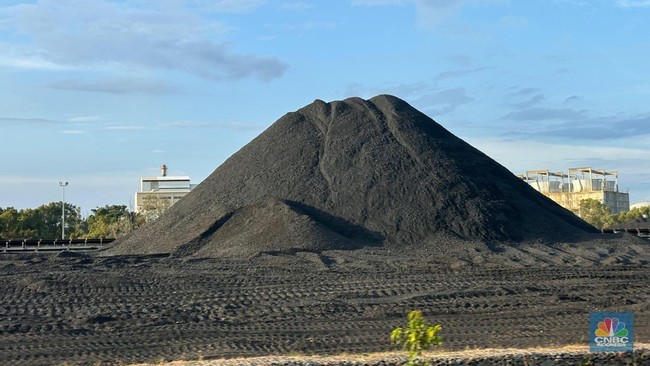
Coal prices plunged again following the fall in global crude oil prices. According to Refinitiv, coal prices closed at US$128.25 per tonne on Tuesday (14/4/2026) trading. The price dropped 2.9%. This weakening contrasts with a 1.7% surge on Monday. Coal prices fell in line with crude oil prices despite positive news from China. Crude oil prices reversed direction from the previous day’s increase. On Tuesday, West Texas Intermediate crude futures fell 7.87% to US$91.28 per barrel, while Brent crude weakened 4.6% to US$94.79 per barrel. Coal prices continued to weaken despite positive news from China and the United States (US). China’s General Administration of Customs reported that importers in China increased coal purchases by 1.3% year-on-year in the January-March period to 116.27 million tonnes. In value terms, coal supplies to China from other countries fell 6% in that period to US$8.73 billion. In March alone, China bought 39.05 million tonnes of coal from abroad, up 26.2% from the previous month. In value terms, imports rose 30.6% to US$2.94 billion. Russia is one of the main coal exporters to China. According to the International Trade Laboratory of the Gaidar Institute, Russia’s share in coal supplies to China reached 29% last year. China’s coal imports rose 14.4% in 2024, then fell 9.6% to 490.27 million tonnes in 2025. Meanwhile, the U.S. Environmental Protection Agency (EPA) officially proposed relaxing federal regulations on the disposal and management of coal combustion residuals from power plants, also known as coal ash. This move opens opportunities for easing cleanup obligations at disposal sites and monitoring requirements, both at operating coal-fired power plants and those already decommissioned, as the Donald Trump administration pushes for more such plants to resume electricity production, often conflicting with the priorities of owners, utilities, and local communities. The changes proposed by the agency, announced on 9 April, include repealing the legacy site surface impoundment rule, implemented in the previous administration, which expanded closure obligations and cleanup of toxic ash at old or inactive facilities. The EPA’s new proposal states that this step aims to eliminate 2024 regulatory requirements deemed by the current administration as “impractical and unfeasible,” which utilities say burden energy production. Other revisions would give state authorities greater flexibility to tailor groundwater monitoring, corrective actions, impoundment closures, and post-closure obligations based on site-specific risks and conditions, including the use of new technologies. Another provision would revise the definition of beneficial use of coal residues for making materials like cement and gypsum board, removing the environmental review requirement for non-roadway uses exceeding 12,400 tonnes of uncovered residue on land. Additionally, coal ash used in cement production in cement kilns and flue gas desulphurisation gypsum used in wallboard or agriculture would be exempted from federal regulations. The EPA claims these revisions could reduce the need for coal ash waste disposal while “enhancing the strength, durability, and workability of the resulting cement and concrete.” The public comment period will run until 12 June, with informational webinars on 15 and 16 April, and a public hearing scheduled for 28 May. India Faces Oversupply Data from the Ministry of Coal for March 2026 shows total production reached 113.67 million tonnes. This figure equals 113.07% of the monthly target of 100.53 million tonnes. However, this represents a slight 4.09% decline compared to March 2025 production. The main producer, Coal India Limited, produced 84.46 million tonnes, equivalent to 90.34% of its monthly target. Singareni Collieries Company Limited produced 5.17 million tonnes, and captive mines and others contributed 24.05 million tonnes, up slightly 0.96% year-on-year. For the full fiscal year 2025-26, total coal production reached 1.04 billion tonnes, down slightly 0.64% from the 2024-25 fiscal year of 1.047 billion tonnes.