
Coal Mining Fire in South Kalimantan Demonstrates Critical Governance Crisis
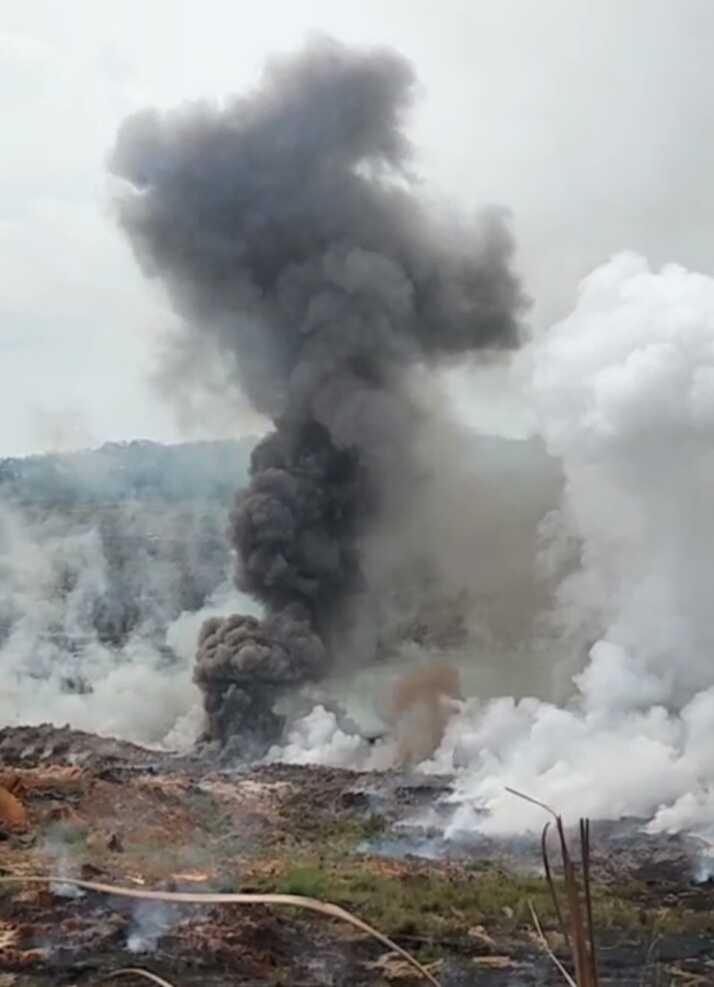
The burning of coal in the mining area at KM 171, Satui District, Tanah Bumbu Regency has become evidence of poor mining governance in South Kalimantan Province.
Raden Rafiq Wibisono, Executive Director of the Indonesian Environmental Forum (Wahana Lingkungan Hidup Indonesia/Walhi) for South Kalimantan, emphasised that the coal mine fire in Satui cannot be interpreted as an isolated incident. It must be placed within a long series of mining problems in the same area, including the collapse of a national road into a mining pit some time ago.
“If comprehensive oversight had been conducted from the beginning, we would not have witnessed state infrastructure in the form of a national highway collapsing and a mine burning in the same location. This proves that our mining governance is in a state of serious crisis,” said Raden Rafiq on Monday (2 March).
In 2022, the trans-Kalimantan national highway at KM 171 Satui, Tanah Bumbu, collapsed into an abandoned coal mining pit. Hundreds of metres of the road surface sustained severe damage, with sections even caving into the pit. This incident disrupted South Kalimantan’s primary transportation corridor and affected the mobility of residents and logistics distribution. Several reports noted that the distance between the mining pit and the road surface was extremely close, triggering soil instability.
Now, at the same location, a fire has occurred, producing thick smoke from a mining pit suspected to be related to illegal mining activity (PETI). The fire point is reported to be within a PKP2B concession area belonging to PT Arutmin Indonesia, a subsidiary of PT Bumi Resources Tbk, in South Kalimantan, although PT Arutmin Indonesia has stated that the fire occurred within the IUP area of PT Mitra Jaya Abadi Bersama.
ILLEGAL ACTIVITY
The regional government has stated suspicions of illegal activities and has reported the incident to the Ministry of Energy and Mineral Resources through the Directorate General of Minerals and Coal.
“Clearly, these two incidents demonstrate problems of unintegrated governance. Public infrastructure is built without ensuring ecological safety in the surrounding area. Meanwhile, both legal and illegal mining activities operate in spaces that are socially and ecologically highly sensitive. When the distance between mining pits and public facilities is so close, the risk of disaster is no longer a possibility but an inevitability,” said Raden Rafiq.
Coal fires in open pits have the potential to generate hazardous emissions and can persist long-term beneath the ground surface. The impacts extend beyond air quality to soil stability and potential water contamination. In the context of Satui, communities are witnessing a combination of risks: land that has already collapsed is now compounded by fire.
Previously, Acting Head of the Energy and Mineral Resources Department (ESDM) of South Kalimantan Province, Nasrullah, stated that his office had conducted inspections and reported the case to the Director General of Law Enforcement and the Director General of Minerals and Coal at the Ministry of ESDM for field handling.