
Coal Export Duty Plan: Which Emitters Will Be Hit the Hardest?
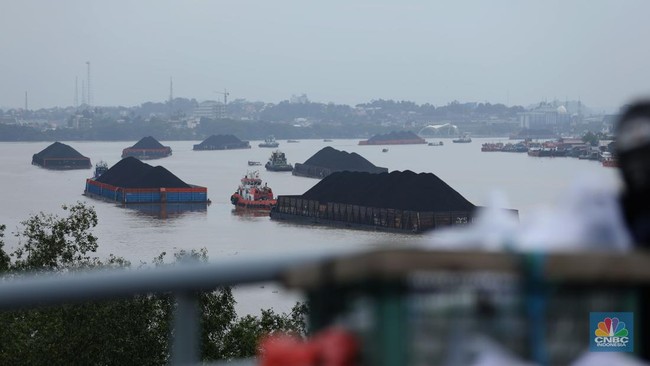
Escalating geopolitical conflicts in the Middle East continue to maintain energy and mineral commodity prices at profitable levels. Coal prices have consistently held above US$135 per tonne, accompanying the stability of nickel prices and the strengthening of global gold prices.
The momentum of these high commodity prices has prompted strategic moves from the government to secure the State Revenue and Expenditure Budget (APBN).
Amid threats of widening deficits due to fluctuations in global oil prices, the government is developing instruments to tighten production quotas and impose export duties. This policy directly alters the operational landscape and profitability projections for mining companies in the country.
Fiscal and Industry Sustainability Arguments
The discourse on levying export taxes on mining commodities has sparked interesting adjustment dynamics among ministries, culminating in how the policy will be implemented.
From the fiscal authority’s perspective, Finance Minister Purbaya Yudhi Sadewa has openly stated that President Prabowo Subianto has approved the direction of imposing export duty tariffs on coal and nickel commodities.
The logic built by the Ministry of Finance is based on the position of coal prices still exceeding US$135 per tonne.
This figure is deemed to provide ample profit margins for businesses, making it appropriate for them to contribute more significantly to state coffers during this vulnerable period.
However, the fiscal push was quickly met with a cautious approach by the Minister of Energy and Mineral Resources (ESDM), Bahlil Lahadalia. In Bahlil’s view, uniformly taxing all coal exports with additional duties risks crippling the industry.
Indonesia holds the status of the world’s largest thermal coal exporter.
However, around 60-70% of Indonesia’s coal export volume is dominated by low-calorie types. This type of coal is traded at prices far below the global high-quality benchmark, resulting in thin margins.
Therefore, the ESDM Minister assured that the implementation of export duties will not be rushed, at least not at the beginning of April, as the formula still requires precise calculations.
On the other hand, upstream sector restrictions are already in place. Director General of Minerals and Coal, Tri Winarno, confirmed that the government is applying strict controls on production volumes.
Coal Work Plan and Budget (RKAB) permits issued are capped at 580 million tonnes. This figure is tightly maintained to not exceed the annual production target of 600 million tonnes, representing a drastic reduction from the previous year’s realisation of 790 million tonnes to maintain global market balance.
Export Margin Test and Coal Emitters’ Resilience
The combination of tightly locked production quotas and the threat of revenue cuts through export duties poses a heavy challenge to profit margins for emitters. PT Indo Tambangraya Megah Tbk (ITMG) is in the most exposed position to these cabinet dynamics.
Referring to 2024 performance, ITMG recorded total net revenue of US$2,304.5 million, of which US$2,288.8 million was purely from coal sales.
With sales volumes reaching 24 million tonnes, mostly absorbed by markets in China, Japan, and India, ITMG is heavily dependent on international market prices. If the Ministry of Finance’s logic is applied and export duties are imposed on their high-calorie coal, ITMG’s gross profit will be directly slashed.
Their room to manoeuvre is limited, forcing management to rely on strict efficiency and coal blending strategies to support short-term profitability.
On the other hand, PT Alamtri Resources Indonesia Tbk (ADRO) also faces margin shrinkage threats from its massive export portion. However, ADRO is estimated not to experience as drastic profit pressure as other emitters.
This is thanks to its internally integrated supply chain logistics infrastructure from upstream to downstream, giving it the ability to suppress operational costs (cash cost) as compensation for rising tax burdens.
Meanwhile, PT Bukit Asam Tbk (PTBA) emerges as an emitter relatively isolated from the export duty debate. Because its sales structure heavily relies on fulfilling the Domestic Market Obligation (DMO) to supply state power plants, PTBA is safe from export taxes, making its profitability projections far more stable, albeit with limited growth potential due to domestic benchmark prices.
Difficult Nickel Smelter Transition and Precious Metal Profit Shield
The same policy logic is also applied to the mineral sector. The government is limiting nickel ore RKAB to a quota of 150 million tonnes to preserve domestic supply. Beyond that, the export duty discourse is now specifically directed at early-stage downstream products like Nickel Pig Iron (NPI).
This policy is deliberately designed to squeeze the profit margins of exporting semi-finished goods. The goal is to force companies like PT Trimegah Bangun Persada Tbk (NCKL) and PT Merdeka Battery Materials Tbk (MBMA) to immediately allocate large-scale capital expenditure to build electric vehicle battery processing facilities.
In terms of profit projections, NCKL and MBMA will face a tough transition period. Their operational margins will be eroded by taxes, while at the same time infrastructure investment burdens swell, significantly pressuring net profits.
Conversely, PT Aneka Tambang Tbk (ANTM) demonstrates a solid profit resilience profile amid these regulatory pressures. Although ANTM has feronickel sales of Rp4.13 trillion that fall under the export duty radar, this figure is relatively small compared to the company’s total revenue.