
Coal Export Duty Deemed Appropriate to Boost State Revenue
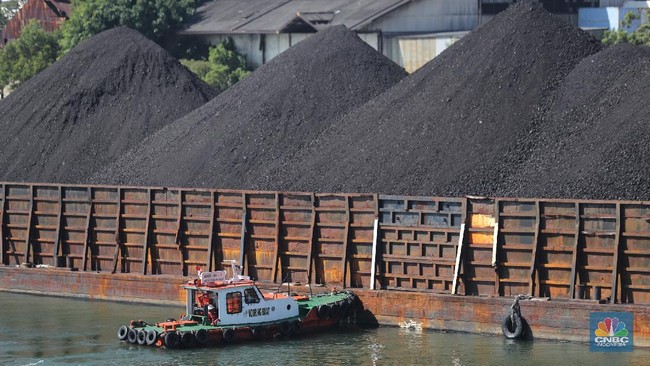
The government’s plan to impose a coal export duty is considered an appropriate step, particularly to increase state revenue amid the surge in commodity prices due to Middle East conflicts.
Executive Director of the Center of Economic and Law Studies (CELIOS), Bhima Yudhistira, views the policy as an instrument to optimise the potential windfall profits from the coal sector.
“The coal export duty is the right decision to increase windfall profit tax from the rise in commodity prices. The levy could take the form of an export duty or additional corporate income tax for companies recording abnormal profits,” Bhima told CNBC Indonesia on Wednesday (25/3/2026).
However, he emphasised that the export duty policy must be accompanied by production controls through adjustments to the Work Plan and Budget (RKAB). According to him, policy consistency is key to keeping prices at premium levels in the export market.
“If production is increased, it risks a supply glut and the prices won’t yield windfall profits,” he said.
Additionally, RKAB cuts are also needed as an effort to accelerate the energy transition, so that funds from the windfall export duty can be redirected to the 100 Gigawatt (GW) solar power plant programme.
As is known, the government plans to apply a coal export duty to anticipate the impact of the Middle East war.
Coordinating Minister for the Economy, Airlangga Hartarto, stated that the policy is directed to keep the state budget deficit below 3% of GDP.
“We are maintaining the state budget so that the deficit remains below 3% and in line with the directives from the Full Cabinet Plenary Session, which has been discussed with technical ministries. This is done through efficiencies across various ministries and agencies. With these efficiencies, the 3% deficit can be maintained,” Airlangga revealed during a Limited Meeting with Indonesian President Prabowo Subianto on Thursday (19/3/2026).
Airlangga mentioned that the planned coal export tax is intended to increase state revenue, in line with the global energy price trend as an impact of the Middle East war, which has disrupted supplies of several energy sources such as oil and gas.
In addition, the government also plans to increase coal production volume through adjustments to the Work Plan and Budget (RKAB).
In the energy sector, the government is pushing for the acceleration of converting diesel power plants (PLTD) to solar power plants (PLTS) as an efficiency measure amid high oil prices. This assignment has been given to the Danantara Investment Management Agency for immediate follow-up.
The government is also examining a work flexibility policy through a one-day Work From Home (WFH) scheme in every five working days.
“There are savings in terms of mobility usage; the petrol savings are quite significant, one-fifth of what we usually spend,” Airlangga explained.
The government is currently finalising the technical aspects of implementing this policy. The WFH implementation is expected not only to apply to Civil Servants (ASN) but also to be adopted by the private sector and local governments.
The planned implementation of this policy is scheduled to begin after the 2026 Eid al-Fitr holiday. However, the exact timing will still be determined further.
“We’ll see the situation later. The oil price situation, the war situation. We’ll follow the developing situation,” he concluded.
From all these policies, the government is not taking the option of raising fuel prices. These various steps reflect the government’s adaptive and measured response in maintaining economic stability, while strengthening the direction towards energy self-sufficiency and national resilience.
As is known, since the end of last year, the government has planned to implement a coal export duty. Initially, the coal export duty was planned to run from 1 January 2026. However, to date, the policy has not yet been implemented.
Could Be Implemented on 1 April 2026
Finance Minister Purbaya Yudhi Sadewa revealed that President Prabowo Subianto has approved the amount of the export duty for coal and nickel commodities.
The decision on the figure to be set will be discussed across ministries today, Thursday (26/3/2026).
“What is clear is that we will decide in tomorrow’s meeting. But what is clear is that the President has already headed towards a certain figure, so there’s no problem,” Purbaya said during a Halal Bihalal event with reporters on Wednesday (26/3/2026).
Purbaya explained that although the exact figure has already leaned towards a certain amount in line with the President’s directive, the final decision will be taken after technical discussions are completed.
“The President said just that amount, but the technical details must be matured, because once mature, we announce it,” he said.
“The figure has been decided by the President, but the meeting can be discussed first, then we can issue it as what later. But what is clear is that the export duty will be imposed in accordance with the President’s directive. It’s not me who decides, you know,” he added.
Purbaya also acknowledged that business actors are likely not to fully agree with the export duty policy.
“They definitely won’t agree. But coal prices are very high now, over US$135,” he said.
“So there’s a certain figure that has been approved by Mr President, but clearly we must discuss whether the industry can accept it, not just what they want, how much the profitability is disrupted, that’s what is calculated, not what the coal company leaders want. If it’s them, they definitely don’t want it,” he explained.
The same applies to coal production targets. According to him, the 2026 RKAB coal production target will also be changed, and the government will boost coal production this year.
“The RKAB plan may be changed. But it depends on what the Ministry of Energy and Mineral Resources decides later. But what is clear is that it will be changed,” he said.
If the entire discussion process runs smoothly and reaches an agreement, the export duty policy has the potential to be implemented on 1 April 2026. However, Purbaya emphasised that the implementation…