
Co-ordinating Ministry for Infrastructure Socialises National Zero ODOL Starting in 2027
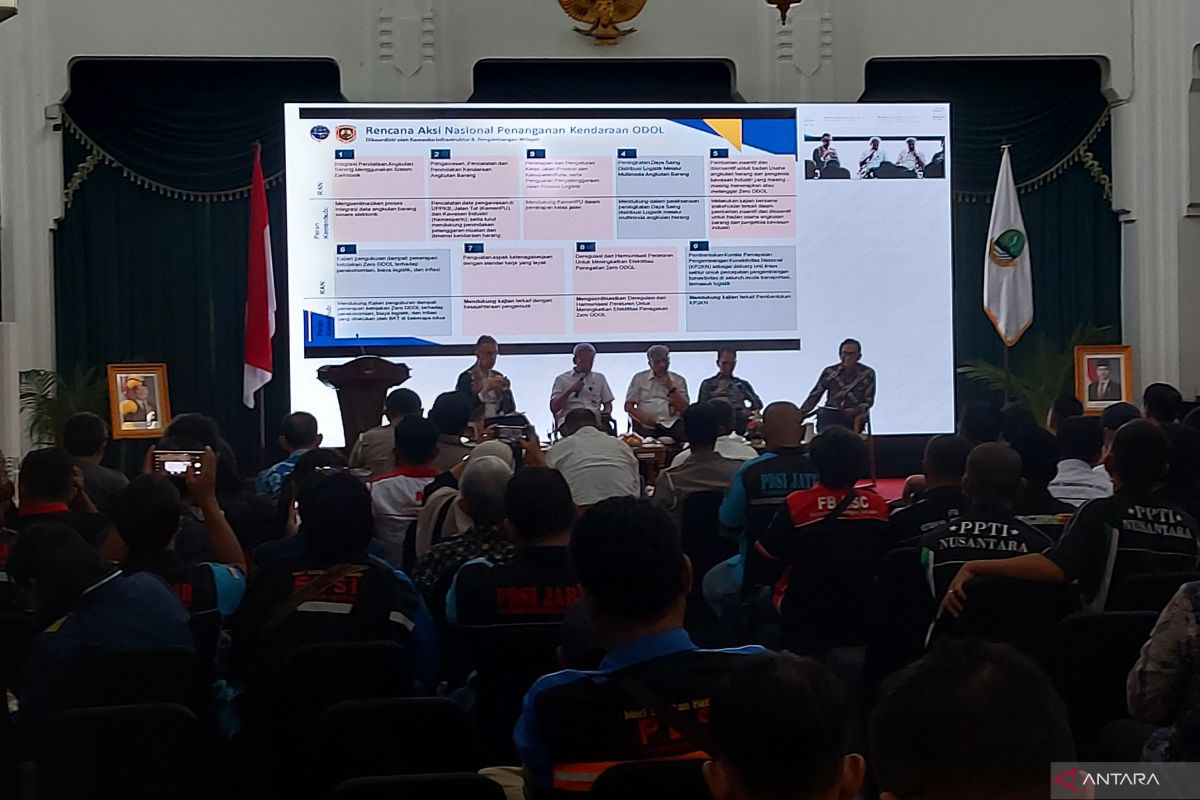
Bandung (ANTARA) – The Coordinating Ministry for Infrastructure and Regional Development (Kemenko Infra) in Bandung on Thursday socialised and gathered public input on Indonesia’s Zero Over Dimension Over Load (ODOL) policy for 2027 in West Java. Deputy for Connectivity Coordination Odo RM Manuhutu, speaking during the socialisation and public hearing titled “Transforming the Freight Transport Ecosystem That Is Safe, Fair and Sustainable” at the Gedung Sate in Bandung, said the national policy, which will start nationally on 1 January 2027, has been chosen due to several issues. The foremost is the rising number of fatal accidents shown by the Central Statistics Agency (BPS), increasing from 150,906 incidents in 2024 to 158,508 in 2025, with fatalities remaining high at 26,839 in 2024 and 24,296 in 2025. “This averages three deaths per hour, and has a social-economic cost impact (Rp305.29 billion in 2025). Traffic accidents involving freight transport account for 10.5 percent, the second highest after motorcycles (77.4 percent),” Odo said. The reason is the suboptimal enforcement of ODOL vehicles. On 4 August 2025, at a meeting between the Deputy Speaker of the House of Representatives (DPR RI), the Minister of Transportation, the Minister of State Secretary, the Cabinet Secretary, the leadership of DPR Commission V, the Indonesian Independent Drivers Alliance (API), and logistics drivers from various regions, an agreement was reached to fully implement Zero ODOL across the national road network starting 1 January 2027. The policy seeks to balance accountability by not solely blaming the driver, who is often carrying out tasks for a company. “The Coordinating Minister for Infrastructure AHY also questioned whether there should be firm and consistent consequences for the owners and business actors themselves. We are presenting fairness through this policy to ensure the owners do not escape responsibility, and the driver is not unfairly targeted,” Odo said. The obligation to operate vehicles in line with dimension and load rules applies to all projects, including government projects, government procurement, local government projects, and state-owned enterprises. Moreover, industrial estates must require Non-ODOL vehicles via explicit estate regulations, to be binding for all tenants and industrial vendors. With this policy, long-term positive benefits are projected, such as an economic growth boost of up to 0.05 percent driven by increased investment through fleet adjustment and operational efficiency up to Rp42.4 trillion. There are also projected social benefits up to Rp1.4 trillion, as road safety improves and social costs from job losses, material losses, and medical costs are reduced. “And finally, savings in road maintenance budgets for the government,” he added. ODOL on Toll Roads Although the policy starts on 1 January 2027, the government has also launched a 2026 Quick Wins programme banning ODOL vehicles on toll roads and ferry terminals from 1 June 2026. The Quick Wins programme is accompanied by reinforced monitoring data on tolled road segments, with the government (Kemen Pu and Kemenhub) and the Toll Road Business Entity (BUJT) strengthening integrated freight transport monitoring through Weight in Motion (WIM), Electronic Test Pass Evidence (BLUe), RFID, and data support from toll road operators. Sony Sulaksono Wibowo of the Toll Road Regulatory Agency (BPJT) said officers hope ODOL trucks will no longer be used, with stricter bans starting 1 June 2026. He conceded some toll roads may implement it, but others object. “These are the kinds of issues we want to sort out for uniform application by 1 June. It will not be easy, as BUJTs are cautious, but we are trying everything because the data is integrated with Etle (police) and BLUe in Kemenhub,” Sony said. Meanwhile, Dani, Secretary General of the Nusantara Logistics Drivers Association, said his organisation supported Zero ODOL 2027 because it concerns road safety. He noted that in the logistics system there are different responsibilities among the cargo owner, fleet owner, and driver. “The driver should be only the vehicle operator. Don’t punish the driver for a bad vehicle. We support ODOL 1000 percent, provided there is a change in law to punish the owners and fleet owners, not the drivers, as is currently the case,” Dani said.