
Civil Society Concerned Over Lack of Transparency in Military Court's Investigation of Andrie Yunus Case
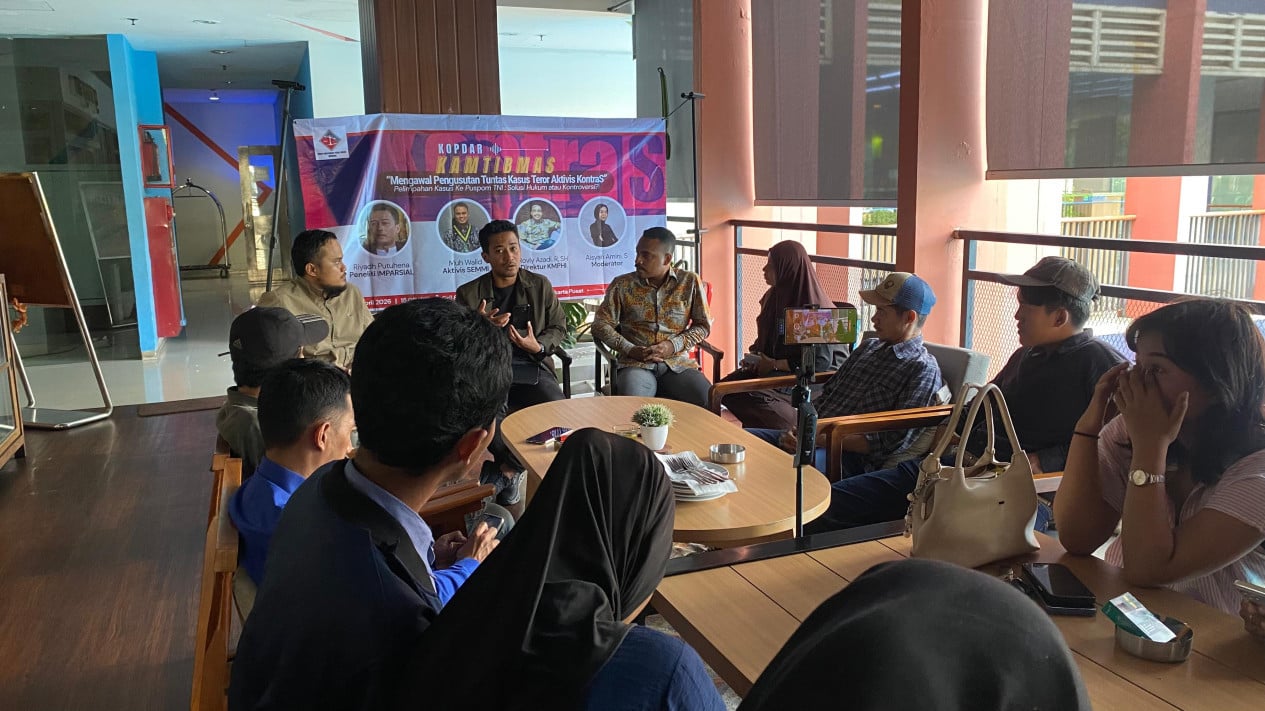
Jakarta – The Indonesian Law Concern Committee (KMPHI) held a public discussion titled “Monitoring the Thorough Investigation of the KontraS Activist Terror Case” (Transfer of the Case to Puspom TNI: Legal Solution or Controversy?). The discussion addressed the issue of terror against a civilian, Deputy Coordinator of KontraS, Andrie Yunus.
The event was attended by Riyadh Putuhena, a researcher from Imparsial, Muh Walid, an activist from the Indonesian Muslim Students’ Union, and Rovly Azadi Rengirit, SH, Director of KMPHI.
Imparsial researcher Riyadh Putuhena stated that the Andrie Yunus case cannot be separated from the TNI’s own role. It is also inseparable from activism work and KontraS’s efforts.
“He (Andrie) was involved in advocacy against military resurgence; at the Constitutional Court, he was involved as a witness and petitioner for Judicial Review (JR), both formal and material, of the TNI Law. He was also involved in advocacy for the Military Court Law and was part of the Fact-Finding Commission for the August events, which essentially highlighted TNI involvement through the Strategic Intelligence Agency,” said Riyadh Putuhena, quoted on Thursday, 2 April 2026.
Additionally, he mentioned that TNI Law No. 3 of 2025 is a revision of TNI Law No. 34 of 2004 regarding TNI Non-War Military Operations (OMSP). Riyadh also explained that the Strategic Intelligence Agency (BAIS) is a combat intelligence unit tasked with early detection of threats to national sovereignty.
“The question in the context of Andrie Yunus is whether Andrie falls into the category of threatening (national sovereignty). He rides a motorbike, not a tank or weapon; I don’t think so. This means BAIS has deviated from its duties as the TNI’s strategic intelligence detector for combat,” he said.
Meanwhile, KMPHI Director Rovly A Rengirit stated that regarding the transfer or handover of the Andrie Yunus case to Puspom TNI, according to TAP MPR No. 7 of 2000, all soldiers must be subject to the General Court as per its provisions; however, under Law No. 31 of 1997, it is permissible but must be transparent.
“The Military Court may take this case for investigation and conduct inquiries, but the process must be transparent so that the public can know who the perpetrators are and there is clarity (on motives and intellectual actors),” he said.