
Civil Servants and Reserve Components: Agenda for Forging Reformist Bureaucrats
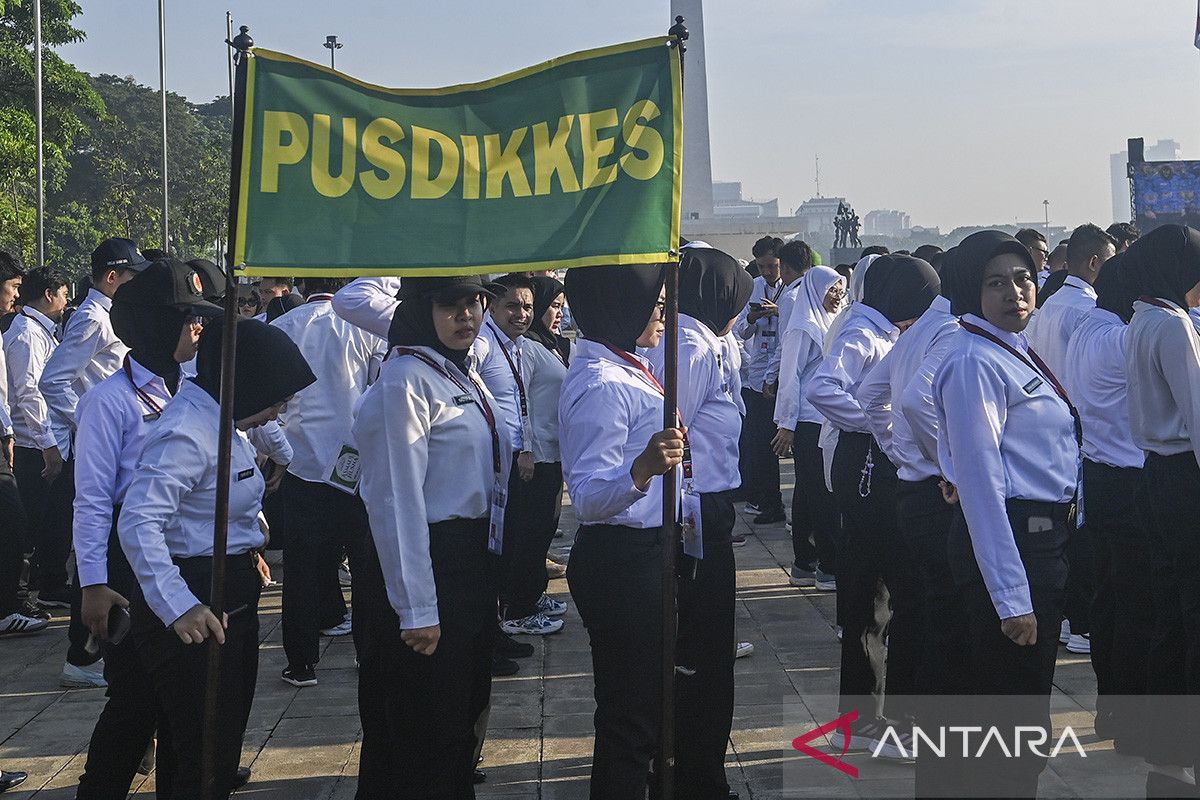
Jakarta (ANTARA) - A total of 2,019 civil servants (ASN) from 49 ministries and agencies participated in a rigorous selection process to become part of the reserve component. Those who pass will undergo 1.5 months of basic military training, covering defence knowledge indoctrination to practical skills such as shooting exercises.
The send-off ceremony for these thousands of civil servants took place at the National Monument area on Monday, 13 April 2026. Several officials attended the event, including the Head of the National Reserve Agency of the Ministry of Defence, Lieutenant General Gabriel Lema, and the Head of the Reserve Component Centre, Brigadier General Hengki Yuda Setiawan.
The participants will undergo training spread across six military education institutions, namely the State Defence Centre of the Ministry of Defence’s Training and Education Agency, the Jaya Regional Training Command, and the Army Health Training Centre. Additionally, training will be held at the 1st Infantry Brigade of the 1st Marine Task Force, the Language Training Centre of the Special Forces Training Command, and the 500th Air Force Training Wing Atang Sanjaya. The next stage involves the selected civil servants participating in basic military training, which will be opened by Defence Minister Sjafrie Sjamsoeddin at Halim Perdanakusuma Air Base on 22 April 2026.
The Reserve Component (Komcad) is a strategic instrument in the national defence system with a strong legal foundation, as regulated in Article 28 paragraph (2) of Law No. 23 of 2019 on the Management of National Resources for National Defence. Within this framework, Komcad is positioned as a supporting force sourced from citizens, prepared for deployment in emergency situations, whether facing conventional military threats or hybrid crisis spectra. Civil servants, in this context, fall under the category of citizens who can legally become part of Komcad.
Nevertheless, it is important to emphasise that participation in Komcad is not mandatory. The law explicitly stipulates that involvement is voluntary, through a selection mechanism, and considers the needs of national defence. This principle forms the normative foundation ensuring that civil servants’ engagement in Komcad remains within the corridor of professionalism and does not obscure their primary function as public servants.
Furthermore, Article 29 of Law No. 23 of 2019 on the Management of National Resources for National Defence affirms that Komcad is prepared for deployment through mobilisation mechanisms to expand and strengthen the main component’s forces in facing military threats or hybrid threats. This formulation indicates that Komcad is not merely a supplement but an integral part of the state’s adaptive defence design against contemporary threat dynamics.
Bureaucratic Reform
Upon examination, the Komcad policy is inherently intertwined with the bureaucratic reform agenda, as mandated by Law No. 20 of 2023 on Civil Servants. The transformation of civil servants is no longer measured solely by administrative capacity but also by character resilience, discipline, and national orientation. The core values of civil servants—oriented towards service, accountable, competent, harmonious, loyal, adaptive, and collaborative—become increasingly relevant when confronted with multidimensional national resilience demands.
Thus, the involvement of civil servants in Komcad can be interpreted as part of efforts to strengthen the dimension of national ethos within the bureaucracy. The hope is not just military training, but a process of character building for resilient, responsive civil servants with a strong awareness of state defence.
In situations of global uncertainty and increasing complexity of threats, civil servants are required not only to be adept in government governance but also to have readiness as part of the national defence system.
State apparatus must remain positioned as the forefront in carrying out public service functions, while also serving as a representation of the state that upholds the Pancasila ideology, the 1945 Constitution of the Republic of Indonesia, as well as loyalty to the Unitary Republic of Indonesia and the legitimate government. The integration of bureaucratic professionalism and the spirit of state defence is the essential prerequisite for building a state apparatus that is not only effective but also resilient in facing the challenges of the times.