
Civil Coalition Sues Government over Handling of Sumatra's Ecological Disaster in Administrative Court
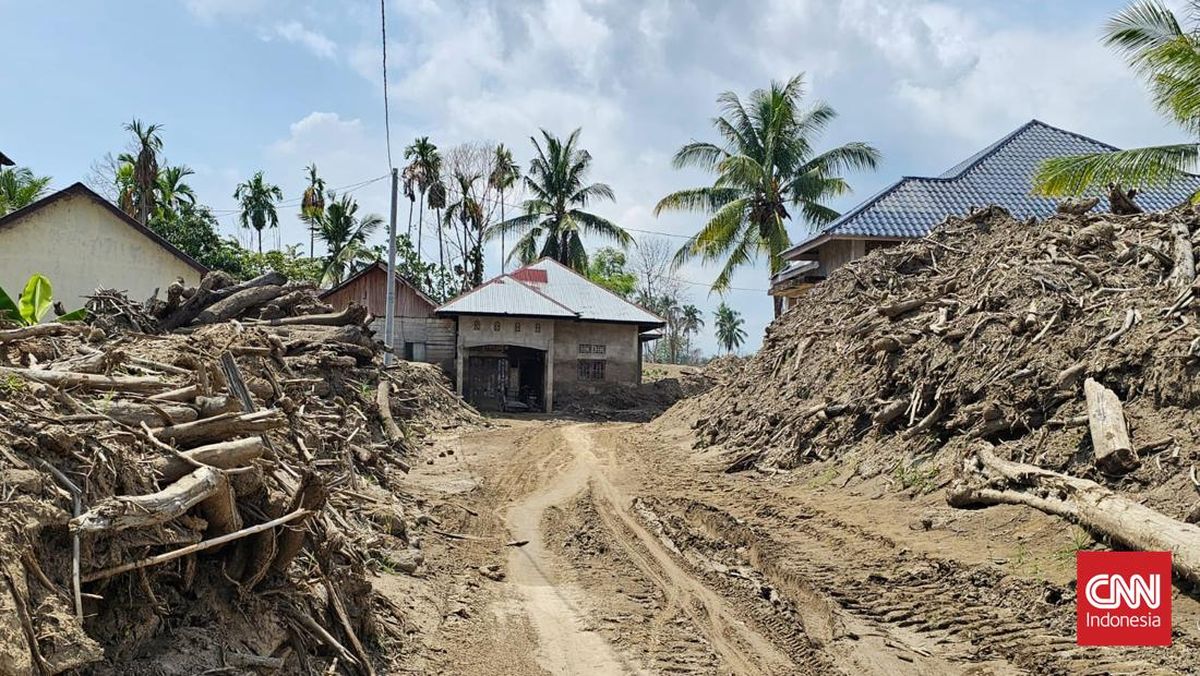
The Advocacy Team for Justice in Sumatra, comprising several civil society organisations, has filed an administrative state lawsuit regarding the handling of the ecological disaster on Sumatra Island late last year to the State Administrative Court (PTUN) in Jakarta.
The plaintiffs, who are disaster victims collaborating with the Advocacy Team for Justice in Sumatra, base their claim on the expansion of administrative state dispute objects in the PTUN under Law No. 30 of 2014 on Government Administration.
Government Administration Actions constitute acts by Government Officials or other state implementers to perform and/or not perform concrete actions in the framework of government administration.
“Victims of the Sumatra floods (Aceh, North Sumatra, and West Sumatra) have filed a Government Administrative Action Lawsuit in the PTUN Jakarta,” as quoted from a press release shared by the Indonesian Legal Aid Foundation (YLBHI) on Thursday (7/5).
They take issue with the central government, which, instead of mobilising all its resources and efforts for emergency response, has undertaken several actions that have drawn criticism.
Such as the statement by the Head of the National Disaster Management Agency (BNPB), Lieutenant General TNI Suharyanto, that the dire situation was only on social media, the rejection of foreign aid, and the refusal to declare national disaster status.
Edy Kurniawan from YLBHI said that when the disaster struck, numerous infrastructures were damaged, leading to the shutdown of communication and electricity networks, which worsened the situation; roads were cut off, causing several areas to become increasingly isolated and inaccessible, resulting in conflicting information about the post-disaster situation.
This made humanitarian aid unable to be distributed effectively. According to him, the President tended to be slow and unresponsive in addressing calls to elevate the disaster to national emergency status.
The declaration of the floods and landslides in Sumatra as a national disaster emergency should have been carried out as mandated by Law 24/2007 on Disaster Management, Government Regulation 21/2008 on Disaster Management Implementation, and Presidential Regulation 17/2018 on Disaster Management Implementation in Certain Circumstances.
Edy explained that these regulations provide sufficient guidelines and mechanisms for declaring national disaster emergency status.
“Therefore, there is no reason for the central government not to declare national disaster emergency status on the grounds of potential disruption to the state budget structure, bureaucratic administration, and politics,” Edy stated.
Meanwhile, Sekar Banjaran Aji from Greenpeace Indonesia stated that the disaster on Sumatra Island is not merely a weather anomaly but is caused by development patterns reliant on uncontrolled extractive sectors (forestry and plantations) over the past two decades.
On Sumatra Island, Sekar revealed, in almost all River Basins (DAS), natural forest cover in each DAS is less than 25 percent. This condition indicates how critical nearly all DAS on Sumatra Island are.
Meanwhile, the area of natural forest on Sumatra Island is only between 10-14 million hectares or less than 30 percent.
Looking at Aceh Tamiang (the worst-hit disaster location), where the natural forest area in the DAS is recorded at 329,000 hectares or 67 percent of the DAS area. Then, deforestation recorded from 1990-2022 overall amounts to 114,000 hectares or 23 percent of the DAS area.
“This is what worsens the disaster situation when the burden on the land has been left for years, thus weakening its environmental carrying capacity,” Sekar said.
Ahmad Ashov Birry from Trend Asia added that the catastrophe triggered by Cyclone Senyar is concrete evidence of the climate crisis due to industrial activities.
The climate crisis is said to continue increasing the frequency and intensity of similar phenomena in the future, making the regions of Aceh, North Sumatra, and West Sumatra vulnerable to disasters from extreme weather and recurring flash floods in the coming decades.
“Without serious and systematic intervention from the central government, massive damage to the agricultural sector and infrastructure will widen regional disparities and trap rural and coastal communities in chronic poverty traps that are hard to break,” Ashov stated.
Muhammad Qodrat from LBH Banda Aceh emphasised that the ecological disaster on Sumatra Island can no longer be viewed merely as a natural disaster. According to him, there has been long-standing neglect of environmental damage, poor spatial planning, uncontrolled exploitation of natural resources, and weak state oversight, leaving communities living under constant threat.
“What is happening today is the accumulation of policies that ignore public safety and environmental sustainability,” he asserted.
In this lawsuit, the plaintiffs request the TUN court panel to order the Government of Indonesia to immediately declare national disaster status for the 2025 Sumatra ecological disaster event, along with implications for financing and mechanisms led directly by the central government.
In addition, the plaintiffs also request the government to promptly carry out relevant and systematic administrative actions, particularly related to environmental recovery efforts, licensing audits, disaster-based spatial planning policies, and building disaster mitigation capacity.