
Cilacap Regent Arrested in Anti-Corruption Sting; Expert: High Political Costs Fuel Corruption After Regional Elections
A legal expert in election law from the University of Indonesia, Titi Anggraini, has assessed that the proliferation of regional leaders ensnared in corruption cases following regional elections (pilkada) demonstrates serious problems in political financing governance at the local level.
According to Titi, regional elections in many areas continue to be conducted with extremely high political costs, whilst the system for regulating and monitoring campaign funds remains ineffective. This condition makes electoral competition vulnerable to becoming a political investment for candidates.
“The high number of regional leaders caught in corruption after pilkada actually reveals a serious problem in political financing governance. Regional elections in many areas remain an arena of extremely expensive competition,” Titi told Media Indonesia on Saturday (14 March).
She explained that when political costs become too large, elected candidates are often driven to recoup these costs once in power.
“In such a situation, electoral politics becomes vulnerable to transforming into a political investment that encourages ‘cost recovery’ practices once the candidate is in office,” she said.
Additionally, Titi believes urgent reforms are needed in the political financing system, particularly by strengthening transparency and oversight of campaign fund sources and usage.
“Campaign financing regulations must ensure that every political contribution can be clearly traced, transparently reported, and strictly monitored,” she stated.
She also emphasised the need to strengthen campaign fund audit mechanisms. According to Titi, audits that have so far been merely administrative in nature need to be upgraded to audits capable of uncovering potential abuse.
“Therefore, audits that have merely been compliance audits urgently need to be transformed into investigative audits,” she said.
On the other hand, she also encourages a healthier political financing scheme, including opening space for more proportional state support for legitimate political activities. This step is deemed capable of reducing candidates’ dependence on non-transparent funding sources or on particular economic patrons.
“The aim is to reduce candidates’ dependence on non-transparent financing sources or on particular economic patrons who subsequently demand policy returns when the candidate is in office,” said Titi.
According to Titi, without serious reform in the political financing system, regional elections risk continuing to be expensive competitions that ultimately drive corruption practices.
“Without serious reform in the political financing system, regional elections will continue to be at risk of becoming arenas of expensive competition that ultimately encourages corruption as a mechanism for recovering political costs,” she said.
Furthermore, Titi believes that breaking the chain between pragmatic voting behaviour and the emergence of corrupt regional leaders requires joint effort between election organisers, political parties, and society.
She said election organisers need to strengthen voter education so that society does not view political contests solely from a transactional aspect.
“Voters need to be encouraged to examine candidates’ track records, integrity, and capacity, not merely on the basis of short-term incentives,” she said.
However, Titi emphasised that the greatest responsibility still lies with political parties as the primary gateway for leadership recruitment.
“If the nomination process within parties is not based on integrity, track record, and leadership capacity, then regional elections risk continuing to produce candidates who are stronger financially than morally and in competence,” she said.
Therefore, she urges political parties to improve their candidate recruitment and selection systems in a transparent and merit-based manner.
“Parties must also be willing to reject political dowry practices or nomination transactions that ultimately become sources of corruption problems in the future,” she stressed.
Cilacap Regent Syamsul Auliya Rachman is recorded as having net assets of approximately Rp12.03 billion based on the 2025 State Official Wealth Report (LHKPN).
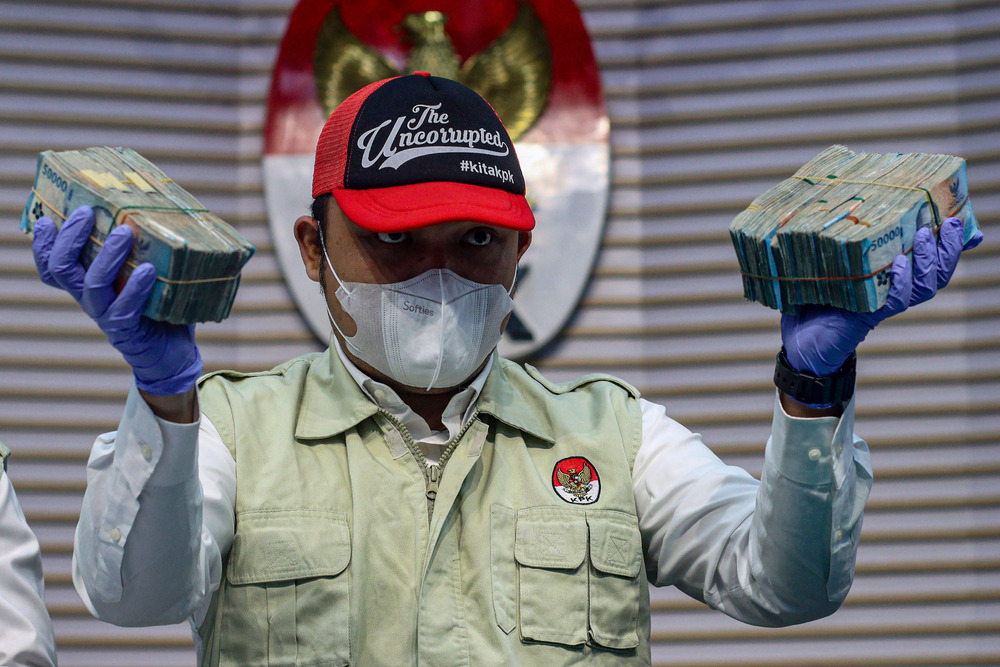
The Corruption Eradication Commission (KPK) brought 13 individuals from a total of 27 people secured in an anti-corruption sting (OTT) related to Syamsul Auliya Rachman, Cilacap Regent.
The KPK conducted an anti-corruption sting against Cilacap Regent Syamsul Auliya Rachman from the National Awakening Party (PKB). His profile and political career details are available separately.
Sealing was conducted by placing seal tape on the doors of the two rooms in question.
Following the KPK anti-corruption sting in Cilacap, Central Java, officials from the Cilacap Regency Government including Regent Syamsul Auliya Rachman along with other officials were questioned at the Criminal Investigation Unit of the Banyumas Police Resort.
Oversight from the central government has so far been conducted through general guidance by the Ministry of Home Affairs and sectoral guidance by technical ministries.
Executive Director of the Indonesian Centre for Policy and Governance (KPPOD) Arman Suparman highlighted weak oversight of the merit system following the abolition of the State Civil Service Commission (KASN), which has triggered position-selling practices by regional leaders.
Researchers at the Anti-Corruption Studies Centre believe the proliferation of corruption cases among regional leaders is due to the absence of deterrent effects in law enforcement and low penalties.
The Ministry of Home Affairs is encouraging evaluation of political recruitment and the regional election system to reduce corruption among regional leaders that continues to recur despite strengthened oversight.
Deputy Minister of Home Affairs Bima Arya stated that 500 regional leaders have been ensnared in corruption since 2005 and encouraged evaluation of regional elections and digitalisation to reduce corruption practices.