
Chronology of Caustic Acid Attack on Human Rights Activist Andrie Yunus
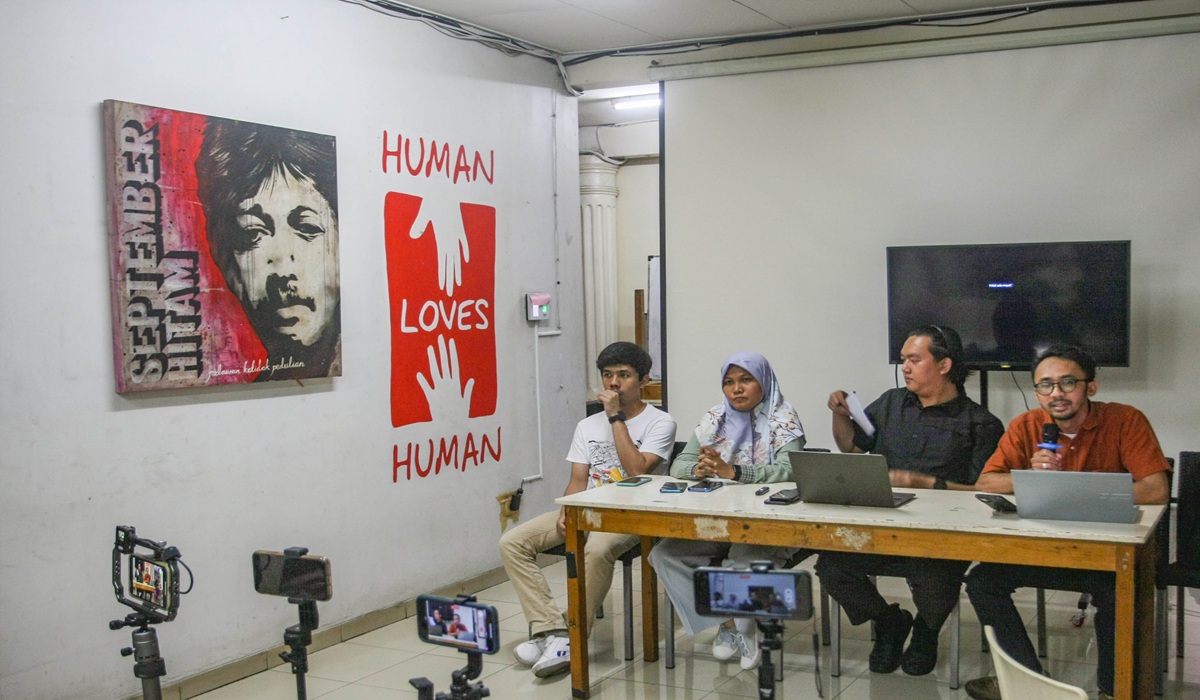
Human rights activist and Vice Coordinator of the Commission for Missing Persons and Victims of Violence (KontraS), Andrie Yunus, was attacked with caustic acid by two unknown assailants in the Salemba area of Central Jakarta on Thursday, 12 March at night.
The incident occurred as the victim was riding a motorcycle when the perpetrators approached from the opposite direction before spraying the dangerous liquid towards the victim’s body.
KontraS Coordinator Dimas Bagus Arya explained that based on initial information gathered by the organisation, the incident began around 23:37 hours when Andrie Yunus was passing along Salemba I Street towards Talang, Central Jakarta.
“Around 23:37 hours, Andrie Yunus was riding his two-wheeled vehicle on Salemba I–Talang Street, Central Jakarta. Two perpetrators then approached from the opposite direction on Talang Road or Talang Bridge using one motorcycle,” Dimas stated on Friday, 13 March 2026.
According to him, the perpetrators allegedly used a Honda Beat automatic motorcycle model from 2016–2021. Both perpetrators were men riding together, with one as the driver and one as a passenger who is believed to have been the executor of the acid spraying.
“The first perpetrator, who was the driver, was wearing a white-blue combination shirt, dark trousers allegedly denim, and a black helmet. Meanwhile, the second perpetrator sitting behind was wearing a black buff-like face covering or mask covering half the face, a dark blue shirt, and blue long trousers rolled up to be short,” Dimas said.
Upon approaching the victim, one of the perpetrators sprayed the liquid, suspected to be caustic acid, towards Andrie Yunus, hitting parts of his body.
“After being sprayed, the victim immediately screamed in pain until he dropped his motorcycle,” Dimas said.
The victim was immediately taken to the nearest hospital in Jakarta for emergency medical treatment, particularly to the eyes which were exposed to the liquid. Based on initial examination, no items belonging to the victim were lost or stolen in the incident.
KontraS believes the attack is strongly suspected to be connected to Andrie Yunus’s activities as a human rights defender. According to Dimas, caustic acid attacks are often used as a form of intimidation to silence critical voices from civil society.
“We believe this action is an attempt to silence critical voices from society, particularly human rights defenders,” he said.
He explained that the work of human rights defenders is protected by various regulations, including Law Number 39 of 1999 concerning Human Rights, which guarantees public participation in human rights enforcement, and Law Number 32 of 2009 concerning Environmental Protection and Management, which protects anyone who fights for the right to a good and healthy environment.
Additionally, protection for human rights defenders is also regulated in the Regulation of the National Human Rights Commission Number 5 of 2015 concerning Procedures for Protecting Human Rights Defenders.
Dimas added that before the incident, the victim was known to be conducting advocacy activities. On Thursday afternoon around 15:30 hours, Andrie Yunus left the KontraS office to attend a meeting at the Celios office to discuss follow-up to a Fact-Finding Commission investigation report regarding the August 2025 Action. After that, the victim also recorded a podcast at the office of the Indonesian Legal Aid Foundation (YLBHI).
KontraS also revealed that Andrie Yunus had previously experienced several instances of terror and intimidation, particularly after being involved in protests against the draft revision of the Military Law in March 2025.
Regarding the incident, KontraS urged police to thoroughly investigate the perpetrators and the motive behind the attack, which is considered to pose a potential threat to the safety of human rights defenders.
“Caustic acid attacks can cause serious injuries and even result in death. Therefore, the perpetrators must be punished as severely as possible,” Dimas said.
He added that the action could be charged under the attempted murder provision as regulated in Article 459 of the New Criminal Code, which provides severe sentences for premeditated murder.
KontraS emphasised that the state has an obligation to ensure protection for human rights defenders so that advocacy work and public oversight of power can continue without intimidation or violence.