
Chromebook Procurement Corruption Trial: Prosecutors Reveal Investment Irregularities at Education Ministry
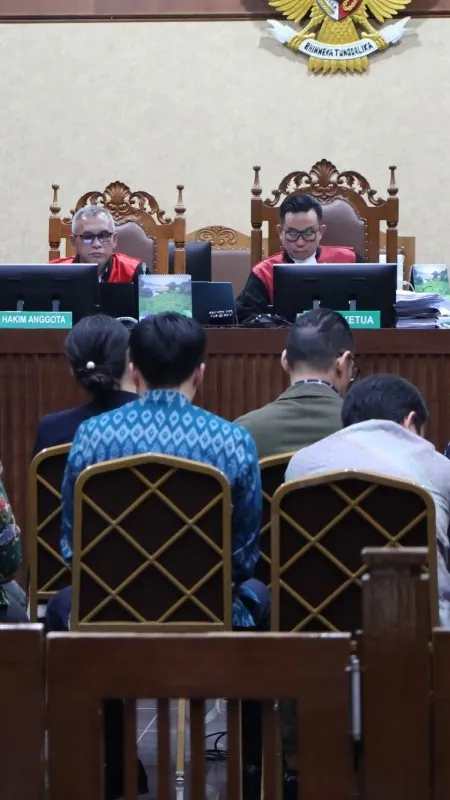
A continuing session of the alleged corruption case concerning Chromebook procurement at the Ministry of Education and Culture has revealed irregularities in Google’s investment in PT Aplikasi Karya Anak Bangsa (AKAB), the parent company of GoTo.
This was disclosed by Public Prosecutor Roy Riady during a press statement following the hearing held at the Corruption Court (Tipikor) at Jakarta Central District Court on Tuesday, 24 February 2026.
Roy explained that the hearing focused on the role of PT AKAB and the involvement of foreign capital in the Chromebook procurement project ecosystem at the Ministry of Education and Culture.
The prosecutor outlined irregularities in the recording of a USD 786 million investment that was only documented as several billion rupiah in domestic records.
In his statement, Roy revealed a pattern of relationship described as “mutualistic symbiosis” between PT AKAB and Google Indonesia. This business synergy, he continued, provided mutual benefits through the exploitation of the digital ecosystem.
PT AKAB played a significant role in enhancing Google’s business growth by integrating Google services such as Google Maps and various other features into their widely-used applications. In return for the use of this technology, PT AKAB received benefits in the form of 20 per cent cashback from every use of Google services or features by the public through their platform.
Additionally, the prosecutor noted that Google received ongoing revenue from service fees paid by PT AKAB.
The prosecution also highlighted a contradictory financial irregularity. Despite receiving 20 per cent cashback payments, PT AKAB reportedly continued to sustain operational losses.
This was allegedly because of the burden of monthly instalment payments to Google Indonesia, which reached millions of dollars.
Based on the statement of notary witness Jose, it was found that the General Meeting of Shareholders (RUPS) process was conducted circularly without evidence of any underlying agreement for such a large investment.
Furthermore, prosecutors highlighted a surprising admission from the company’s operational finance personnel, who stated that the company, despite its size, lacked Standard Operating Procedures (SOPs) or established regulations regarding financial management. This was deemed unusual for a large corporation and is suspected to have enabled impropriety.
These statements further suggest a scheme in which the company continued to show operational losses, whilst simultaneously experiencing increases in share value that benefited certain individuals, including shareholders such as defendant Nadiem Makarim, who allegedly profited from the valuation increase.
“We want to ensure this legal process runs with transparency. It is highly irregular for a large company managing millions of dollars to claim it has no financial SOPs. We will continue to pursue facts regarding the mechanisms of this investment irregularity to prove state losses caused,” stated Public Prosecutor Roy Riady.
The hearing also addressed a statement by witness Khusnul Khotimah from Advan, who had questioned the signature on an Inspection Report (BAP) from 2025.
To ensure transparency, the prosecutor requested that physical evidence of the BAP be shown directly before the judges’ panel.
Based on confirmation during the hearing, the witness ultimately verified that the signature was indeed theirs.
The prosecutor affirmed that the investigation had been conducted in accordance with procedure, with the witness examined in July 2025 accompanied by legal counsel, rendering the witness’s claim of having signed the BAP only in 2023 baseless.
The trial will continue at the next session to examine the statements of other witnesses and strengthen proof regarding state financial losses in the education digitalisation project.
The prosecution also filed demands for one billion rupiah fines against nine defendants.