
Chinese President Meets Taiwan Opposition Leader, Emphasises Unification
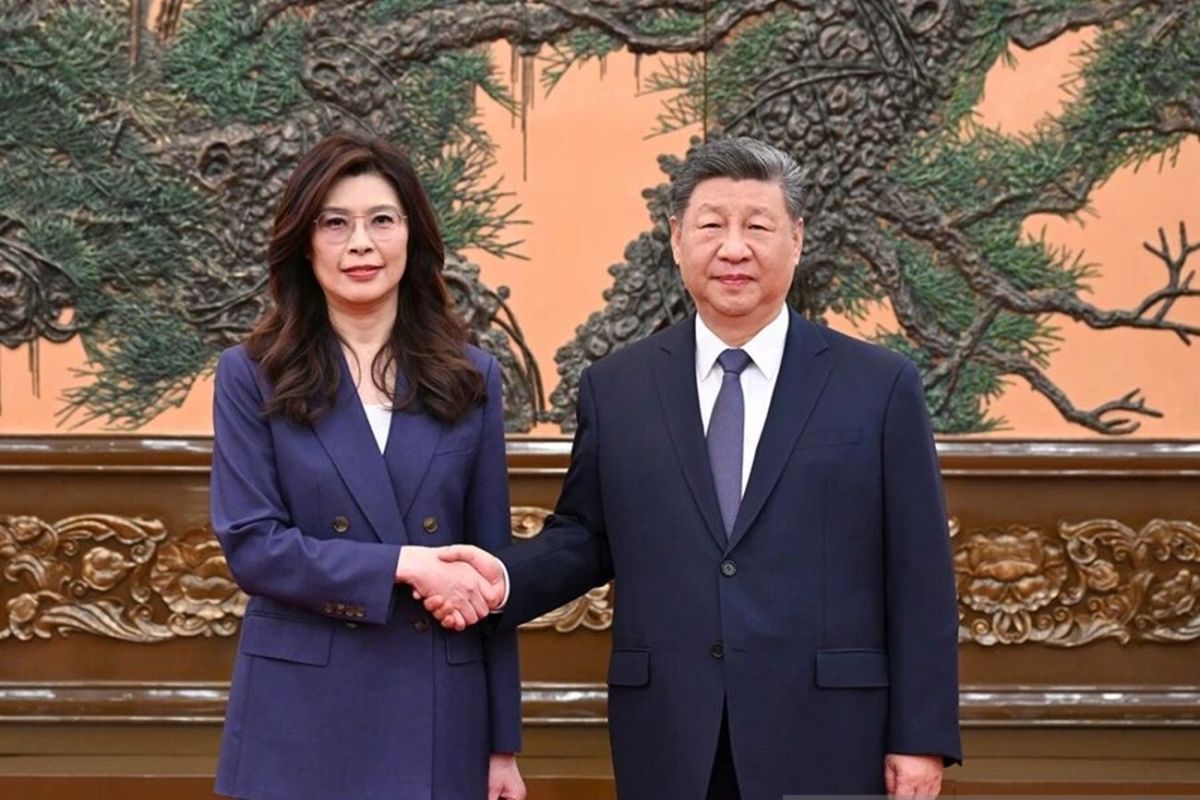
Beijing (ANTARA) - Chinese President Xi Jinping met with the Chairman of Taiwan’s Kuomintang (KMT) party, Eric Chu, in Beijing on Friday (10/4), with one of the key discussion topics being the unification of the two sides.
“President Xi Jinping emphasised that no matter the changes in the international landscape or the situation across the Taiwan Strait, the trend of the great rejuvenation of the Chinese nation will not change, nor will the major trend towards closer ties between the people on both sides of the Strait,” stated a report on the Chinese government media website accessed by ANTARA in Beijing on Friday.
Before meeting Xi Jinping in Beijing, Chu also visited Shanghai on 8-9 April 2026 to witness developments in technology and industry in the city.
The meeting also marked the first encounter between leaders of the Communist Party of China (CPC) and the KMT in 10 years.
“The people on both sides of the Taiwan Strait are all part of the Chinese nation. Including the people of Taiwan, various ethnic groups together form a united multi-ethnic country, jointly writing a glorious history of China, creating a splendid Chinese civilisation, and forging a great national spirit,” Xi Jinping stated.
In response to this claim, President Xi expressed a shared conviction that territory must not be divided, the country must not be split, the nation must not be separated, and civilisation must not be severed.
“The people on both sides of the Strait look forward to peace and stability in the Taiwan Strait, improvement and development of cross-strait relations, and better lives. This is an inescapable responsibility for both parties and also a driving force for joint cooperation,” Xi Jinping added.
The Chinese government, according to President Xi, adheres to the “1992 Consensus” and opposes “Taiwan independence”.
“Together with various political parties, groups, and figures from Taiwan society, including the Kuomintang, we wish to strengthen exchanges and dialogue to achieve cross-strait peace, the well-being of the people, national rejuvenation, and ensure that the future of cross-strait relations rests in the hands of the Chinese people themselves,” Xi Jinping explained.
The 1992 Consensus is an understanding between the then-ruling KMT and the CPC on the principle of “One China” while allowing room for differing interpretations. Meanwhile, Taiwan’s current ruling party, the Democratic Progressive Party (DPP), has consistently rejected the 1992 Consensus, arguing that it undermines Taiwan’s sovereignty.
The KMT is known to traditionally maintain warm relations with China. During the meeting, President Xi Jinping also outlined four points regarding cross-strait relations.
“First, adhere to the correct identity to strengthen unity. The people on both sides of the Strait share the same roots, the same culture, and close blood ties, forming a community with a shared future,” Xi Jinping stated. Differences in social systems, he added, are not a reason for division.
“Both parties and the people on both sides of the Strait must adhere to the national position, inherit and develop Chinese culture, and strengthen identity with the nation, culture, and country, thereby fostering confidence and pride as Chinese people,” Xi Jinping added.
Second, adhere to peaceful development to safeguard our shared home. “The people on both sides of the Strait must safeguard and build this shared home, which fundamentally lies in adhering to the ‘1992 Consensus’ and opposing ‘Taiwan independence’, with the core recognition that both sides of the Strait belong to one China,” Xi stated.
President Xi described “Taiwan independence” as the primary cause of disrupting peace in the Taiwan Strait and stated that it will not be tolerated.
“Third, adhere to dialogue and integration to enhance people’s well-being. The Chinese government will continue to uphold the principle of ‘one family across the Strait’ and actively provide tangible benefits to Taiwan’s people,” Xi said.
Mainland China, Xi noted, has beautiful landscapes and a vast market, welcoming Taiwan’s people to visit frequently, encouraging Taiwan’s youth to come and develop on the mainland, and opening markets to high-quality agricultural, fisheries, and goods from Taiwan.
“Fourth, adhere to unity and struggle to achieve the great rejuvenation of the Chinese nation. More and more people in Taiwan will understand the mainland’s social system and development path, and realise that Taiwan’s future is linked to the rejuvenation of the Chinese nation,” Xi stated.
Meanwhile, Eric Chu stated that the people on both sides of the Strait are descendants and part of the Chinese nation, influenced by the same culture and forming one family.
“Therefore, both sides should cooperate and must adhere to the ‘1992 Consensus’ and oppose ‘Taiwan independence’, strengthen political trust, leverage communication channels, preserve Chinese history and culture, promote cooperation in various fields, and advance the peaceful development of cross-strait relations,” Chu said in the report.
The visit precedes local elections in Taiwan scheduled for the end of this year and is seen as potentially influencing the subsequent presidential election in 2028.
Eric Chu himself is a former talk show host and former DPP member. He was elected as KMT chairman at the end of 2025, where the KMT currently holds a majority of seats in Taiwan’s parliament.
Chu’s visit comes a few months after the KMT blocked a defence budget of 57 billion US dollars that would have allowed Taipei to purchase US weapons to defend against any potential invasion by China. The KMT did not support the package, arguing that Taiwan could not afford it.
The Chinese government itself describes Taiwan’s current leader, Lai Ching-te, as a “separatist” who seeks “Taiwan independence”.