
Chinese Consumer Preferences Reshape Durian Plantation Landscape in Southeast Asia
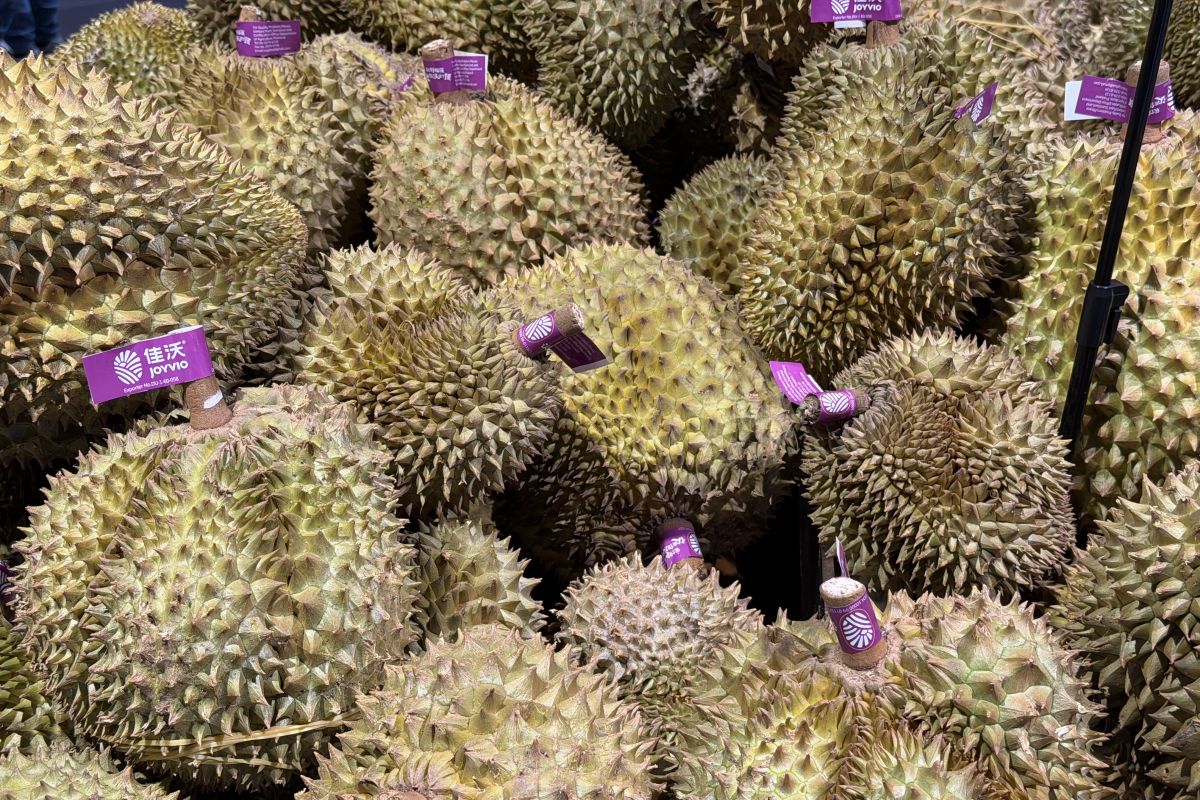
Nanning (ANTARA) - During the recent May Day holiday, at a fruit logistics centre in Pingxiang, near Friendship Pass—the main gateway for ASEAN products in Guangxi Zhuang Autonomous Region in southern China—tourists and wholesalers crowded around neatly arranged durians, drawn by the promise of fresher fruit and competitive prices.
“Many visitors come to experience the border area firsthand and buy durian as the best souvenir,” said Liu Xian, a local stall owner.
Industry players describe this consumer pattern as more than a seasonal trend, but a structural shift. “As Chinese consumers’ knowledge of durian varieties, ripeness, and texture increases, the market is shifting from uniform pricing to tiered pricing,” said Guan Caixia, an experienced durian trader in Guangxi.
In 2025, China imported a record 1.868 million tonnes of fresh durian. Although Vietnam holds 51 per cent of the market share by volume, Thailand maintains its edge in total value, supported by the prestige of its Monthong durian variety, dubbed the “golden pillow”.
Chinese consumers are now increasingly focused on traceability and quality consistency, and the rise of e-commerce is creating new growth opportunities in lower-tier cities, prompting Southeast Asian producers to enhance their efforts to remain competitive.
“Our strengths lie in the long-accumulated planting and export experience, internationally recognised quality control, and logistics tailored specifically for China,” said Niti Pratoomvongsa, trade advisor at the Royal Thai Consulate General in Nanning.
“Thai authorities also enforce Good Agricultural Practices from farm to port, working closely with Chinese inspectors to ensure traceability and monitor pesticide residues,” Pratoomvongsa added.
Huang Meixia from Charoen Pokphand (CP) Group revealed that Thai exporters now classify durians into three categories: A, B, and C. Category A durians, characterised by four to five fully filled segments (durian fruit chambers), are the market favourite.
This has encouraged both experienced and novice farmers to invest in standardised farming and technology to consistently achieve the best quality, Huang added.
This positive ripple effect has also reached Indonesia, which is emerging as a promising competitor. The country is developing 240 “durian villages” and introducing smart technology for real-time orchard monitoring.
In January, Indonesia’s first container of frozen durian arrived at Qinzhou Port in Guangxi, signalling Indonesia’s intent to capture a larger market share in China’s annual $8 billion market (1 US dollar = Rp17,362), or about 54.8 billion yuan (1 yuan = Rp2,552).
The backbone of this rapidly growing trade is an evolving logistics network. Thai durians can now reach Kunming, the capital of China’s southwestern Yunnan Province, via the China-Laos Railway in just 26 hours.
During peak season, the frequency of these train trips surges from two to six per day, distributing the “king of fruits” to more than 30 cities in China within 48 hours.
“The durian supply is largely stable now,” said Wang Zhengbo, chairman of TWT Supply Chain, a Guangxi-based supply chain management company. “Durian is now available almost year-round,” he added.
“Durian is still far from market saturation in China,” said Wang, noting that the consumer base has surged from tens of millions to over 100 million.
From logistics to quality control, industry players believe that the application of Chinese artificial intelligence (AI) technology is beginning to impact the durian supply chain. The long-term prospects are undoubtedly promising, signalling a technology-driven evolution for global durian trade.