
Chinese and British Families Remember Heroic Rescue in World War II
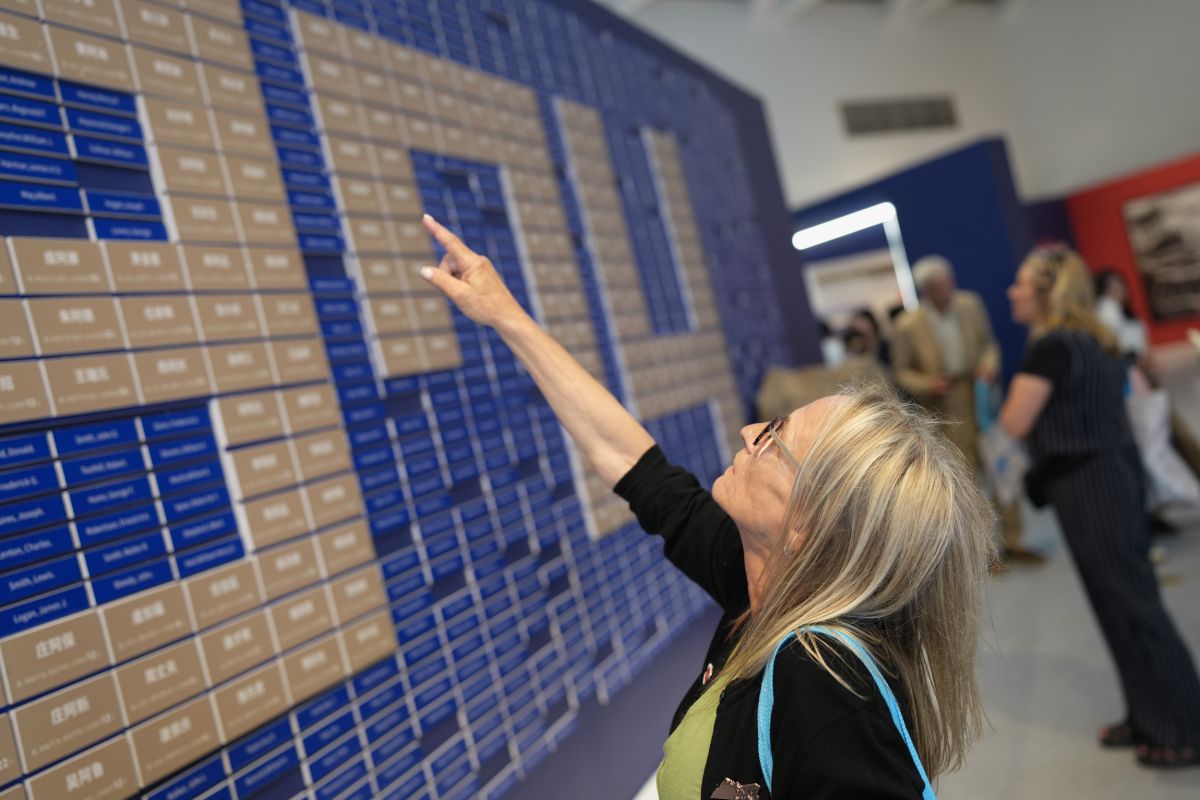
Hangzhou, China – In front of a sea-facing monument on a small island off Zhejiang province, Josephine Olsson hugged Wu Xiaofei. Wu is descended from a Chinese fisherman who helped save Olsson’s great-uncle, a British former prisoner of war, from the sea in World War II.
Amid the sea air and memories of wartime rescues more than eight decades on, tears filled the eyes of the two women as they exchanged scarves as tokens of the bond formed during one of the war’s darkest chapters.
‘Josephine said she will keep the scarf for life. I will do the same. This symbolises the most sincere bond between our two nations,’ Wu said.
Around 20 descendants of British POWs aboard the Lisbon Maru gathered on Zhoushan Island, Zhejiang Province, to attend a memorial marking the extraordinary bravery involved.
In October 1942, the Lisbon Maru, a cargo ship used by Japanese forces to transport more than 1,800 British POWs from Hong Kong to Japan, was torpedoed off Zhoushan by an American submarine after it failed to display the mandatory marking for a POW transport ship.
Amid Japanese fire, local Chinese fishermen undertook 65 crossings using 46 small wooden boats to rescue 384 POWs from the sunken vessel.
For residents of the Zhoushan archipelago, the rescue story has long been passed down not only as wartime heroism but as a moral instinct. ‘If someone falls into the sea, you save them,’ said Lin Zhonghua. His father was among the fishermen who took part in the rescue. ‘There is an old saying here: save one life, and heaven will remember your kindness.’
Among the crowd were Christopher Borge and his sister Kirsteen Dugan, visiting for the first time. Their grandfather and great-uncle were aboard Lisbon Maru and were rescued by Chinese fishermen in 1942.
‘Here, in one of the war’s darkest moments, we see extraordinary humanity,’ Borge said. He added that the Chinese fishermen, risking their own safety, showed kindness to strangers in a time of fear and conflict.
Dugan echoed the sentiment: ‘What happened here is not only extraordinary bravery but also acts of friendship and compassion that have forged a bond between China and the United Kingdom that endures to this day.’
For Dugan, the story has been part of family memory since childhood. She recalls asking her grandmother to show the tin boxes containing her grandfather’s wartime mementoes. ‘I always remember the newspaper cuttings about Lisbon Maru and the brave fishermen who carried out the rescue,’ she said.
In addition to blood ties, the ceremony was attended by people who have dedicated themselves to preserving this shared history. Richard Graham, an 85-year-old writer who once worked with Lisbon Maru survivors, spent decades documenting their stories. ‘If I could meet a survivor today, I would tell them what I have done. I would tell them they can rest easy, because in Zhoushan they are not forgotten,’ he said.
After wreaths were laid, relatives of the British servicemen and descendants of the fishermen took up shovels and planted boxwood saplings as a symbol of a friendship that endures beyond war and distance.
‘It is a beautiful symbol of what has been created here—a lasting relationship across the sea between China and Britain, built on kindness, bravery, and humanity in one of the war’s darkest moments,’ Dugan said, hoping the story will be passed down to future generations. She also hopes that someday her two sons can undertake this journey, stand beneath the tree, and continue sharing the tale of courage, sacrifice, and friendship.
Before the young tree, the sea wind carried a poem by Dugan: ‘A bond of life from sea to shore, between two nations, forever. May those who stand beneath its shadow remember all the sacrifices made.’
Reporter: Xinhua’s Duan Jingjing, Weng Xinyang, and Song Lifeng in Hangzhou contributed to this report.