
Chinese Ambassador and Islamic Friendship Organisation Call for Heightened Vigilance Against Global Crisis
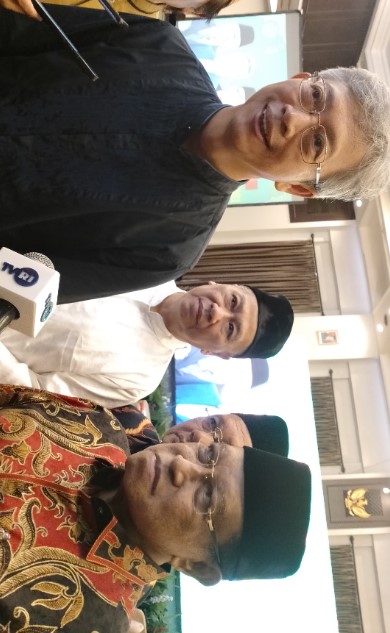
The Islamic Friendship Organisation (LPOI) together with China’s Ambassador to Indonesia Wang Lutong has called for vigilance concerning potential global crises caused by conflict and threats of ecological disasters.
The appeal was made during an ‘Ecology Recitation, Breaking Fast Together and Sharing’ event in Jakarta on Friday, 13 March 2026. The event was attended by numerous cross-religious figures, leaders of Islamic community organisations, professional communities, and the Coordinating Minister for Food Zulkifli Hasan.
According to LPOI Chairman Prof Dr KH Said Aqil Siroj, prolonged conflict in the Middle East could trigger food, energy, and financial crises globally. The world’s dependence on oil and gas, agricultural fertilisers, and global digital and financial transaction systems means global stability is heavily dependent on maintaining peace.
Additionally, he highlighted threats from ecological disasters due to climate change, environmental degradation, industrialisation impacts, and deteriorating soil conditions that increasingly affect various aspects of human life. “Adaptation and mitigation measures are needed for various possibilities arising from conflict and ecological disaster threats. Solutions must be urgently sought for food, energy, and financial sovereignty, as well as the comfort of hajj and umrah pilgrimage which could be disrupted,” said Said Aqil.
He added that strategic options to reduce import dependency across various sectors need to be accelerated. Furthermore, improving public literacy is important so Indonesia is not left behind in global competition, including facing digital warfare, cyber attacks, and modern weapons technology development.
Said Aqil also warned of potential misuse of weather control technology such as HAARP (High-frequency Active Auroral Research Program) that could be exploited for climate engineering.
Indonesia must also anticipate natural disaster vulnerability given its location in the Ring of Fire region. The former PBNU chairman emphasised that a nation’s sovereignty today is not determined solely by territorial sovereignty, but also by various other dimensions such as digital sovereignty, data and information sovereignty, ecological sovereignty, food sovereignty, energy sovereignty, and mastery of futuristic technology.
“A nation’s positioning can also change through valuation based on data and information sovereignty, which shows how much assets and strength a country possesses,” he added.
He believes Indonesia needs to conduct a comprehensive reassessment of national strategic assets to negotiate its position on the global stage as a sovereign developed nation.
On this occasion, Said Aqil also urged BRICS Plus nations led by China to provide solutions to various global dynamics and problems. “War under any pretext must be stopped and ecological crises must be ended so that world civilisation does not move towards destruction,” he stressed.
Meanwhile, Chinese Ambassador to Indonesia Wang Lutong stated that China will continue supporting global peace efforts and respecting religious freedom worldwide. He also expressed China’s openness to cooperate in learning processes related to ecological restoration and technology development.
“Ecology Recitation, Breaking Fast Together and Sharing represents China’s concrete commitment to be present alongside Indonesian Muslim society and demonstrates concern for humanity,” he said.
Said Aqil, also serving as Chairman of the Indonesian Supreme Islamic Council (MIAI), proposed that the government conduct an audit of natural resource accounts and human resource accounts to map national potential more accurately.
National leaders must be able to clearly see various potentials that can be valued as ‘State Capital’ and answer with precision what threats, challenges, disruptions, and obstacles we face and must be solved immediately. At the same time, he proposed to the Chinese Ambassador to Indonesia to develop a Mutual Cooperation for Humanity and Environmental Life scheme in a ‘Trust Fund’ format based on ‘People to People’ initiatives.
Concluding his remarks, Said Aqil emphasised the importance of strengthening the bonds of brotherhood between Indonesian and Chinese Muslims in various strategic fields. “When Indonesian Muslims and Chinese Muslims are closely connected in humanitarian brotherhood, Islamic brotherhood, and global brotherhood, supported by ecosystems of food, energy, technology, finance, and ecology, then this relationship can become guardian of the two nations’ civilisation and contribute to global stability,” he concluded.
War will trigger food crises, energy disruption, refugee waves, extreme poverty, human rights violations, and global economic instability.
According to KH Said Aqil, now is the time to accelerate ecological consolidation by conducting ecosystem restoration and achieving ecological justice.
He believed that negative narratives against Islamic boarding schools not only hurt Muslim hearts but could also potentially disrupt social harmony.
Islamic spirit and Confucian spirit that have spread widely throughout the world can be optimised as connecting instruments that can dampen conflict and disputes.
The added value of halal investment, industry, and ecosystems is not only financially beneficial but can also become the spearhead of soft diplomacy and branding for Indonesia in the global view.