
China's Two Sessions to discuss ways to boost domestic consumption
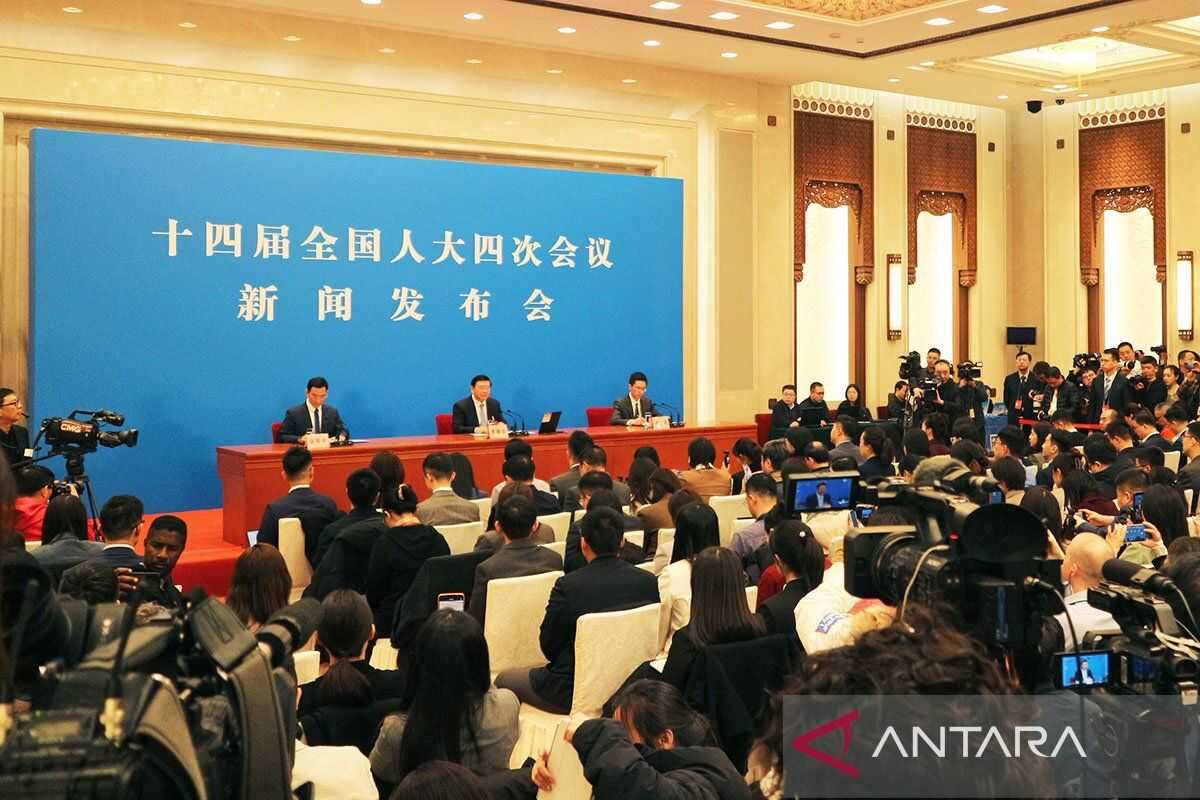
Beijing (ANTARA) — China’s ‘Two Sessions’ parliamentary meetings will discuss economic issues, including ways to boost domestic consumption. “This year, we will continue to make expanding domestic consumption a strategic focal point and push for stronger development of the domestic market,” said National People’s Congress (NPC) Spokesman Lou Qinjian at a press conference at the Great Hall of the People, Beijing, on Wednesday.
The press conference was held a day before China’s annual parliamentary session, commonly known as the ‘Two Sessions’ (Liang Hui), in Beijing. The Two Sessions refers to the gathering of sessions of the Chinese People’s Political Consultative Conference (CPPCC) and the National People’s Congress (NPC).
For 2025, total retail sales in China were RMB 50 trillion (about Rp113,658 trillion) or up 3.7 percent. The figure accounted for 52 percent of China’s Gross Domestic Product (GDP) in 2025.
The problem is that the Consumer Price Index (CPI) hovered around 0.0 percent in 2015, indicating price stability and even deflation for food and energy, suggesting demand for goods was not rising.
“On the one hand, we will expand the supply of quality consumer goods and services, raise the quality of service consumption that benefits the public, accelerate new growth points for service consumption, optimise trade-in policies for goods, and create an internationally standard consumption environment, such as the ‘Shop in China’ campaign,” Lou Qinjian added.
The Chinese government will also progressively advance the equalisation of basic public services, improve the education, childcare, elderly care, and health protection systems to reduce concerns that may dampen people’s willingness to shop.
In addition to discussing ways to boost consumer spending, the NPC session, held from 5-12 March 2026, also has 11 items on the agenda. The first item is to review the government work report; the second, to review the outline of the 15th Five-Year Plan for Economic and Social Development; the third, to review the report on the implementation of the 2025 national economic and social development plan and the draft 2026 development plan; and the fourth, to review the report on the implementation of the central and local budgets for 2025 and the draft central and local budgets for 2026.
The fifth item will discuss the Environment and Ecology Law; the sixth, the Ethnic Unity and Progress Law; the seventh, the National Development Planning Law; the eighth, the work report of the NPC Standing Committee; the ninth, the work report of the Supreme Court; the tenth, the work report of the Supreme People’s Procuratorate; and the eleventh, the work report for the drafting of laws.
The CPPCC itself does not have the authority to draft laws, but can offer advice and serve as a source of ideas and social cohesion. It provides its advice to China’s legislature, namely the NPC.
The NPC is a parliamentary body comprising politicians elected by public vote from provinces and regions of China and various government departments. Members of the NPC are referred to as ‘deputies’ with a five-year term.
There are 2,773 NPC deputies attending the session. The deputies work on a part-time basis and act as a channel for the public to voice aspirations to the government.
The NPC also has a Central Committee consisting of 152 members based in Beijing, serving as the ‘engine’ driving daily governance and legislation. They work year-round to ensure the country keeps moving.
The duties of this standing committee include drafting and supervising laws, overseeing government operations, appointing and removing state officials, making decisions on important issues, handling internal NPC deputy affairs, conducting parliamentary diplomacy, and leading special committees.
Under the Chinese Constitution since 15 September 1954, the NPC has been the most important and highest body in China’s domestic politics.