
China's Two-Pronged Strategy to Secure Interests Amid US-Iran Turmoil
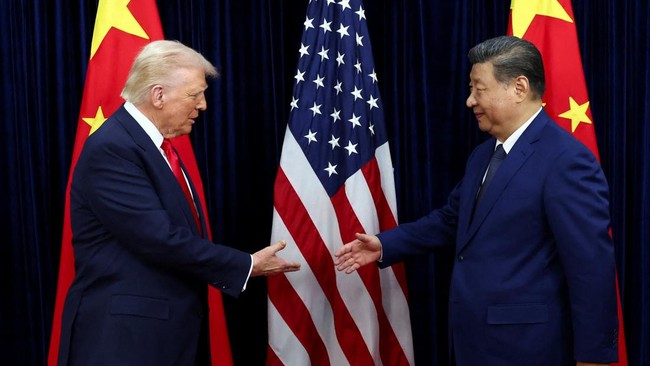
China is playing a cautious hand in facing the conflict between the US-Israel bloc and Iran. Behind the visible active diplomatic efforts with Tehran, Beijing is also preparing for an important meeting between President Xi Jinping and President Donald Trump next month, an agenda that is shaping China’s stance in the war.
Analysts assess that China’s approach to the Iran war cannot be separated from broader strategic interests, particularly as the world’s largest importer of crude oil that is highly dependent on energy supplies from the Middle East. Half of its energy needs come from the region, making stability Beijing’s primary concern.
This measured step by China has even been acknowledged by Washington. Trump is said to have given credit to Beijing for helping to push Iran to attend peace talks held in Pakistan last weekend.
“You have heard President Trump repeatedly mention how China is talking to Iran,” said Eric Olander, editor-in-chief of the China-Global South Project, cited by Reuters on Friday (17/4/2026). “That places them in the negotiation room, even if not at the main table.”
On the other hand, sources familiar with the Chinese government’s thinking state that Beijing is also using this momentum for other interests, including trade issues and Taiwan, ahead of the Xi-Trump meeting.
Trump is viewed as a “transactional and easily influenced by praise” figure, so China is said to want to “give him a red carpet welcome and maintain strategic stability.”
Meanwhile, amid rising pressures, including the US naval blockade of Iranian ports, China is increasing its diplomatic activities. However, Beijing is deliberately holding back from launching harsh criticism of Washington’s military moves, to ensure the smooth progress of the meeting with Trump, which was delayed due to this conflict.
Xi himself spoke out on Tuesday, presenting a four-point peace plan. The plan emphasises the importance of peaceful coexistence, state sovereignty, the supremacy of international law, and a balance between development and security.
However, when Trump warned that “an entire country could be destroyed in one night,” China remained cautious. Foreign Ministry spokesperson Mao Ning only stated that Beijing is “deeply concerned” and urged all parties to play a “constructive role in de-escalating the situation.”
China’s diplomatic efforts are also evident from the intensity of communications by its officials. Foreign Minister Wang Yi has made nearly 30 calls and meetings with international partners to push for a ceasefire. Meanwhile, special envoy Zhai Jun has toured five Gulf and Arab country capitals.
During one of his trips, Zhai even had to take a land route to avoid contested airspace. He admitted to hearing air raid sirens during the journey.
Xi himself presented the peace plan during a meeting with Abu Dhabi’s Crown Prince, Sheikh Khaled bin Mohamed bin Zayed Al Nahyan, a move that also shows China’s efforts to strengthen ties with other parties in the region, including Iran’s rivals, while still pushing Tehran towards dialogue.
Although appearing active, several analysts assess that China’s room for influence remains limited. Beijing has indeed played a role in pushing Iran to the negotiating table, but it lacks a military presence in the Middle East that could strengthen its diplomatic pressure.
Professor of international relations at Renmin University, Cui Shoujun, said that “China’s sense of urgency and tactical level of intervention mode is changing” as the conflict drags on since it began on 28 February.
However, according to Drew Thompson from the S. Rajaratnam School of International Studies, China’s position remains advantageous.
“Beijing’s ideal outcome is to maintain unconditional relations with anti-Western countries like Iran, but also to keep opportunities to reach some kind of modus vivendi with the US,” he said.
On the other hand, there is a sceptical view of China’s role. Patricia Kim from the Brookings Institution assesses that Beijing’s diplomacy is more symbolic.
“Although Iran wants to highlight their relationship with China and ask Beijing to be a guarantor of the ceasefire, China shows zero interest in taking that role,” she said.
“China seems quite content to stay on the sidelines while the United States bears the main pressure,” she added.
The Xi-Trump meeting itself is expected to focus on practical issues. China is said to be able to agree to a large purchase of Boeing aircraft, which could potentially be the largest transaction in history, as well as increasing imports of US agricultural products.
However, analysts assess that discussions will not touch on major issues like AI governance, market access, or industrial overcapacity.
“There is no chance at all for China to reach a big deal with the United States,” said Scott Kennedy from the Center for Strategic and International Studies.