
China's Surveillance System Advances as Foreign Nationals Monitored
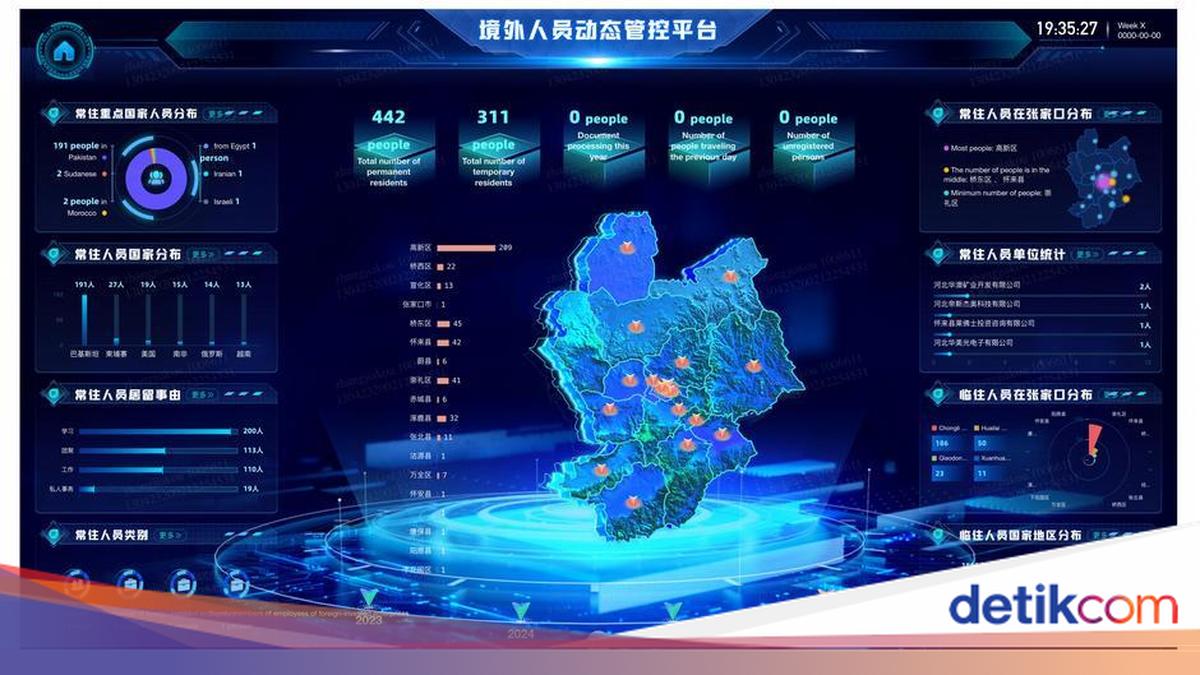
A cybersecurity researcher using the pseudonym NetAskari recently clicked on a tab labelled ‘Journalist Data Search’ on an unsecured Chinese web dashboard, initially expecting to find a set of automatically generated dummy data. Instead, familiar faces appeared. It was a comprehensive database of nearly all foreign journalists based in Beijing around 2021, including official passport photos from immigration offices, personal mobile numbers, visa details, and birth dates. He even found his own personal data listed in the Chinese police’s surveillance records.
‘This is more intriguing than surprising,’ NetAskari told DW. ‘As a journalist in China, you essentially assume you’re always under surveillance. What shocked me was how easily this highly sensitive system could be accessed,’ he added.
The findings are part of a system known as a ‘holographic profile’, a surveillance model that integrates multiple data sources in real time.
The system was developed for the Zhangjiakou Public Security Bureau, host of the 2022 Winter Olympics. Surveillance no longer relies solely on CCTV cameras but has evolved into a data analytics network capable of recording individuals’ movements in detail.
The data reveals China’s rapid surveillance evolution—from street camera networks to an integrated social control system operating 24/7 and capable of predicting behaviour.
China has long been known for having the world’s largest CCTV network. Through the national ‘Xueliang’ (Bright Eyes) project, the government has sought to unify disparate surveillance systems into a single integrated network.
However, data from Zhangjiakou’s police dashboard reveals a far higher level of surveillance detail. The system can track individuals’ movements with extreme precision, reflecting authorities’ increasingly sophisticated monitoring capabilities.
The system no longer depends on street cameras. Technology can record specific train carriages and seat numbers used during travel, such as from Beijing or Shanghai.
Data integration also includes facial recognition ticket gates at ski resorts synced to tracking systems. Individuals’ movements, including tourist activities, can be mapped in detail with clear travel trails.
‘The core idea is processing as much data as possible from as many sensors in real time,’ the researcher explained.
Moreover, the system logs daily activities such as fuel consumption, regular shopping locations, and visit patterns to specific areas. All data is combined to create comprehensive individual profiles, including physical locations, consumption habits, and digital footprints.
Foreign journalists targeted
In increasingly integrated surveillance, foreign nationals—particularly Western journalists—have become a primary focus for Chinese authorities.
Data in the ‘smart report’ feature shows security forces prioritising citizens from ‘Five Eyes’ nations—the US, UK, Australia, New Zealand, and Canada. Some journalists are tagged with special labels enabling real-time tracking.
Upon entering a region, the system instantly alerts authorities. This poses a serious threat to independent journalism in China.
Whereas foreign journalists covering sensitive regions like Xinjiang could previously evade surveillance through conventional methods, such approaches are now ineffective. Algorithm-based systems allow monitoring without physical tailing.
‘They no longer need to send multiple cars to follow you,’ NetAskari said.
With access to digital payment data, travel tickets, and social networks, authorities can precisely predict individuals’ movements. Even interactions with sources can be detected, leading to pressure on those involved.
In this increasingly opaque surveillance system, space for covert investigations is shrinking.
System can predict movements
The surveillance system is growing more sophisticated with the ability to analyse human relationships and group interaction patterns. Technology enables authorities to map social networks without intensive physical surveillance.
Through the main dashboard, the system automatically builds network graphs based on camera-captured interaction frequencies. From this analysis, authorities can determine individual relationships, including closeness and meeting intensity.
Technology development has been ongoing for years. In 2019, Chinese tech firm Hisense patented a comprehensive relationship model incorporating travel data, communication records, and vehicle usage. In 2025, Shanghai’s Putuo Public Security Bureau allocated around $200,000 for an integrated personnel archive system.
Limitations of manual surveillance methods—such as high error rates and heavy manpower demands—are rapidly being replaced by efficient, tireless, and highly accurate automated algorithms.
Western democracies indeed face controversies over surveillance technology misuse, such as Palantir. However, NetAskari said such comparisons only go so far.
‘In Western democracies, there’s still debate. In China, that debate barely exists. Police and the Ministry of State Security can do almost anything with minimal oversight,’ he explained.
Whether it’s foreign journalists navigating Beijing’s narrow alleys for news or ordinary tourists—