
China's Stock Market Stands Firmest Amid War, IHSG Need Not Be Mentioned
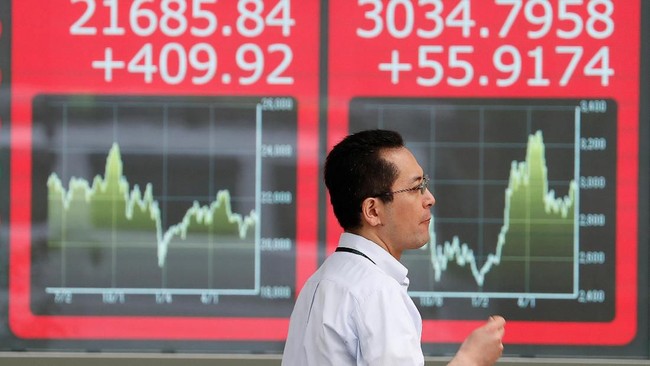
Geopolitical tensions in the Middle East in March 2026 have sparked concerns over disruptions to the global energy supply chain. This situation has directly impacted the weakening of the majority of major stock exchanges in the Asian region.
Amid this selling pressure, China’s stock market has recorded a more stable performance compared to other countries in the same region.
The differences in resilience levels among countries are not only influenced by the structure of energy dependence and historical valuations but are also supported by China’s solid macroeconomic conditions and current political stability.
Performance of Asian Indices During Geopolitical Shocks
Trading data for the market during the period from 2 March to 31 March 2026 recorded that the heaviest pressure was experienced by countries with high energy import dependence and vulnerability to foreign capital flows.
South Korea’s KOSPI index recorded the sharpest decline, reaching 18.30%. This weakening was followed by Indonesia’s IHSG, which corrected by 11.52%, Japan’s Nikkei 225 index with a 10.63% decline, and India’s Nifty 50 index which weakened by 10.19%.
In contrast, China’s stock exchange proved more moderate in facing this shock. The benchmark CSI 300 and Shanghai Composite indices each experienced declines of only 5.56% and 6.56%.
These figures confirm that the level of correction in China was far more limited compared to its regional peers, which recorded double-digit falls.
Political Stability and Strategic Geopolitical Position
The resilience of China’s capital market at present is strongly supported by a stable domestic political climate and a geopolitical position oriented towards supply chain resilience.
Following the annual session of the National People’s Congress (NPC) in early March, the Chinese government consolidated its economic policy direction, focusing on national self-reliance and industrial stability.
In the geopolitical arena, China is actively strengthening strategic cooperation and trade with developing countries while maintaining long-term energy partnerships with non-conflict partners.
This economic diplomacy provides additional protection for China’s supply chain, ensuring the smooth distribution of raw materials and energy even though international sea routes are disrupted by escalating conflict in the Iran region.
Domestic Macroeconomic Recovery
From a macroeconomic perspective, China shows solid fundamental recovery indicators. China’s official manufacturing PMI for March 2026 was recorded to expand to 50.4, ending a series of contractions in previous months and marking the fastest growth rate in the past year.
The non-manufacturing sector, which includes services and construction, also showed positive growth at 50.1. The recovery of these key economic indicators provides a signal to market participants that industrial activity is improving, driven by various policy easing measures launched by local authorities.
This momentum of internal economic recovery serves as a buffer that minimises the impact of negative sentiment from global markets.
Influence of Valuations and Energy Structure
In addition to macroeconomic factors and political stability, valuations of Chinese issuers have been at discounted levels. Historical valuations show that China’s stock exchange is at an average Z-Score of minus 0.4.
This rational valuation limits investors’ drive to carry out further selling actions, given the relatively narrow room for price declines. Furthermore, China has adequate energy self-sufficiency through the utilisation of domestic coal and continuously increasing renewable energy capacity.
The surge in global crude oil prices due to the conflict does not exert massive direct pressure on its industrial production costs. This is in stark contrast to the economic structures of Japan and South Korea, which are highly sensitive to international oil supply disruptions.