
China's New Battery Lasts Decades Without Recharging
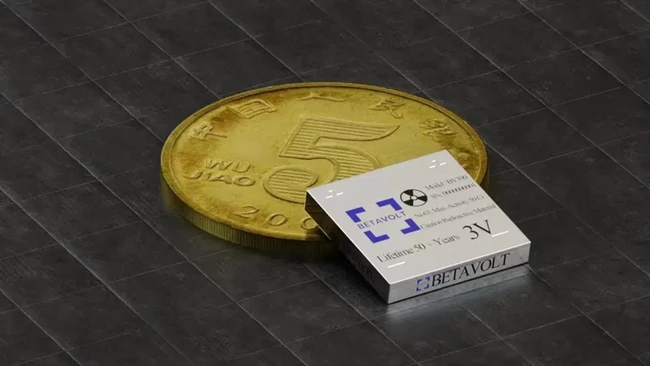
China is beginning to build nuclear batteries that can last for decades without needing to be recharged. This technology was actually first developed by the United States over seven decades ago, with research into nuclear radiation batteries starting in the 1950s. However, entering the 21st century, that position has begun to shift. China is now the most aggressive player in the development of nuclear batteries, particularly betavoltaic battery technology. Citing Popular Mechanics, the Chinese technology company Betavolt introduced a mini nuclear battery named BV100 at the beginning of 2024. Its size is only that of a coin, but it can last up to 50 years without recharging. Not just a laboratory prototype, this battery is even being mass-produced. Its target uses are very broad, from medical devices and aerospace technology to future smartphones. This technology works by utilising beta particles from radioactive decay. Those particles strike a special semiconductor and generate a small but stable electric current. Although its electrical power is not as great as conventional batteries, this technology has a main advantage: an extremely long lifespan. Betavoltaic batteries even have the potential to last up to 100 years, depending on the radioactive material used. Because beta radiation can be stopped with just a thin layer of aluminium, this technology is also considered relatively safe. Its ability to operate in extreme conditions makes nuclear batteries ideal for various future technologies such as planetary rovers, deep-sea sensors, and pacemakers. China is not stopping at just one innovation. Some time ago, Northwest Normal University in Gansu announced the development of a carbon-14-based nuclear battery claimed to last up to a century. To support this industry, China is also beginning to build a domestic nuclear battery supply chain from upstream to downstream, mimicking its successful strategy in the solar panel industry. Meanwhile, the United States is now trying to catch up on the lag. The Miami-based company City Labs is developing tritium-based betavoltaic batteries for space missions and pacemakers. Those batteries are estimated to have a lifespan of about 20 years. This company actually once created the world’s first betavoltaic battery named Betacel in the 1970s. However, limitations in technology and stigma against nuclear energy prevented that innovation from developing widely. The situation has now changed. A number of companies in the US, UK, and Europe are starting to seriously develop nuclear batteries again. The launch of China’s 50-year battery last year has become a global alarm for the technology industry. After more than seven decades since it was first discovered, nuclear batteries are finally entering a new era. However, this time, the technology race does not seem to be led by the US.