
China's budget deficit targeted at 4% in 2026
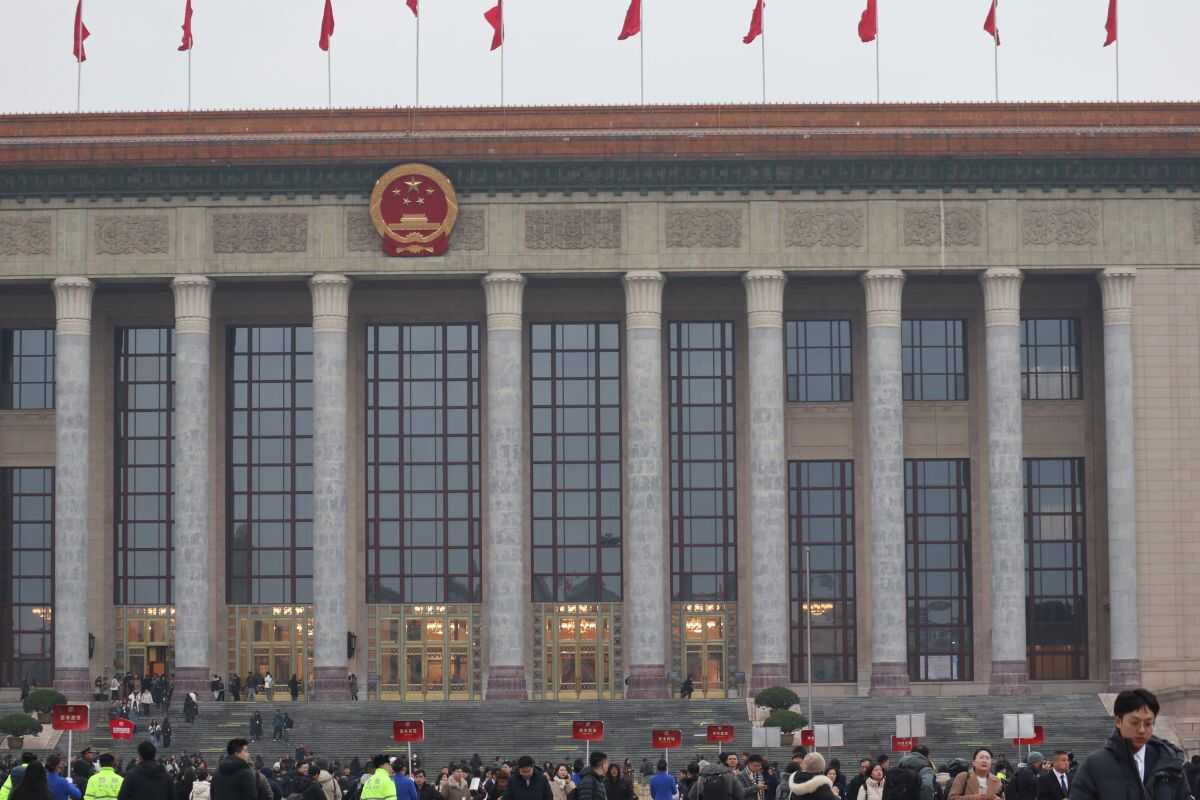
Beijing — The Chinese government has set a budget deficit target of 4% for 2026, amounting to 5.89 trillion RMB, the same as the 2025 target. The deficit-to-GDP ratio for the year is projected at 4% to reach 5.89 trillion RMB (about Rp14.43 quadrillion) or an increase of 230 billion RMB (about Rp563.5 trillion) from 2025, Premier Li Qiang said at the opening of the National People’s Congress in the Great Hall of the People, Beijing, on Thursday, 5 March 2026.
The deficit will take the form of long-term special government bonds worth 1.3 trillion RMB, to be issued to support major national strategies and projects to build security capacity in key areas, and to back programmes for upgrading equipment and consumer goods substitution schemes. In addition, special government bonds worth 300 billion RMB will be issued to bolster the capital of large state-owned commercial banks.
This year, local government special-purpose bonds will also be issued with a value of 4.4 trillion RMB.
We will enhance the management of projects funded by those bonds through a ‘negative list’ mechanism, and refine rapid testing of bond issuance after review and approval at the provincial level, Li said.
A larger share of the funds raised through these bonds will be directed to investment projects and placed in separate management categories so they can be used for major projects, replacing hidden debt, and paying overdue payments that are the government’s obligation.
China’s central government spending in 2026 will also remain sizeable, with greater support for boosting consumption and raising living standards. Central government expenditure in 2026 is projected to rise by 5.5% to 4.542 trillion RMB (about Rp11.13 quadrillion), including diplomatic spending of 70.975 billion RMB (about Rp173.89 trillion) up 9.3%; defence spending of 1.9 trillion RMB (about Rp4.655 quadrillion) up 7%; public security spending of 258.269 billion RMB (about Rp632.76 trillion) up 5.9%.
Education spending of 192.476 billion RMB (about Rp471.57 trillion) up 5%; science and technology spending of 426.42 billion RMB (about Rp1.04 quadrillion) up 10%; expenditure on grain reserves, edible oils and other materials of 110.684 billion RMB (about Rp271.18 trillion) up 8.1%; and interest payments on debt of 873.99 billion RMB (about Rp2.14 quadrillion) up 6.7%.
Furthermore, 10.415 trillion RMB (about Rp25.52 quadrillion) will be transferred to local governments, up 2.2%; and 50 billion RMB (about Rp122.5 trillion) will be allocated to the central government’s reserve fund, the same as in 2025. The reserve fund will be counted as central government spending or as transfers to local governments.
“We will ensure that local governments have greater fiscal resources and better coordination capacity, so that basic living needs are met, salaries can be paid, and government functions operate normally,” Li said.
Governments at all levels are urged to exercise greater prudence in managing financial resources, build sound mechanisms to raise revenue and reduce expenditure, and make optimal use of existing resources and assets.
“We must strengthen fiscal and economic discipline, tighten budgetary ceilings, strictly control public spending, and continue to achieve savings. Every saved penny should be used to address urgent development problems and meet urgent needs of the people. We will continue to implement accommodative monetary policy,” Li added.
Li also said the government will seek to regulate business activity in the credit market and cut intermediary financing costs to reduce overall financing costs. The RMB exchange rate will be kept broadly stable at a level that is adaptive and balanced.
A total of 755 billion RMB (about Rp1.85 quadrillion) will be allocated in the central government budget this year for investment. In addition, 800 billion RMB (about Rp1.96 quadrillion) raised from ultra-long-term special government bonds will spur greater private-sector investment.
“To revive private investment, we will implement relevant policies and measures. We will also improve long-term mechanisms to facilitate private sector participation in large projects and promote private investment in new areas such as high technology and modern services,” Li said.