
China's Artificial Sun Surpasses Physical Limits
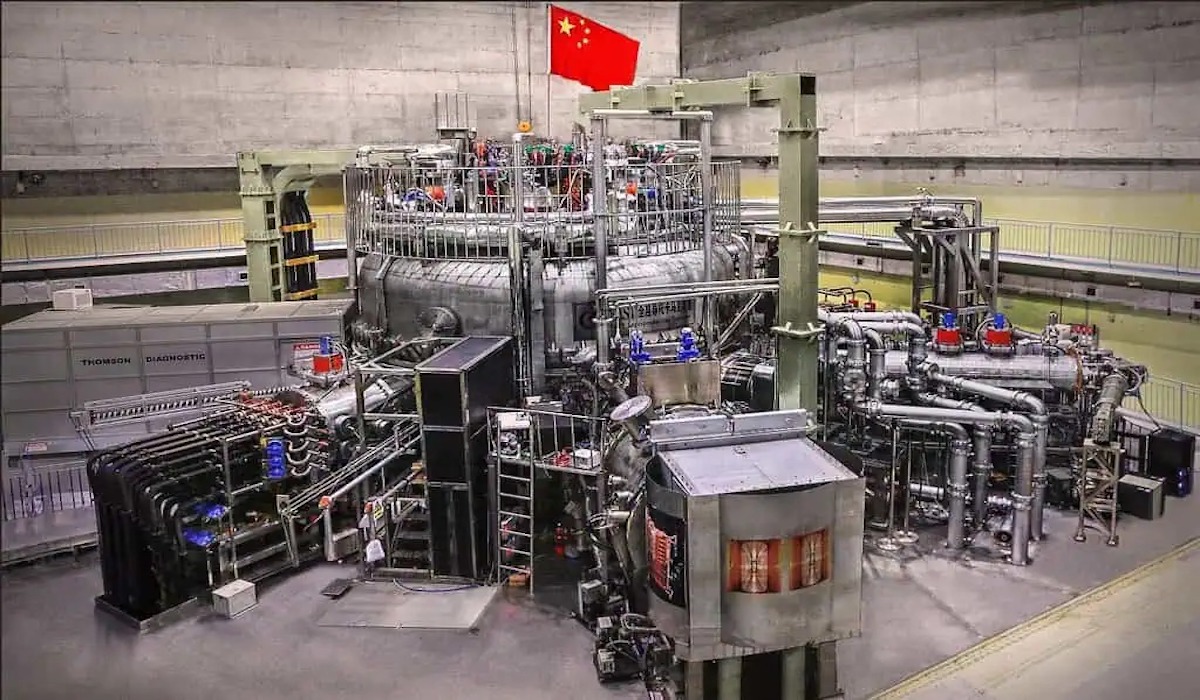
A major breakthrough in nuclear fusion energy has come from China once again. A team of researchers at the Institute of Plasma Physics of the Chinese Academy of Sciences (ASIPP) has successfully surpassed one of the toughest limits in tokamak physics, the Greenwald Density Limit.
Through experiments on the EAST (Experimental Advanced Superconducting Tokamak) reactor, nicknamed the ‘artificial sun’, the scientists operated plasma at densities 1.3 to 1.65 times above the theoretical threshold without triggering plasma collapse or reactor damage.
This achievement, published in Science Advances, marks a crucial step towards a truly stable fusion reactor.
For decades, the Greenwald Limit has been considered a ‘glass wall’ of tokamak technology. When exceeded, plasma typically becomes unstable, cools suddenly, and releases energy that could damage the reactor walls.
However, the team led by Zhu Ping found a way to circumvent this limit through a new model, Plasma-Wall Self-Organization (PWSO). This model reveals that the key to stability lies in the subtle interactions between the plasma and the reactor walls, an area that has been poorly understood until now.
Their strategy focused on the most critical phase: plasma start-up. By utilising microwave wave heating (ECRH) and higher initial gas pressure, the team succeeded:
The result is stable plasma even above the theoretical limit.
ASIPP describes this condition as the beginning of a ‘density-free region’, a new operating regime where the Greenwald Limit is no longer the primary obstacle. This is an important prerequisite for fusion ignition, the condition in which the fusion reaction can sustain itself.
The experiment conducted in Hefei, Anhui, is an international collaboration between ASIPP, HUST, and Aix-Marseille University (France).
More than just a technical achievement, this success reinforces EAST’s position as a global laboratory in the race towards a clean, nearly limitless energy source.
If this trend continues, the ‘artificial sun’ will no longer be just an experiment but a real candidate for the future of world energy. (World Nuclear News/Earth/Z-10)