
China unveils measures to become ‘best export destination’ amid global turmoil and surplus scrutiny
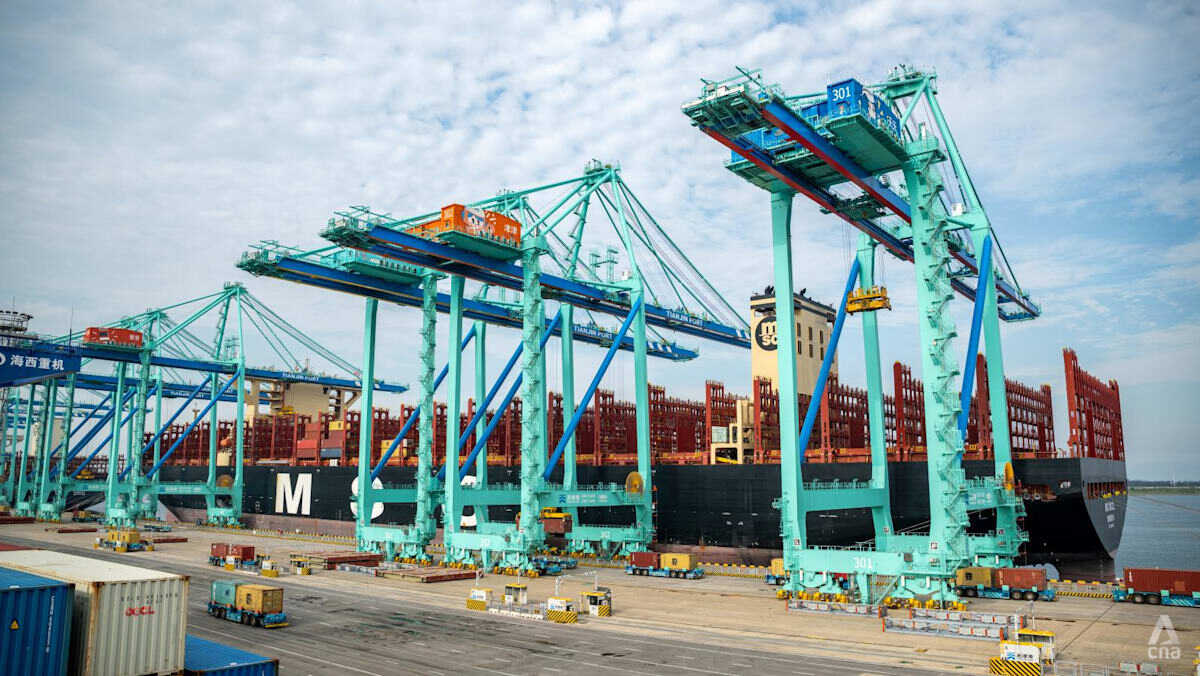
China unveils measures to become ‘best export destination’ amid global turmoil and surplus scrutiny
Speaking on Friday (Mar 6), Chinese commerce minister Wang Wentao outlined incentives aimed at drawing global businesses into China’s vast domestic market.
BEIJING: The Chinese government will be conducting studies of individual countries’ capacity to export to China and offer targeted support to help them improve, an initiative aimed at making the world’s second-largest economy the “best export destination” for more trading partners, said its commerce minister.
“As a responsible major country, China is proactively opening its super-large market,” said Wang Wentao at a press conference on the sidelines of the Two Sessions on Friday (Mar 6).
“We treat the market as an opportunity, as cooperation.”
He said Beijing will be publishing an “Export to China Capability Development Report” - that assesses each country’s export strengths, and then provides concrete assistance to help them improve - in what he described as “precise supply-demand matching”.
Citing how some countries were using market access “as a weapon and a bargaining chip” and “implementing protectionism”, Wang pointed to how Beijing has been doing the opposite.
These included moves such as three flagship programmes - Buy in China, Export to China and Invest in China - aimed at allowing goods, services, people, technology and capital to flow between domestic and international markets.
More than 100 “Export to China” events have also been planned for this year - with the United Kingdom, Kazakhstan, Kenya and Thailand among countries receiving tailored “one-country, one-strategy” approaches.
China’s full-year goods trade surplus hit nearly US$1.2 trillion in 2025 - drawing attention from trading partners worldwide.
Wang acknowledged the friction directly. “We have noticed the concerns of our trading partners. We will promote balanced trade development,” he said.
“Exports and imports are like the two wheels of a car. If they are balanced, the car runs more smoothly and can go further.”
Balanced trade means stabilising exports while expanding imports, he said - specifically agricultural products, quality consumer goods, advanced technology and equipment, and key components.
“We are the world’s second-largest economy, but at the same time we are also the world’s second-largest import market. Our market is a proactively open market,” Wang said.
CHINESE COMPANIES GOING OUT
Wang also detailed a less-discussed dimension of China’s global expansion: as Chinese manufacturers and investors move abroad, they are pulling Chinese service providers with them - from R&D and design firms to financial, legal and consulting companies.
“Accompanying ‘Made in China’ going overseas, we will expand exports of R&D, design, testing, maintenance and other productive services. And as Chinese investment goes overseas, it will bring along the coordinated export of financial, legal, consulting and other professional services,” he said.
China’s cross-border e-commerce imports and exports reached 2.75 trillion yuan (around US$400 billion) last year. Chinese digital content - online novels, games and web dramas - is sweeping overseas markets, Wang said.
Goods imports and exports reached 45 trillion yuan in 2025, growing 3.8 per cent and marking nine consecutive years of expansion.
Services imports and exports exceeded 8 trillion yuan, maintaining China’s position among the world’s top.
Exports to the United States fell 19.5 per cent in yuan terms, yet overall exports still grew 6.1 per cent.
“This decrease and increase is the result of our diversification strategy,” Wang said.
Belt and Road partner countries accounted for 51.9 per cent of total trade.
However, Wang cautioned that “the external environment remains complex and severe, and pressures on stabilising trade remain considerable.”
THE YUAN: STABILITY AS A FEATURE
At the press conference, People’s Bank of China Governor Pan Gongsheng sent a direct signal to trading partners anxious about currency risk: the yuan will not be weaponised.
“China has no need and no intention to seek trade competitive advantage through currency depreciation,” he said.
The yuan appreciated nearly 4.5 per cent against the dollar in 2025, Pan noted, broadly at the median level among major economies.
The yuan is now China’s largest settlement currency for its own foreign exchange receipts and payments, and the world’s second-largest trade finance currency, he said.
Foreign holdings of yuan-denominated assets - including stocks, bonds, deposits and loans - have crossed 10 trillion yuan.
The outstanding stock of panda bonds - yuan-denominated debt issued in China by foreign entities - grew 34 per cent year-on-year, with new issuance exceeding 170 billion yuan in 2025.
Governments, international development institutions, financial institutions and large corporations are among the issuers, with Pan describing the market as “very active”.
More than 60 per cent of China’s trade is now relatively insulated from exchange rate swings, Pan said, through a combination of yuan settlement and corporate hedging tools - each accounting for 30 per cent - a proportion he said is expected to rise further this year.
He also pointed to the US-Israeli military strikes on Iran as an example of how complex exchange rate pressures have become.
“Recent military strikes by the United States and Israel on Iran have triggered a sharp rise in risk aversion sentiment in global financial markets, causing sharp fluctuations in the dollar index and exchange rates of major economies - something very visible in international financial markets over the past week,” he said.
DOMESTIC ENGINE
Officials made plain that the answer to external pressure is domestic demand - and this year, the government is handing consumers control over how stimulus gets spent.
A 100 billion yuan central fiscal package - covering six policies across private investment and household consumption