
China Strengthens Ideological Work, Xi Jinping Thought 'Taught' in Churches
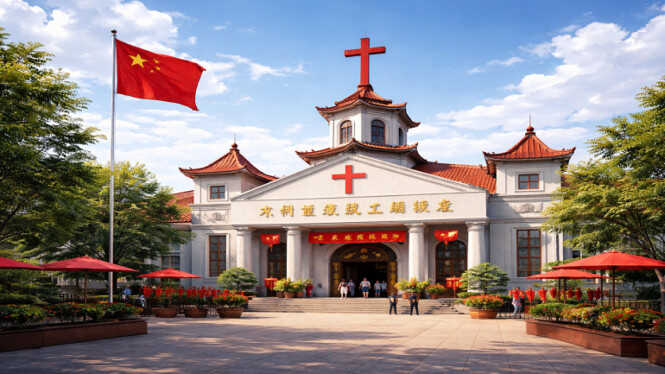
China’s official government-controlled Protestant church, the Three-Self Church, has declared its support for the newly issued “Regulations on Ideological and Political Work” promulgated by the Chinese Communist Party.
The regulations, introduced earlier this year, emphasise the strengthening of ideological work across all sectors of society and promote the adoption of Xi Jinping Thought as the primary guiding principle in various areas of public life.
In an interview on 21 January, Vice Chairman of the Three-Self Patriotic Movement, Shan Weixiang, described the new regulations as a “historic milestone” and a “guiding principle” for strengthening ideological work, including within church settings.
According to Shan, the Three-Self Church has made Xi Jinping Thought a central agenda item in various meetings and development programmes. He stated that the institution is committed to ensuring religious activities proceed in alignment with national policy and development direction.
A number of concrete measures have been implemented, including the integration of political education into seminary curricula. Theology students not only study Christian doctrine but also receive instruction in ideology and national policy. Several seminaries, such as Fujian Theological Seminary, are reported to have developed teaching materials combining religious studies with political education.
At the congregational level, churches are directed to display national symbols such as flags and the national anthem, promote core socialist values, and organise traditional cultural activities. These initiatives are described as part of the “sinicisation” of Christianity — the adaptation of religious teachings and practices to the cultural context and national policies of China. The stated aim is to create “a profound ideological space,” whatever that may mean.
Furthermore, religious leaders are required to participate in regular programmes entitled “law and policy study month.” These programmes aim to enhance understanding of state regulations, including issues such as religious extremism and foreign influence.
These terms readily encompass everything from unregistered house churches to foreign missionaries, and perhaps even the Apostle Paul himself. Clergy are expected to “rectify church practices,” “enhance self-discipline,” and present “a pure and solemn image,” which in practice means avoiding any form of independent religious expression.