
China rejects ‘major power co-governance’, warns against bypassing UN in veiled swipe at US
China rejects ‘major power co-governance’, warns against bypassing UN in veiled swipe at US
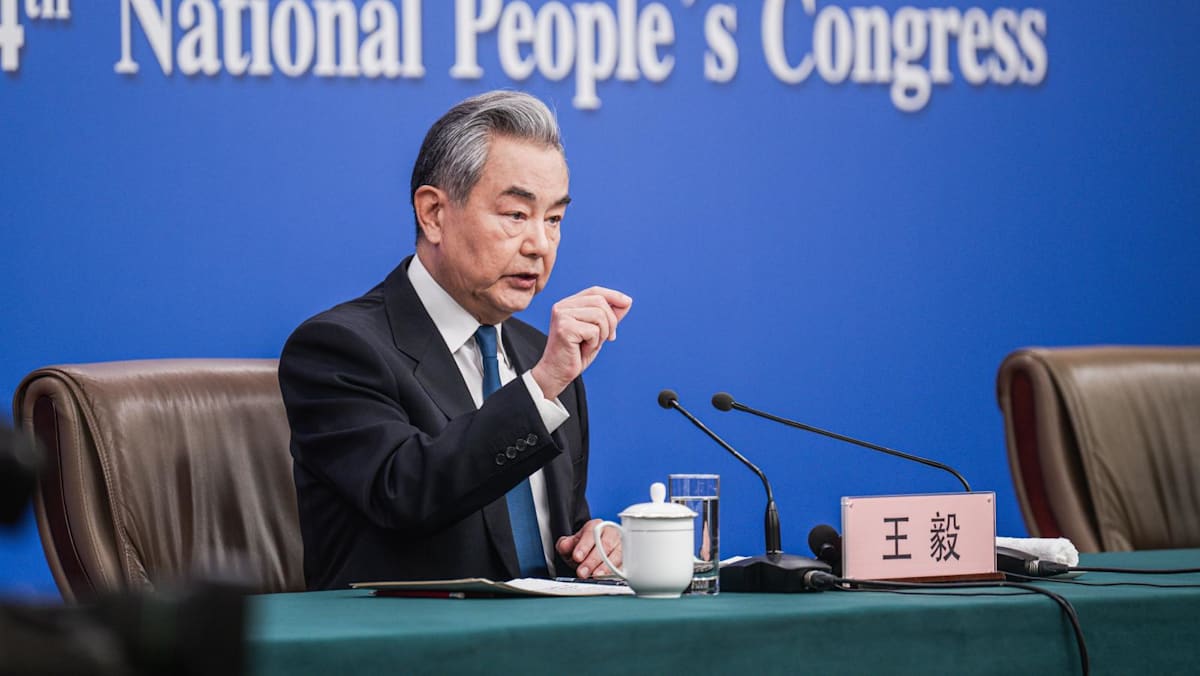
“(China does not) subscribe to the logic of major power co-governance,” said Foreign Minister Wang Yi in a Sunday (Mar 8) press conference during the Two Sessions.
BEIJING: China has rejected the idea that global affairs should be jointly steered by a handful of major powers, as its top diplomat sets out the country’s vision for global governance amid intensifying geopolitical tensions.
China does not “subscribe to the logic of major power co-governance”, Wang Yi said in rare direct remarks on Sunday (Mar 8) in a press conference on the sidelines of the Two Sessions.
Wang also warned against bypassing the United Nations (UN) through alternative mechanisms - remarks that appeared to be a veiled swipe at recent United States initiatives, including its Board of Peace.
During the wide-ranging 90-minute press conference on Sunday, Wang fielded 21 questions from domestic and foreign media, setting out Beijing’s positions on major-power rivalry, its vision for the world order and the trajectory of China-US ties.
He also addressed a series of current geopolitical flashpoints - from the latest escalation in the Middle East to tensions with Japan and disputes in the South China Sea.
Wang’s remarks on global affairs were in response to a question that cited his own description of China-US ties as the most consequential relationship in the world.
The reporter asked whether a joint-responsibility model - floated previously by United States President Donald Trump and others - could help the two powers prevent confrontation and reassure the world that China’s rise would not destabilise the existing international system.
Wang signalled that Beijing does not accept a framework in which a handful of big countries co-manage world affairs.
“Looking back at history, every episode of rivalry among major powers and bloc confrontation has brought disaster and suffering to humanity,” said Wang, who is China’s foreign minister and the country’s top diplomat by virtue of his concurrent role as head of the Central Foreign Affairs Commission of the Communist Party.
“For this reason, China will never follow the old path where a strong country inevitably seeks hegemony, nor does it subscribe to the logic of major power co-governance.”
On China-US ties, Wang said the relationship “concerns all sides and affects the world”, warning that a lack of engagement would only lead to misunderstandings and misjudgments, while conflict and confrontation would harm not just the two countries but the broader international community.
China and the US are both major powers that cannot change each other, he said, but they can change the way they interact.
That requires mutual respect, adherence to the bottom line of peaceful coexistence and efforts to pursue win-win cooperation - an approach he said serves the interests of both peoples and meets global expectations.
Wang noted that exchanges between the two heads of state have provided “important strategic guidance” and helped stabilise ties despite past turbulence.
The veteran diplomat expressed hope that 2026 could become a “landmark year” for healthy, stable and sustainable development.
The optimism comes as both sides line up a series of high-level engagements.
US President Donald Trump is slated to visit Beijing from Mar 31 to Apr 2, according to the White House, with a possible reciprocal visit by Chinese President Xi Jinping to the US later in the year.
Beyond bilateral meetings, the APEC leaders’ summit will be held in Shenzhen in November, while the G20 summit is scheduled to take place in Miami in December.
AN “EQUAL AND ORDERLY” MULTIPOLAR WORLD
Reiterating Beijing’s view that the world is moving towards multipolarity, Wang said China’s foreign policy remains grounded in its constitution and shaped by principles upheld by successive leaders.
The veteran diplomat pointed to China’s commitment to an independent foreign policy and the path of peaceful development, stressing that regardless of how the international landscape evolves or how far China advances, “China will never seek hegemony and will never expand”.
Against this backdrop, Wang outlined what he described as Beijing’s vision for the future international order - building “an equal and orderly multipolar world”.
By equal, he said, countries - regardless of size or strength - are all members of the international community, each able to find its place and play its role.
By orderly, he added, all nations should abide by universally recognised rules, particularly the purposes and principles of the UN Charter that underpin international relations.
Building such a system should be a shared responsibility, Wang said, with major powers bearing greater obligations to “observe rules, honour commitments and uphold the rule of law”.
China, he added, is willing to remain a “constructive force” in shaping this transition and to work with other countries to usher in what he described as a multipolar world.
UNITED NATIONS MUST BE UPHELD: WANG
In his Sunday press conference, Wang also underlined China’s firm backing for the United Nations, warning against attempts to sideline the multilateral system through smaller, exclusive groupings.
“Bypassing the UN to create alternative arrangements, or piecing together various small blocs and exclusive circles, is neither supported by the people nor sustainable,” he said.
Although Wang did not refer to any country or initiative by name, his remarks come amid growing debate over alternative forums - including proposals by Washington and its allies - to create new mechanisms for global coordination.
Trump has established a so-called “Board of Peace” to oversee post-war arrangements in Gaza, although the US president has said its remit would expand to tackle other conflicts globally.
Framing the UN as the central pillar of global governance, Wang said its leading role must be upheld rather than weakened.
“