
China Proves It No Longer Needs US, Trump Finally Gets His Comeuppance
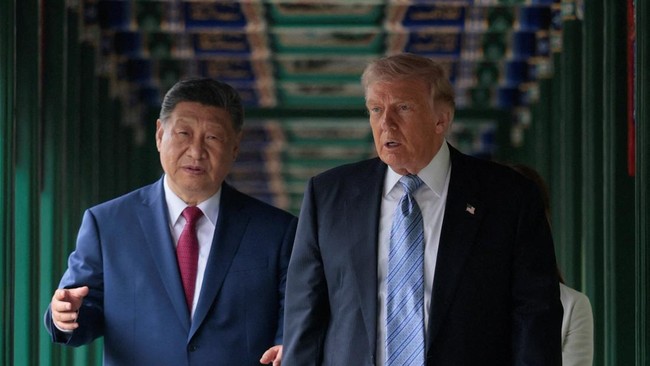
Jakarta, CNBC Indonesia – US export sanctions on advanced chips imposed on China during both the Biden and Trump administrations have, in fact, propelled the Xi Jinping-led nation to greater heights. Since the sanctions were imposed, China has focused on boosting its domestic AI chip industry to reduce technological dependence on the US, with notable success. While the US has come to realise China’s market is too valuable to lose, Beijing is now playing hardball. The US government has approved Nvidia’s H200 chips for export to China—the company’s second-most advanced chip—but Beijing has yet to formally permit their entry. This refusal demonstrates China no longer relies on US technological support. Huawei, one of China’s tech giants, has benefited from this shift. Recent reports indicate the company plans to design high-end chips by 2031. These high-end chips would feature transistor density equivalent to a 1.4nm process—a target revealed even as US sanctions hinder China’s ability to produce the world’s most advanced chips. Huawei’s latest projections were unveiled on Monday (25 May) local time, drawing immediate attention from various stakeholders. Huawei cited the ‘Tau Scaling Law’ principle—a new approach to chip development as the industry can no longer rely solely on shrinking transistor sizes. He Tingbo, Huawei’s semiconductor business president and director of the Scientist Committee, introduced the concept during a keynote speech titled ‘New Semiconductor Pathways in Practice’ at the IEEE International Symposium on Circuits and Systems (ISCAS) 2026 in Shanghai, according to Reuters on 25 May 2026. Though Huawei has not disclosed independent performance data, the target has captured attention. Transistors with 1.4nm density are expected to approach the global limit for advanced chip manufacturing by the decade’s end. China has traditionally been unable to reach this level through conventional manufacturing due to US restrictions on access to advanced lithography equipment and other key semiconductor technologies. The ‘Tau Scaling Law’, Huawei explained, focuses on reducing signal and data transit times within chips and computing systems. If successful, it could offer companies a way to enhance chip performance and density despite China’s limited access to cutting-edge semiconductor equipment. Huawei stated its latest Kirin chip will launch mid-2026 as the first to use LogicFolding architecture, which the company claims will shorten internal chip wiring and significantly boost performance. Huawei has designed and mass-produced around 381 chips over the past six years based on the Tau Scaling Law for industrial use, including in smartphones and AI computing.