
China Makes a New Splash, Its Technology Recognised by America
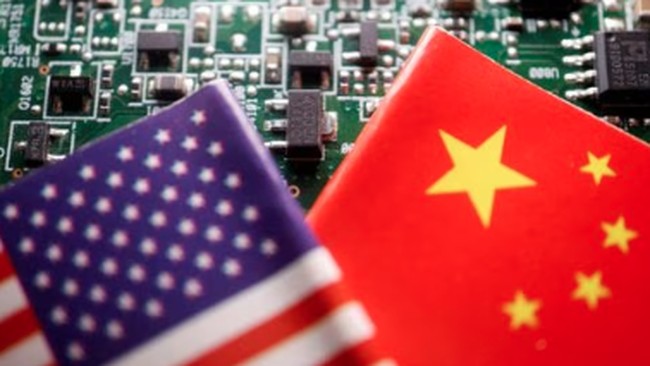
The explosion in artificial intelligence (AI) technology is not only benefiting US chip giants like Nvidia. China, which is in fierce competition with the US in the AI sector, is also vigorously producing innovations to capture opportunities.
One such example is Yuanjie Semiconductor Technology, a Chinese producer of laser chips for optical communications. Yuanjie has emerged as one of the ‘darlings’ benefiting from the AI boom on China’s stock exchanges.
Its shares have increased nearly ninefold over the past year, in line with the company’s efforts to list on the Hong Kong exchange.
This Shaanxi-based integrated device manufacturer closed trading last Friday (27/3) at 1,100 yuan per share. Yuanjie now ranks second in share price among companies listed on China’s exchanges.
Yuanjie trails only Kweichow Moutai, which stands at 1,416 yuan. Yuanjie’s market capitalisation reaches approximately 94.6 billion yuan, equivalent to Rp233 trillion, quoted from the South China Morning Post on Monday (30/3/2026).
This achievement marks Yuanjie as the second company on the Shanghai STAR Market, focused on technology, to break the 1,000 yuan threshold, following AI chip maker Cambricon.
Yuanjie was founded in 2013 by Zhang Xingang, a Tsinghua University graduate who later earned master’s and doctoral degrees from the University of Southern California. Yuanjie listed on the Shanghai STAR Market in 2022.
Zhang previously worked at Luminent and Source Photonics before founding his own company. Yuanjie’s core products are laser chips, the optical core of high-speed data transmission, including continuous-wave lasers, electro-absorption modulated lasers (EML), and distributed feedback lasers.
All serve AI data centres, 5G infrastructure, and fibre optic access networks, powering transceiver modules. Laser chips convert electrical signals into light through fibre optic cables.
Based on external sales revenue throughout 2025, Yuanjie ranks sixth as the world’s largest global laser chip provider.
Yuanjie is also the world’s second-largest supplier of laser chips specifically for high-speed optical interconnect products based on silicon photonics, according to data from China Insights Consultancy cited in the company’s Hong Kong stock exchange filing.
Like Nvidia in the US, Yuanjie has quickly capitalised on AI infrastructure development. The company’s full-year revenue for 2025, released last week, surged 138.5% to 601.4 million yuan.
Meanwhile, net profit attributable to shareholders reached 191 million yuan. This marks a sharp turnaround from a loss of 6.1 million yuan the previous year.
This change was largely driven by its data centre business. Overall gross margin rose 32.3 percentage points to 55.7% in 2025, with data centre products achieving a gross margin of 71.3%.
For the first time, data centre revenue surpassed the company’s legacy telecommunications business, contributing 65.4% of total revenue at 393.3 million yuan. This represents a 719% year-on-year increase.
Yuanjie’s resurgence reflects a broader structural shift in AI infrastructure, namely the transition from copper to optical interconnects. Optical chips, which transmit data using light rather than electrical signals through copper cables, are emerging as critical infrastructure for AI data centres struggling to keep up with bandwidth and heat demands from massive processor clusters.
Recognised by Nvidia
Indeed, Nvidia has validated this trend. At the company’s flagship GTC developer conference this March, founder and CEO Jensen Huang stated that the next-generation Feynman architecture, expected in 2028, will incorporate optical interconnects.
Nvidia also announced investments of US$2 billion each in photonics specialists Lumentum and Coherent, along with multi-billion-dollar purchase commitments and priority access to future production capacity.
However, Yuanjie still lags behind global leaders in production capacity and products like 200G EML, the next-generation laser chip standard already in mass production at Lumentum.
As the transition accelerates, several Chinese optical communications companies, including Eoptolink, Zhongji Innolight, and TFC Communication, have attracted growing investor attention.