
China Develops Mini Nuclear Battery Capable of Lasting 50 Years Without Recharging
Lithium-ion (Li-ion) batteries in electronic devices generally have a limited lifespan. For instance, battery life in smartphones or laptops typically lasts about a day before needing a recharge. Batteries in smartwatches may last from several days to several weeks. Meanwhile, alkaline batteries for household devices such as TV remotes usually last only a few months.
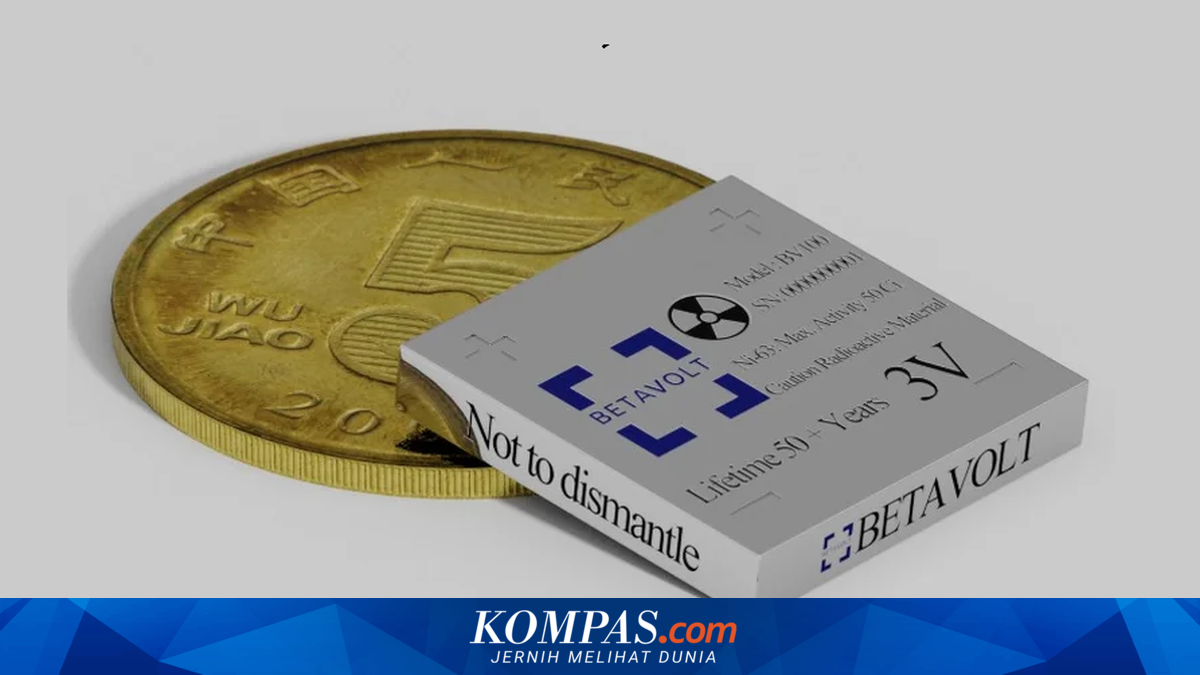
But the story is different with a nuclear-powered battery named Betavolt BV100. This battery, produced by a Chinese company in 2024, is claimed to be able to last up to 50 years without recharge. It is very small, even smaller than a coin, with dimensions around 15 x 15 x 5 millimetres.
Despite its mini size, the battery is designed to continuously generate electricity for decades. The power produced is around 100 microwatts at a voltage of 3 volts.
This is thanks to a radioactive isotope nickel-63 which serves as the energy source for Betavolt BV100. The isotope will naturally decay into copper.
During the decay process, electrons are emitted. These electrons are then captured by a thin layer of semiconductor within the battery and converted into electrical current.
Betavolt uses a diamond-based semiconductor layer that is extremely thin to capture these electrons and channel them into a stable electrical energy.
During the decay process, the battery will continue to generate electricity.
Because the process can continue for decades, such nuclear batteries have a much longer lifespan without needing to be recharged, compared with conventional batteries.
This battery is also designed to withstand extreme conditions. BV100 is claimed to operate from -60 degrees Celsius to 120 degrees Celsius without risk of catching fire or exploding.
Additionally, the company describes the battery as relatively environmentally friendly. The nickel-63 isotope that serves as its energy source will decay into stable copper, making it easier to recycle than ordinary chemical batteries.
Nuclear battery technology is not new. Since the 1950s, the concept has been used for various specialised purposes, such as spacecraft, satellites, and unattended research stations located in remote locations.