
China and Germany Agree to Defend Free Trade
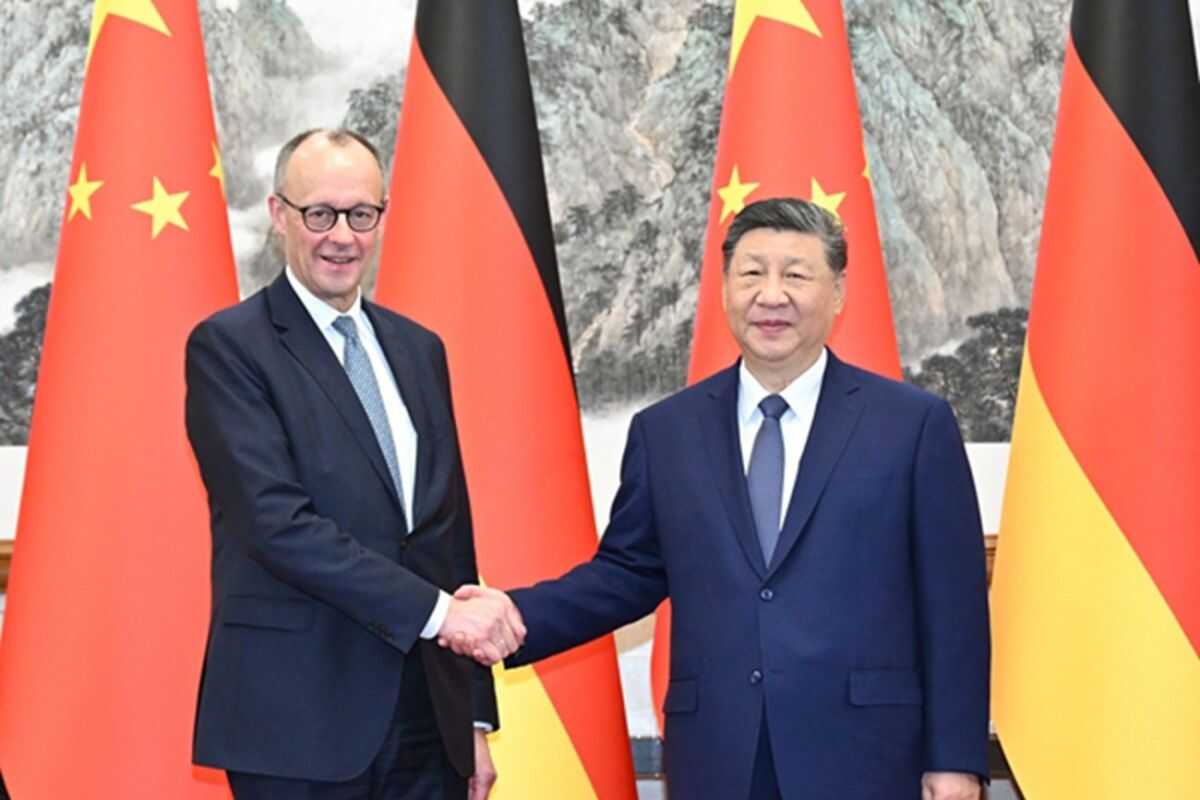
Beijing (ANTARA) - The meeting between Chinese President Xi Jinping and German Chancellor Friedrich Merz in Beijing on Wednesday (February 25) resulted in an agreement to continue defending the sustainability of free trade.
“China and Germany must uphold the central position of the UN, reaffirm its leadership role, and lead in maintaining multilateralism, practicing international law, defending free trade, and advocating for solidarity and coordination,” said President Xi Jinping in a written statement on the website of the Chinese Ministry of Foreign Affairs, accessed in Beijing on Wednesday.
Merz visited China from February 25-26, bringing 30 top executives from leading German companies in an effort to strengthen bilateral cooperation. He met with Xi Jinping at the Diaoyutai State Guesthouse.
President Xi emphasized that China and Germany are the second and third largest economies in the world, and bilateral relations not only affect the interests of both countries, but also have a significant impact on Europe and the world.
He also put forward three proposals for further developing China-Germany relations, namely, first, the two countries must become reliable and mutually supportive partners.
“China will continue to share development opportunities with Germany and the wider world. We hope that Germany can objectively and rationally view China’s growth, pursue a positive and pragmatic policy towards China, and work with China for stable and sustainable bilateral relations,” added President Xi.
The second proposal is that the two countries should become innovative partners that uphold openness and mutually beneficial outcomes.
“The German government has proposed a new development strategy in the fields of technology, innovation and digital development, and this strategy is very much in line with China’s goal of pursuing smart, green and integrated development during the 15th Five-Year Plan,” said Xi.
The third proposal is that the two countries should become partners that understand each other and share close ties through cultural and people-to-people exchanges.
“China and Germany, as major countries with deep cultural heritage, should strengthen mutual learning in the field of culture and enhance people-to-people exchanges, thereby strengthening the foundation of China-Germany friendship,” added Xi.
Meanwhile, Chancellor Merz said that Germany values its relationship with China and firmly upholds the “One China” policy.
“Germany is ready to work with China to continue traditional friendship, remain committed to mutual respect and open cooperation, and continue to deepen comprehensive strategic partnership,” said Chancellor Merz.
The German business community, said Merz, highly prioritizes the Chinese market and hopes to further deepen cooperation with China for mutual benefit and common growth.
“Germany hopes to work with China to enhance coordination, jointly adhere to free trade and reject protectionism,” added Merz.
Xi and Merz also discussed the Ukraine crisis.
President Xi explained China’s position and pointed out that the key to finding a solution lies in consistent dialogue and negotiation, as well as ensuring equal participation from all parties and building a solid foundation for peace.
“It is necessary to accommodate the concerns of all parties and increase the desire for peace, as well as realize common security and build a lasting peace architecture,” said Xi.
Spokesperson of the Ministry of Foreign Affairs, Mao Ning, in a routine press conference, said that there are successful practices of healthy competition and integrated development between China and Germany.
“The two countries should uphold the principles of mutual respect, equality, and mutual benefit, achieve greater progress in China-Germany relations, and jointly make a greater contribution to world peace and prosperity,” said Mao Ning.
Before starting his visit, Merz put forward five main principles in Berlin’s approach to Beijing, one of which mentions fair economic competition, as reported by Deutsche Welle.
The visit of Merz to China adds to the list of US allies approaching China after Trump returns as US president in 2025 with his protectionist agenda.
Before Merz, the President of France visited China in December 2025, followed by the Prime Ministers of the United Kingdom and Canada in January 2026.
In 2025, China surpassed the US as Germany’s largest trading partner with a value of 251.8 billion euros (approximately 4.280 trillion rupiah).
However, Germany experienced a trade deficit with China, estimated at 90 billion euros (approximately 1.530 trillion rupiah), an increase of 30 billion euros (approximately 510 billion rupiah) from 2024.