
Children's Scroll Limit
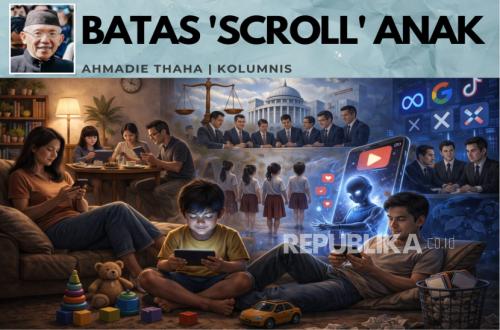
In an era where children learn to scroll before they learn at school, the state has finally intervened. Not out of sudden wisdom, but because it realises that algorithms educate faster than teachers and can sometimes be harsher than a maths exam.
Thus was born Government Regulation Number 17 of 2025, sweetly named PP TUNAS. The name sounds like kindergarten, soft yet its content is firm. An acronym for the Governance of Electronic System Operations in Child Protection.
But like many things in this country, it does not immediately “run”. It was born in 2025, then learned to walk on 28 March 2026. Not because it is disoriented, but because it must wait for the “extended family of rules” to arrive.
Beneath it, there must be derivative regulations, technical readiness, and of course coordination meetings that could outnumber family WhatsApp notifications.
The regulation itself is not an ON/OFF switch. It is the foundation. After being enacted, it still awaits Ministerial Regulations as technical explanations.
If the PP is the state’s grand intention, then the Ministerial Regulation is the state’s way of explaining that intention so it is not misinterpreted, though it is often still misunderstood.
This regulation is like a digital fence. Essentially, children under 13 may only play in the so-called “safe” electronic system garden. Then, children aged 13–15 may explore a bit further, and 16–17 may enter the “algorithm forest”.
Of course, all with parental approval, who often do not even know what terms and conditions are, apart from the “agree” button pressed without reading.
Amusingly, it is not the children who are scolded, but the digital giant entrepreneurs. Meta and Google have been summoned by the Minister like students late to class, i.e., not quite in order.
Meanwhile, TikTok and Roblox are considered “quite polite but not yet neatly uniformed”. As for X and Bigo Live—whether seriously or just compliant—they stand straight: “Ready, Ma’am!”
However, the question is: is the state truly protecting children, or merely chasing its own shadow?
Let us look south to Australia. The Land of Kangaroos does not mince words. In matters of electronic systems, they have long discussed age verification.
Even, the Australian government mandates digital identity for access to certain platforms.
There, the discourse on restrictions is not mere moral panic, but part of a serious regulatory architecture. There are real fines, real audits, and real threats to technology companies.
Europe is even fiercer. The EU’s GDPR (General Data Protection Regulation) treats children’s data like a sacred object. It cannot be touched carelessly, let alone traded secretly.
America? More ambiguous. They are like liberal parents: forbidding, but while giving space. There is COPPA (Children’s Online Privacy Protection Act), but in practice, it often lags behind Silicon Valley innovations.
Indonesia is now trying to stand among them all. It wants to be firm like Europe, practical like Australia, but still grappling with the reality that many parents have not even finished reconciling with the “skip ads” button.
Amid this, our bureaucracy adds another layer: regional governments. When the DKI Jakarta Provincial Government prepares to make derivative rules, the public wonders whether all regions must follow suit with similar regulations?