
Children of Bandung Barat landslide victims to receive aid under the Indonesia Pintar Programme
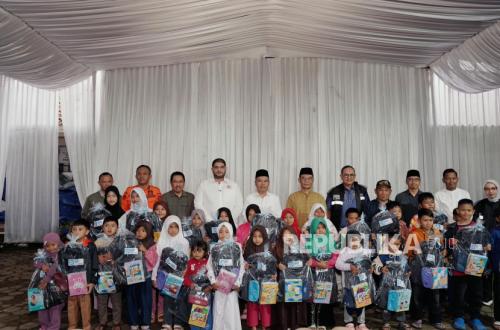
West Bandung Regency, Indonesia — The landslide in Pasirlangu Village, Cisarua District, West Bandung Regency, not only damaged residents’ homes but also threatened the educational continuity of children affected by the disaster. A legislator urged that the educational needs of children be safeguarded after the disaster.
Rajiv, a member of Commission IV of the Indonesian House of Representatives from the NasDem Party, distributed education assistance through the Indonesia Pintar Programme (PIP) to the children affected by the disaster. The distribution was announced during an iftar gathering with landslide-affected residents in Cisarua on Friday, 6 March 2026.
“Here, those affected are the children from primary, junior high and senior high schools; they will receive PIP from me, all of them into PIP until their schooling is completed. So really those affected by the disaster, especially if the children are orphans. I ask for them to be documented so they can access that programme,” Rajiv said in a statement on Sunday, 8 March 2026.
Rajiv asked the village government to record the children among the disaster victims to be included in the education assistance programme. Rajiv also said that children who have lost their parents could be pursued to obtain the Kartu Indonesia Pintar (KIP).
“Especially for children, particularly orphans, if necessary up to KIP.” “From primary through to senior high, up to KIP,” he said.
According to Rajiv, educational support is important so that children affected by the disaster can continue their schooling. He hopes, at minimum, the schooling issues of the victims’ families can be resolved.
“At least one schooling problem is resolved; then we can think about the other issues with the local government and other ministries,” he said.
In addition to education, Rajiv also highlighted the plight of horticulture farmer groups affected by the landslide. Many farmers in the area have lost their farmland or sources of income due to the disaster.
“I also want to meet the affected farmer groups. How can these affected farmers be helped to restart their livelihoods, but on the condition that it’s not on the land they had yesterday,” Rajiv said.
Rajiv noted that the regional government is considering relocating farmland so that farmers’ economic activities can resume. According to Rajiv, the decision on a new site is the jurisdiction of the provincial and district governments.
“Why do we wait for the provincial and district governments? Because they own the land, not us — members of the DPR or ministries — to intervene and move land from here to there; we can’t,” Rajiv said.
Rajiv said he stood ready to help farmers’ needs after the new farmland is established by the local government. “Later, when the land is established by the province or district, it will be our task to provide what the horticultural farmers need. So these horticultural farmers can live again, continue living, and be able to support their families again,” he said.
Rajiv also highlighted the high risk of disasters in West Bandung due to land-use changes. The area now cultivated for horticulture used to be pine forest that absorbed water.
“West Bandung has a high disaster potential because of land-use changes. The main cause is land-use change. It used to be pine forest; when it was cut down and given to horticulture, it no longer has roots and no water absorption; that is the real problem,” Rajiv said.
Rajiv extended condolences to residents who lost family members in the landslide.
“Going forward, we will work together to ensure that the future of the orphaned children, who were left behind by their families, can continue to complete their schooling,” he said.