
Chicken Meat and Egg Prices Show Anomalies Again; Ministry of Agriculture Reveals Root Cause
The Ministry of Agriculture (Kementan) has revealed anomalies in the pricing of several food commodities. Prices at the producer level have begun to fall, yet these decreases are not fully reflected at the consumer level.
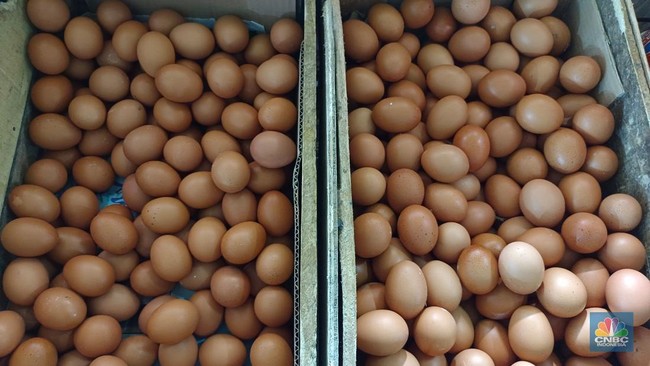
Kementan data shows that the price of layer chicken eggs at the producer level in the first week of March 2026 averaged Rp27,083 per kilogramme, approximately 2.20% above the government’s reference price (HAP) of Rp30,000 per kilogramme. Although still above the HAP, prices at the farmer level have declined around 0.64% compared to the previous week.
Meanwhile, layer chicken egg prices at the consumer level nationally average around Rp32,650 per kilogramme, approximately 8.67% above the HAP. The decline at consumer level is far smaller, at only around 0.15%.
Makmun, Director of Livestock Product Downstream Processing at Kementan, believes the difference indicates a problem in the distribution chain. “The 0.64% decline at the producer level appears to decline only 0.15% at the consumer level in the market,” Makmun said during a Regional Inflation Control Coordination Meeting on Monday, 9 March 2026.
A similar situation exists for broiler chicken. Live chicken prices at the producer level stood at approximately Rp24,363 per kilogramme, or 2.55% below the HAP of Rp25,000 per kilogramme. This represents a decline of around 1.87% compared to the previous week.
However, at the consumer level, carcass chicken prices remain around Rp41,550 per kilogramme, approximately 3.88% above the HAP of Rp40,000 per kilogramme. Price declines in the market are only around 0.95%. “Similarly with eggs, chicken prices fell 1.8% at the producer level but only 0.9% at the consumer level, which is 50% of the producer-level decline,” Makmun explained.
Regarding beef, Makmun reported that live cattle prices at the producer level stood at approximately Rp53,510 per kilogramme, or 4.45% below the lower bound of the HAP at Rp55,000 per kilogramme. Meanwhile, retail beef prices nationally are around Rp136,550 per kilogramme, approximately 2.46% below the HAP of Rp140,000 per kilogramme, but have experienced a slight increase of around 0.11%.
“Whilst live cattle weight is 4.45% below the HAP at Rp53,500 per kilogramme on average, the market price has actually increased, albeit remaining below the HAP, rising by 0.11%,” Makmun said.
He attributed the price disparity to the length of the distribution chain and potential logistical constraints in the field. “This may be a point similar to last week, showing that there are indeed many intermediaries in the chain, whether there are logistical obstacles or simply many hands involved, or whether there are attempts to take extra profits at such moments,” he said.
Nevertheless, Kementan assures that national food stock availability remains safe ahead of Ramadan and Eid. “From the stock perspective, God willing, it is safe. But perhaps we ask regional leaders for assistance if there are logistical constraints so that we can address them together,” he stated.
The government has also reminded businesses not to raise prices unjustifiably. During the same session, I Gusti Ketut Astawa, Deputy I for Food Availability and Stabilisation at the National Food Agency (Bapanas), said that the Agriculture Minister, who also heads the National Food Agency, Amran Sulaiman, has led food price control meetings.
“As a follow-up to last week’s inflation meeting, the Agriculture Minister and National Food Agency Chief has brought together three items: first, broiler chicken, second, beef, and third, cooking oil,” Ketut said. He stressed that the government is asking businesses to maintain price stability from upstream production through distribution. “The leadership led this directly last week to ensure businesses do not raise prices. The key point is that there should be no manipulation upstream or in the middle,” he concluded.