
Cheaper and more practical: BPH Migas says Jargas is increasingly popular
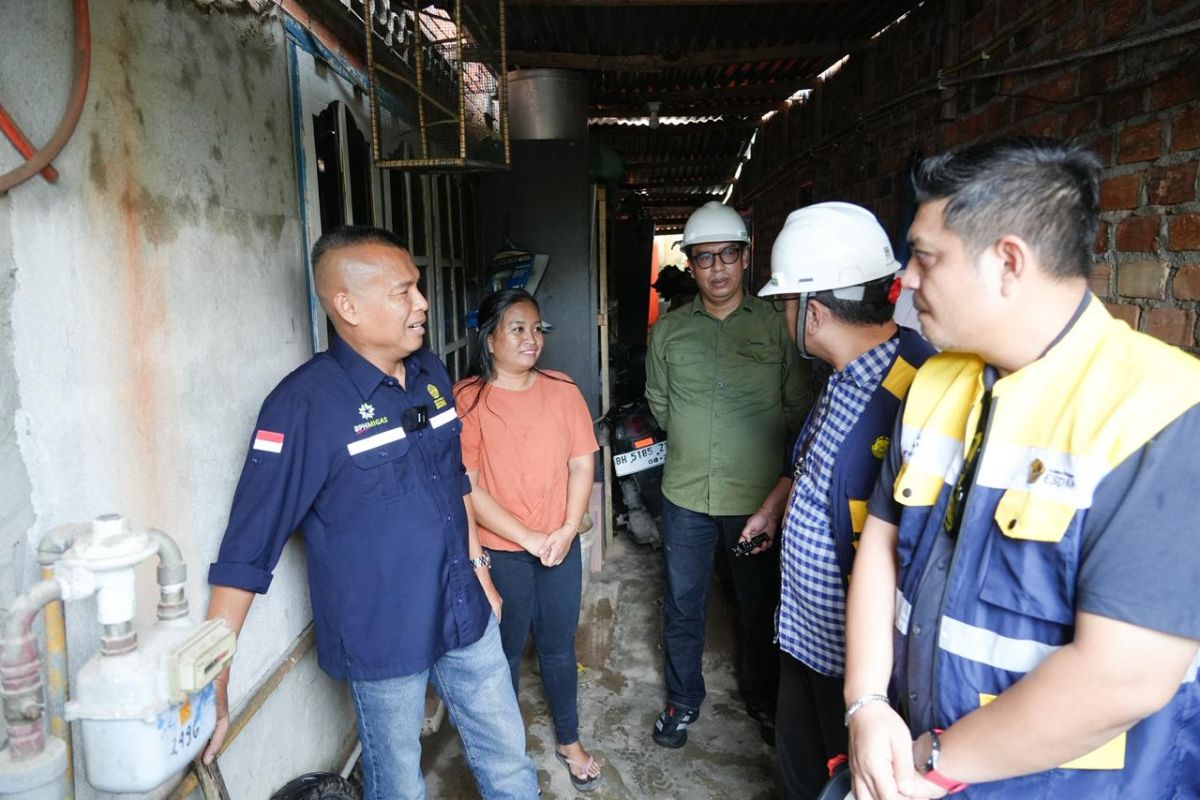
Jakarta (ANTARA) - Member of the Downstream Oil and Gas Regulatory Body Committee (BPH Migas), Hasbi Anshory, stated that household customers and business operators are increasingly experiencing the benefits of using natural gas networks (Jargas), as they are proven to have low emissions, be cheaper, and more practical.
“Jargas has proven to be more efficient, no need to queue, and able to save household expenses. It also helps the country reduce the burden of LPG subsidies,” said Hasbi in his statement in Jakarta on Thursday.
Therefore, the utilisation of Jargas for household and business needs will continue to be encouraged by the government.
Hasbi also urged capable communities to install Jargas independently, thereby accelerating network expansion without fully relying on state subsidies.
“Jargas built using the state budget is prioritised for our less fortunate brothers and sisters. If we expect all Jargas development to be borne by the state with its limited budget, then its development cannot be fast,” said Hasbi while monitoring the metering regulating station (MRS) for Jargas in Thehok Ward, South Jambi District, Jambi City, Jambi.
Meanwhile, Kevindra Try Nugraha, a restaurant owner in Jambi City, admitted that Jargas is a safe, cheap, efficient, and affordable energy choice.
“I was offered to use natural gas because previously a restaurant in Palembang, South Sumatra, had already used Jargas, so I was immediately interested. The savings can reach 50 to 60 percent,” said the Jargas user of eight years.
Previously, the cooking fuel cost at his restaurant reached Rp16-17 million per month, but after using Jargas, his expenses dropped to Rp8-10 million per month.
“I think all food and beverage entrepreneurs should use Jargas. At the start, the installation cost is quite large, but if we calculate afterwards, cumulatively it becomes cheaper. Maybe in 3-4 months, the investment is recovered. In the long term, it will definitely be much better,” he explained.
Kevindra also said that Jargas is practical because there is no hassle of replacing LPG cylinders or worrying about running out of gas.
A household customer, M Silaban, admitted to paying around Rp60,000-70,000 per month for Jargas usage, which is much cheaper compared to a 12 kg LPG cylinder costing Rp200,000.
Over 12 years of using Jargas, he said he has never experienced any issues. Residents around Silaban’s house also expressed interest in using Jargas.
Therefore, this junior high school retired teacher in Jambi City hopes the government will enhance Jargas infrastructure development so that more people can enjoy it.
On that occasion, Hasbi invited the Jambi Regional Government to increase socialisation so that public awareness of the benefits of Jargas increases further.
“Let us together socialise Jargas. Based on the results of dialogues with residents, there are still some who are afraid to use Jargas. In fact, natural gas is very safe. Its specific gravity is smaller than LPG, so the gas evaporates immediately. Jargas is safe, so it needs to be socialised that Jargas is safe and cheap. That’s what we need to remember,” he said.
For Jambi City, 13,000 household connections (SR) of Jargas have currently been built using state budget funds.
The gas supply comes from PHE Jambi Merang. This number is expected to increase to 28,000 SR by 2026, considering that currently 15,000 SR of Jargas are being built with state budget funds.
The management of Jargas in Jambi City is carried out by PT Pertagas Niaga in collaboration with the regional-owned enterprise PT Jambi Indoguna Internasional.
Jargas Infrastructure Manager of Pertagas Niaga, Dwi Wahyono, added that for independent installations, the required cost is around Rp4.5 million, depending on the length of the pipeline network to the customer’s house.
“We will continue to conduct socialisation regarding the benefits of Jargas so that more people and business operators use Jargas,” he said.