
Cheap Food Programme to Curb Inflation Ahead of Ramadan and Eid al-Fitr
As Ramadan and Eid al-Fitr 1447 Hijri approach, the pulse of social concern in North Maluku is felt more strongly. On one hand, local governments are moving to maintain price stability and purchasing power; on the other, security personnel and even the population agencies are strengthening welfare interventions and family development. All are united in one breath: ensuring that the community welcomes the religious holidays calmly and with dignity.
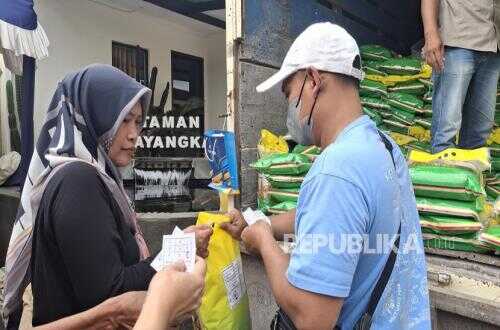
In Sidangoli Gam village, West Halmahera, Governor Sherly Tjoanda distributed 1,000 cheap food packages as part of an effort to curb inflation and safeguard access to basic goods.
She said that every religious holiday moment is often accompanied by price hikes in food. Therefore, the cheap food program represents a direct intervention by the provincial government to provide flexibility for residents.
Under the programme, the public can redeem a staple food package for Rp50,000 containing 5 kilograms of rice, 2 kilograms of sugar, and 2 litres of cooking oil. From field observations, the bright faces of residents carrying full shopping bags provide a tangible illustration of the programme’s benefits. The bustling yet orderly atmosphere reflected the enthusiasm and hope that price stability would be maintained until Eid al-Fitr.
Not only cheap food, the provincial government also handed out two wheelchairs and five walking sticks to residents in need. This step is part of a broader strategy to control supply chains and ensure programmes such as the ‘Gerakan Pangan Murah’ truly reach people directly.
For Governor Sherly, the programme is not merely about providing affordable essentials, but also about fostering a sense of solidarity and gratitude among communities.
Efforts to safeguard the welfare of coastal communities are also undertaken by defence forces. Personnel from the Aru Naval Base distributed staple foods to fishermen in the waters of the Aru Islands as part of Operation Trisila-26. The activity aims to support fishermen whose catches are unpredictable due to weather and economic conditions.
Commander of Lanal Aru, Colonel (Navy) Sriadi, emphasised that Operation Trisila-26 proves that the Navy’s presence in border areas is not only oriented toward defence, but also social care.
The distribution of staples was even carried out directly from the deck of a vessel at sea, symbolising the soldiers’ closeness to coastal communities. The enthusiasm of the fishermen demonstrated that the state’s presence is felt not only in terms of security but also economic support.
Meanwhile, long-term welfare improvements are pursued through stunting intervention. A representative of BKKBN North Maluku stressed the importance of using accurate data in policy formulation.
The head representative of the Ministry of Home Affairs and BKKBN North Maluku, Victor, reminded that the agency’s strength lies in data wealth, but its use must be precise to avoid biased interventions. He explained that stunting, in line with World Health Organization standards and Presidential Regulation No. 72 of 2021, includes children aged two to five years and is not merely a matter of malnutrition.
Stunting is the result of multifactorial causes encapsulated in three main aspects: suboptimal nutrition, suboptimal health, and suboptimal parenting. In fact, factors such as nutrition and health contribute only around 30 percent, while the remaining 70 percent are influenced by environmental factors.