
ChatGPT CEO Defends AI, Claims Humans are More Wasteful
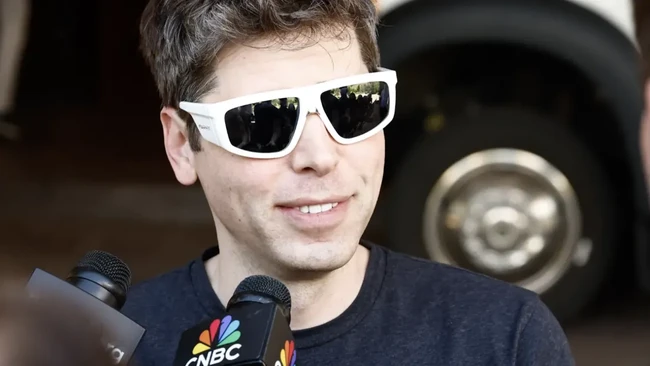
Jakarta, CNBC Indonesia - The issue of excessive electricity and water consumption due to the development of artificial intelligence (AI) remains a hot topic. However, OpenAI CEO Sam Altman has refuted claims that systems like ChatGPT consume excessive resources.
Speaking at the India AI Impact Summit in an interview with The Indian Express, Altman called claims circulating on the internet that ChatGPT uses gallons of water for each query as misinformation.
“That claim is completely false, completely ridiculous, and has no basis in reality,” he said, quoted by CNBC International, Wednesday (February 25, 2026).
Data centers traditionally use large amounts of water to cool electronic components to prevent overheating. However, data center technology continues to evolve, and some new facilities no longer rely on water as the primary cooling system.
Although efficiency continues to improve, a report last month from water technology company Xylem and Global Water Intelligence projected that water used for cooling will increase more than threefold in the next 25 years as computing demand increases, putting pressure on water systems.
While dismissing the water issue, Altman acknowledged that energy consumption is a valid concern. According to him, the issue lies not in a single request, but in the scale of AI usage globally.
“It’s not per query, but in total, because the world is using so much AI, and we need to switch to nuclear or wind and solar very quickly,” he said.
Altman also responded to comparisons previously made by Microsoft founder Bill Gates regarding the energy efficiency of the human brain.
He believes that comparisons that often focus on the energy required to train AI models are not entirely fair.
“One of the things that is always unfair in these comparisons is that people talk about how much energy it takes to train an AI model. But training a human also takes a lot of energy,” Altman said.
“It takes about 20 years of life, and all the food you eat before that time, before you become smart,” he added.
According to him, a more relevant comparison is to calculate the energy required for AI to answer a single question after the model is trained, or what is known as inference. At this stage, he claims that AI may already be equal to or even surpass human energy efficiency if measured in that way.
Altman’s comments, particularly the comparison of AI with humans, have sparked online debate amid growing concerns about AI’s ability to replace human jobs.
Sridhar Vembu, one of the founders and chief scientist of Indian software company Zoho Corporation, who attended the event, criticized the equating of humans and AI.
“I don’t want to see a world where we equate a piece of technology with a human,” said the billionaire in a post on X.
On the other hand, the expansion of data centers to support AI computing needs continues to spark debate. Several communities in the United States have opposed the construction of new facilities due to concerns about burdening the electricity grid and increasing electricity rates.
Some time ago, the San Marcos City Council, Texas, rejected a $1.5 billion data center project after months of citizen opposition.
Amid the opposition, many technology leaders, including Altman, argue that data centers will require more energy production from various sources, including renewable energy and nuclear.
(dem/dem)