
Charging Technology Poses Challenge to Energy Transition, Academic Offers Solution
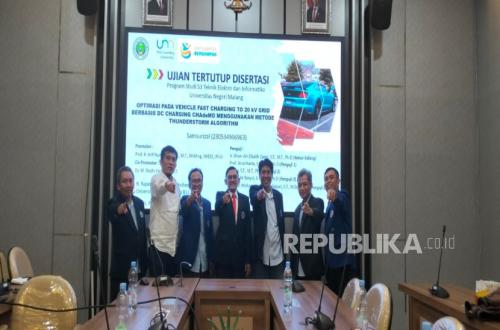
A lecturer at Institut Teknologi PLN (ITPLN), Dr. Samsurizal, has developed an artificial intelligence-based method for optimising fast charging of electric vehicles as a solution to the charging technology challenges in the energy transition. The innovation was produced in his doctoral dissertation at Universitas Negeri Malang (UM). Samsurizal was declared to have passed the doctoral programme (S3) after undergoing a closed dissertation examination at UM’s Faculty of Engineering on Thursday (9/4/2026). His research focuses on efforts to accelerate electric vehicle charging without sacrificing battery life or the stability of the electrical system. “One of the biggest challenges in developing electric vehicles is how to speed up charging without damaging the battery and without disrupting the electricity grid,” said Samsurizal in his statement on Friday (10/4/2026). He explained the main dilemma of DC-based fast charging technology. Fast charging can indeed significantly reduce time, but it risks increasing battery temperature, reducing battery health or state of health (SoH), and adding load to the 20 kV medium-voltage electricity grid. The study also covers the integration of vehicle-to-grid (V2G) concepts. This technology allows electric vehicles not only to consume energy but also to supply electricity back to the grid, potentially supporting a more adaptive energy system. “If not optimised, fast charging can impact battery life and the overall stability of the electricity system,” he said. As a solution, Samsurizal proposes the use of the Thunderstorm Algorithm (TA), an artificial intelligence-based optimisation method inspired by lightning storm phenomena. This approach is designed to find a balance between charging performance and system safety. The algorithm works through three main stages: initial solution formation (cloud phase), optimal path search (streamer phase), and evaluation until convergence is achieved (avalanche phase). This process allows the system to determine the most efficient charging scenario with minimal risk. This approach is considered capable of accommodating various important variables, from charging speed, battery life, temperature stability, to its overall impact on the electricity grid. “This method seeks the optimal point between charging performance and system safety,” said Samsurizal. The dissertation titled Optimisation of Vehicle Fast Charging to 20 kV Grid Based on DC Charging CHAdeMO Using the Thunderstorm Algorithm Method was supervised by Prof. Arif Nur Afandi and Dr. Mohamad Rodhi Faiz. In the session held at 1:00 PM WIB, he was declared to have passed by the examination team led by the Head of the S3 Industrial Electrical Engineering Programme, Ilham Ari Elbaith Zaeni. The examination team also included external examiner Mohammad Noor Hidayat from Politeknik Negeri Malang as well as internal examiners Aripriharta, Sujito, and Harits Ar Rosyid. The assessment states that the research has strategic contributions to the development of the national electric vehicle ecosystem. The results of this research have the potential to improve fast charging efficiency, extend battery life, and maintain electricity grid stability. This development also opens opportunities for integrating electric vehicles into smart grid systems as an important part of the transition to clean energy. Samsurizal hopes this innovation can be applied in the national electricity system as the use of electric vehicles increases. Efficient and stable charging technology is key to supporting a sustainable energy future.