
Central Java Provincial Government Issues Circular on Energy Efficiency, Urging Civil Servants Within 1.5 Km of Office to Walk
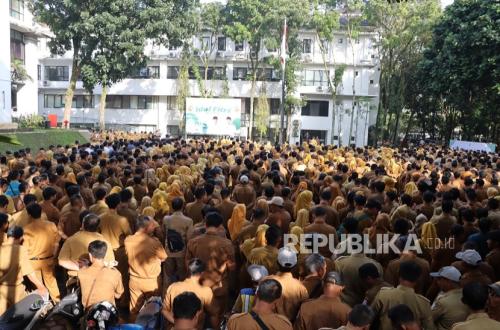
The Central Java Provincial Government has issued a circular on the transformation of civil servants’ work culture within its administration. This circular follows the Minister of Home Affairs’ circular on energy savings in response to the surge in global oil prices due to conflicts in the Middle East.
The Provincial Secretariat of Central Java issued Circular Number B/000.8.3/3/2026/2026 on the Transformation of Civil Servants’ Work Culture in the Central Java Provincial Government on 1 April 2026. This circular follows the Minister of Home Affairs’ Circular Number 800.1.5/3349/SJ on the Transformation of Civil Servants’ Work Culture, issued on 31 March 2026.
The Central Java Provincial Secretariat’s circular contains 10 main points. In general, it regulates the technical implementation of energy efficiency in the civil servants’ work environment, including the application of working from home (WFH). As decided by the central government, the WFH policy is implemented every Friday.
Under the Central Java Provincial Secretariat’s circular, WFH is exempted for: high-level and mid-level leadership positions; service and operational support units at the Investment and One-Stop Integrated Services Agency; regional hospitals; health laboratories; public health centres; educational units; regional revenue service units; and other work units and/or service units that provide direct services to the public.
“Violations of the WFH provisions by civil servants will be subject to administrative sanctions in accordance with applicable regulations,” states point four in the Central Java Provincial Secretariat’s circular on the Transformation of Civil Servants’ Work Culture in the Provincial Government Environment.
The Central Java Provincial Secretariat’s circular also encourages changes in transport modes for civil servants. “Walking, prioritised for employees with a distance between residence and office of less than or equal to approximately 1.5 kilometres; b. Using non-oil fuel transport such as bicycles and electric bicycles, prioritised for civil servants with a distance between residence and office of less than 10 kilometres and relatively flat terrain,” states points a and b in the ninth main point of the Central Java Provincial Secretariat’s circular.
In addition, civil servants are encouraged to use public transport if feasible in terms of accessibility, distance, and travel time. Other options include using shared vehicles or ride-sharing for commuting to work.
Other points in the Central Java Provincial Secretariat’s circular regulate the technical aspects of efficient use of electricity and water in the civil servants’ office environment. Furthermore, civil servants are encouraged to optimise information and communication technology as a means of coordination and reporting on task implementation.
The Provincial Secretary of Central Java, Sumarno, revealed that the substance of the circular issued by his office on 1 April 2026 is almost the same as the Minister of Home Affairs’ circular. “We very much hope that this will have an impact on the efficiency of carbon fuel use,” Sumarno said when interviewed at the Central Java Provincial DPRD Office on Monday (6/4/2026).