
Central Information Commission affirms that public bodies must fulfil information disclosure obligations
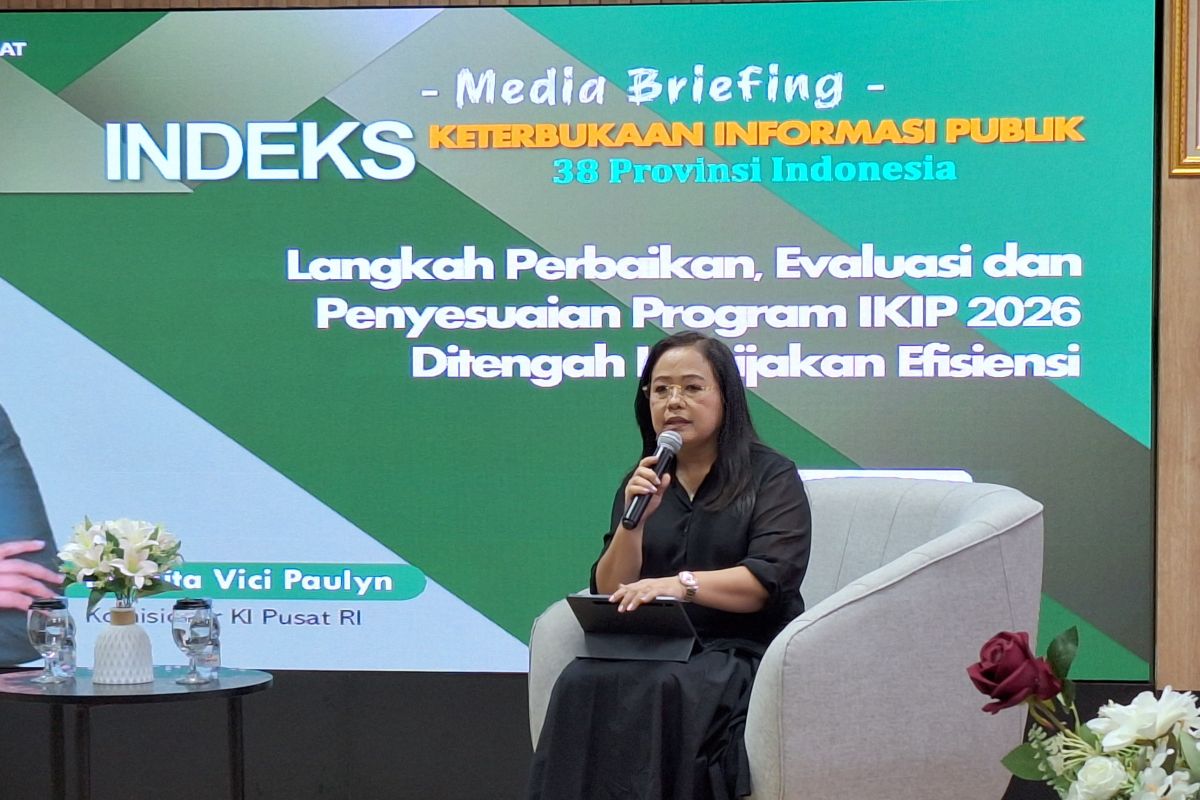
Jakarta (ANTARA) - The Central Information Commission (KI Pusat) has announced the cancellation of the 2026 Public Information Disclosure Index (IKIP), but emphasises that information openness is a state obligation and a fundamental right of the people that must be fulfilled by all public bodies.
“We hope that media colleagues will directly convey to all public bodies, particularly local governments, that the IKIP for 2026 cannot be implemented. However, this must not be used as an excuse by the government to neglect efforts towards openness,” said KI Pusat member Rospita Vici Paulyn at the KI Pusat Auditorium in Jakarta on Tuesday.
She continued, “Our hope is that when the Public Information Disclosure Index measurement is resumed in 2027, the results will be far better than the 2025 measurement.”
Rospita explained that the decision was taken following national budget efficiency policies that impacted the availability of operational funding for the RPJMN programme. She stressed that the absence of the IKIP must not be interpreted as a decline in commitment to transparency.
The cancellation of the 2026 IKIP serves as a moment for reflection, given that the 2025 National IKIP results showed a score of 66.43 (moderate category). This achievement indicates that public information openness in Indonesia still faces several fundamental challenges.
Rospita also highlighted several crucial issues related to public information openness, including low public literacy, such as the public’s understanding of the right to obtain information.
Additionally, the quality and availability of information are not yet optimal, such as outdated information that does not meet public needs. Furthermore, there is minimal commitment from leaders and the capacity of public bodies, including limited understanding of the role of the Information and Documentation Management Officer (PPID).
Another issue that Rospita noted is the numerous access barriers, including intimidation against information requesters and journalists in several regions, as well as the tendency to restrict information under the pretext of the public body’s excluded information list (DIK), even though such information is openly accessible based on the Information Commission Regulation.
She assessed that these findings indicate that information openness has not yet fully become a culture in government governance, both at the central and regional levels.
KI Pusat views 2026 as a moment for consolidation and strengthening the quality of public information openness. Without formal assessment through the index, public bodies are instead demanded to demonstrate independent commitment in providing transparent, accurate, and easily accessible information services.
“Our current focus is to ensure that the foundation of information openness does not falter even without index measurement. We encourage every province to continue innovating so that when measurement resumes in 2027, Indonesia is ready with a higher quality leap,” said Rospita.
KI Pusat also invites civil society and the media to remain active in conducting oversight and utilising information rights to encourage public participation in the policy-making process.