
Ceasefire Stalls, Trump Proves 'Toothless' in the Middle East
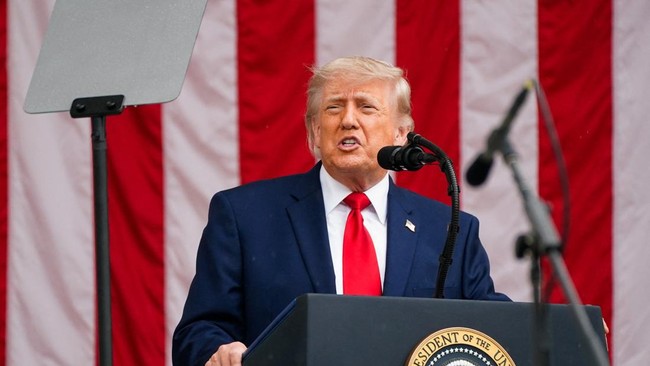
Jakarta, CNBC Indonesia - Ceasefires mediated by United States President Donald Trump at several conflict points in the Middle East have not yet been able to stop the violence completely. In the past week, attacks have still occurred in the Gaza Strip, southern Lebanon, northern Israel, and even Kuwait, despite a number of peace deals having been announced by Washington. Trump himself even acknowledged that the current ceasefire more closely resembles an effort to dampen the intensity of the conflict rather than to stop the war entirely. “The shooting is done in a more moderate way,” Trump said on Wednesday, describing the fragile condition of the deals his administration had negotiated, as quoted by Reuters.
In Gaza, the US succeeded in mediating a ceasefire between Israel and Hamas on 10 October 2025. The agreement included a halt to the fighting, the release of all Hamas hostages, the release of Palestinian prisoners by Israel, a gradual withdrawal of Israeli troops, an increase in humanitarian aid, and the opening of border access to Egypt. However, the implementation of the agreement is still facing many obstacles. Hamas has not yet agreed to disarm, while Israel and Hamas are still at odds over the distribution of humanitarian aid. The reconstruction of Gaza has also not progressed significantly, while Israel has stated it wants to expand the territory under its control. Consequently, Israeli airstrikes in Gaza are continuing. Since the ceasefire was enacted, more than 900 Palestinian citizens have been reported killed, including nine people in the latest attack on Thursday. On the other hand, sporadic attacks by Palestinian militant groups have also killed four Israeli soldiers.
A similar situation is occurring in Lebanon. The ceasefire between Israel and Hezbollah agreed upon after the conflict in 2024 has only been partially implemented. Tensions rose again from March when a war involving Iran broke out, prompting Hezbollah to resume launching rocket attacks into Israel and triggering Israeli military operations in southern Lebanon. Trump then announced a 10-day ceasefire on 16 April 2026 following rare communication between the governments of Israel and Lebanon. Although the intensity of strikes on Beirut has decreased, fighting in the southern region is still ongoing. Lebanese authorities have recorded more than 3,500 people killed since 2 March, while Israel reports 26 of its soldiers and four civilians killed by Hezbollah attacks. Iran has also made the ceasefire in Lebanon an important part of its efforts to end the conflict with the United States and Israel and to reopen the Strait of Hormuz, a vital global energy trade route. However, the latest proposal requiring Hezbollah to leave the southern Lebanon territory was rejected by the group, meaning clashes are still continuing.
Meanwhile, relations between the US and Iran are also not yet fully stable. After a joint US and Israeli strike on Iran on 28 February that targeted Tehran’s nuclear programme and ballistic missiles, both parties agreed to a ceasefire in early April and began a series of indirect negotiations. A permanent agreement has not yet been reached. Although talks mediated by Pakistan and Qatar are ongoing, both sides are still launching attacks against each other. Iran even targeted a number of Persian Gulf states, including Kuwait, this week. Analysts assess that the failure of the three ceasefires is rooted in the failure to achieve a long-term political settlement. The initial phase of stopping the conflict did succeed in reducing the scale of the war, but it was unable to resolve the main issues that are the source of the disputes. “When there is no movement and no political horizon, it is very difficult for a ceasefire to hold, because there is no real incentive for the parties involved in the ceasefire to continue adhering to it if it does not actually result in any change,” said Urban Coningham, a researcher at the Royal United Services Institute. According to him, the weakening influence of international institutions and the increasing assertiveness of regional powers are further diminishing the chances of achieving a more permanent peace in the Middle East.