
Cause of Return Traffic Density According to Transport Minister: Not a Surge in Vehicles
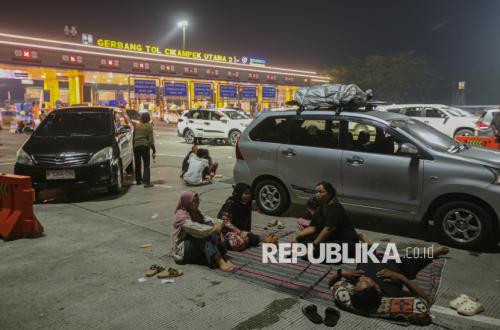
Several road users reported dense return traffic for this year’s Eid al-Fitr. Transport Minister Dudy Purwagandhi revealed that the congestion on the Trans-Java Toll Road on Friday morning (27/3/2026) was not triggered by a surge in vehicle volume exceeding predictions, but rather by obstacles at several rest area points.
This condition then prompted the government, together with the National Traffic Police Corps (Korlantas) of the Indonesian National Police, to implement a segmental one-way scheme to alleviate the slowdown in traffic flow towards Jakarta. Dudy explained that field monitoring results showed traffic counting was still moving according to projections.
However, vehicles piling up in rest area areas triggered disruptions to the smooth flow on several main sections of the Trans-Java Toll Road.
“Traffic counting is actually in line with predictions, not too high. However, due to obstacles on several sections, especially at rest areas, congestion occurred,” said the Transport Minister at the Korlantas Polri Command Center at KM 29, Cikampek, on Friday (27/3/2026).
According to him, the government has anticipated the return flow through cross-agency coordination meetings and the implementation of a Joint Ministerial Decree (SKB) for traffic regulation during the 2026 Eid mudik and return period. One of the chosen measures was a segmental one-way traffic engineering to curb vehicle queues from the east towards Jakarta.
Dudy urged the public to plan their journeys more carefully. Mudik travellers were advised to utilise digital information channels to avoid getting stuck entering crowded rest areas or those not suited to their travel needs.
Korlantas Polri Chief Inspector General of Police Agus Suryonugroho explained that the first stage of the one-way scheme was implemented from KM 132 to KM 70 starting at 07:30 WIB. This engineering was prioritised for return flow vehicles from Trans-Java that began experiencing slowdowns in the morning.
He stated that the traffic flow regulation pattern was not carried out all at once, but rather staged following the vehicle flow generation in the field. If vehicle movement increases again in the afternoon to evening, Korlantas is preparing to expand the one-way from KM 169 to KM 70, then KM 188 to KM 70, and even up to KM 263 if needed.
“This morning at 07:30 we have already conducted direct clear socialisation, so we implemented the first stage of one-way from kilometre 132 to kilometre 70. This is the first stage,” said Agus.
Korlantas also opened the possibility of implementing a national one-way if vehicle indicators at the Kalikangkung Toll Gate continue to rise approaching 4,000 vehicles. Monitoring of the return flow is not only focused on vehicles from Trans-Java, but also from West Java, Banten, and vehicles from Trans-Sumatra entering Java Island via Cikupa.
From the traffic data side, PT Jasa Marga recorded that the vehicle flow entering Jakarta until Friday at 06:00 WIB has reached 2.3 million vehicles. This figure is equivalent to about 69 percent of the total projected return flow for this year’s Eid.