
Capital Market Supports Energy Transition, OJK-BEI Promote Sustainable Investment
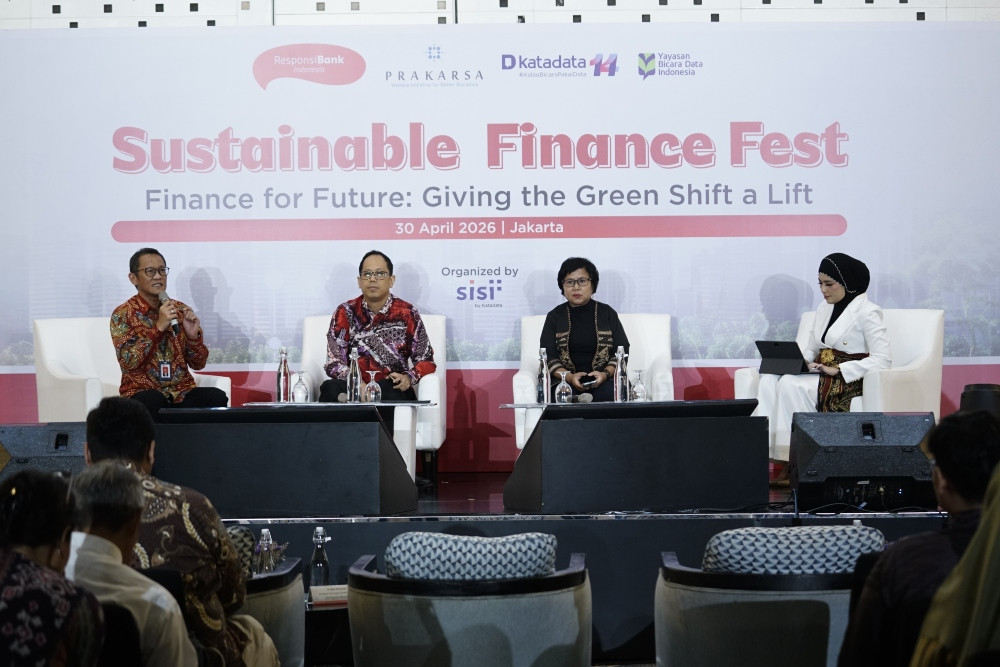
The Financial Services Authority (OJK) considers the capital market to have a strategic role as a driver of investments supporting energy transition and sustainable development in Indonesia. Deputy Commissioner for Regulation, Licensing, and Quality Control of OJK, Deden Firman Hendarsyah, stated that climate change now not only impacts the environment but also extends to social and economic aspects, even becoming a systemic risk to financial stability. “Climate change is not merely an environmental risk, but has evolved into an economic risk and a financial risk that threatens stability,” he said while serving as the keynote speaker at the Sustainable Finance Fest 2026 in Jakarta on Thursday (30/4/2026). Deden emphasised that the transition to sustainable finance is a collective mitigation effort against climate risks involving various stakeholders. For the financial services industry, this step is no longer an option but a necessity. Nevertheless, he reminded that the transition process must be carried out carefully with good governance. According to him, the risks from stagnation could be greater than those during the change process. “What is needed is prudent courage to innovate in designing green and sustainable financial products, yet accompanied by caution and good governance,” he explained. Deden also invited the public, especially the younger generation, to actively participate in driving the transformation of the financial sector. He stressed the importance of being investors who not only chase returns but also consider the impact of their investments. “Every rupiah invested is a vote for a better future for humanity and the earth,” he said. In promoting a sustainable financial ecosystem, OJK has issued various policies, such as the Indonesia sustainable finance taxonomy and guidelines for climate risk management. On the same occasion, OJK’s Director of Sustainable Finance, R. Joko Siswanto, conveyed that these regulations aim to shift the industry players’ paradigm from mere compliance to awareness. “In the future, the market or public will punish or appreciate business actors in implementing sustainable practices,” he said. From the capital market perspective, Head of Division for Development 2 of the Indonesia Stock Exchange (BEI), Ignatius Denny Wicaksono, affirmed that the exchange serves as a bridge between investors and green investment instruments. According to him, the capital market can be the main engine in navigating environment, social, and governance (ESG)-based investments, while accelerating the flow of funds to sustainable sectors. “Our task is to navigate ESG investment, that is, how to ensure investors invest in more sustainable sectors,” he said. BEI has undertaken various efforts to promote green investments, including enhancing information disclosure, collaborating with ESG rating agencies, launching six ESG indices, and developing various sustainable investment products. Executive Director of The PRAKARSA, Victoria Fanggidae, explained that the financial sector’s transition towards greater sustainability must consider social aspects. Energy transitions often overlook their social impacts, such as job losses in the energy and mining sectors. When retiring coal-fired power plants early, for example, stakeholders need to account for how many jobs will be lost as a result. “Inequalities in benefits also need attention. Many green investments only benefit corporations, while local communities bear the impacts—both in terms of livelihoods and land conflicts,” Victoria stated.