
Can Merz Save German Industry from Chinese Dominance?
China’s rise from poverty to become the world’s second-largest economy has rewritten the rules of globalisation. Now, Beijing’s ambition to reach the upper echelons of technology is being pursued at an even greater pace.
If the United States and the United Kingdom had decades to absorb the first “China shock” at the turn of the century, the countries now facing the second wave — particularly Germany — have been given almost no respite.
Signs that Beijing’s massive investment in high-technology sectors was beginning to bear fruit emerged shortly after the first Chinese electric vehicles (EVs) were unloaded from carrier ships at various European ports in 2023. Many doubted that Chinese EVs could erode the dominance of legendary German manufacturers. Yet two years on, Chinese automakers have become a disruptive force in the European market.
Germany: Losing its foothold in the largest automotive market
Names such as Volkswagen, BMW and Mercedes-Benz have lately been sounding the alarm as sales figures come under increasing pressure, both in China and in their domestic market. German vehicle exports to China have fallen by two-thirds since 2022, according to data from the EU’s statistical agency, Eurostat.
The rivalry that was initially concentrated in the automotive sector has now spread to various other industries. Last year, German goods exports to China fell 9.3 per cent to €81.8 billion — the lowest in a decade — whilst imports from China surged.
“Germany is at the heart of the ‘second China shock’,” said Andrew Small, Director of the Asia Programme at the European Council on Foreign Relations. “The two economies used to complement each other; now they function as competitors.”
German exports in a phase of ‘structural decline’
Last week, the New York-based research firm Rhodium Group warned that Germany’s outbound trade with China had entered a phase of “structural decline”. Without alternative markets, the wave of bankruptcies and redundancies currently hitting Germany “is likely to accelerate further”.
In its report entitled Germany’s ‘China Shock’ Revisited, Rhodium noted that Chinese competitors are beginning to seize market share from German producers in the machinery, chemicals and power generation systems sectors.
“The Chinese market was once a goldmine for German multinationals,” said Noah Barkin, Rhodium’s senior adviser on China. “But over the past three years, a quarter of German exports there have evaporated.”
For years, China was Germany’s largest or second-largest export destination. However, in 2024 its position slipped to fifth place, and it is projected to fall further.
Chinese competitors target non-EU markets
The pressure on German industry is no longer confined to China. In third-country markets — across Asia, Latin America and Africa — Chinese firms are making significant strides by offering products at far lower prices.
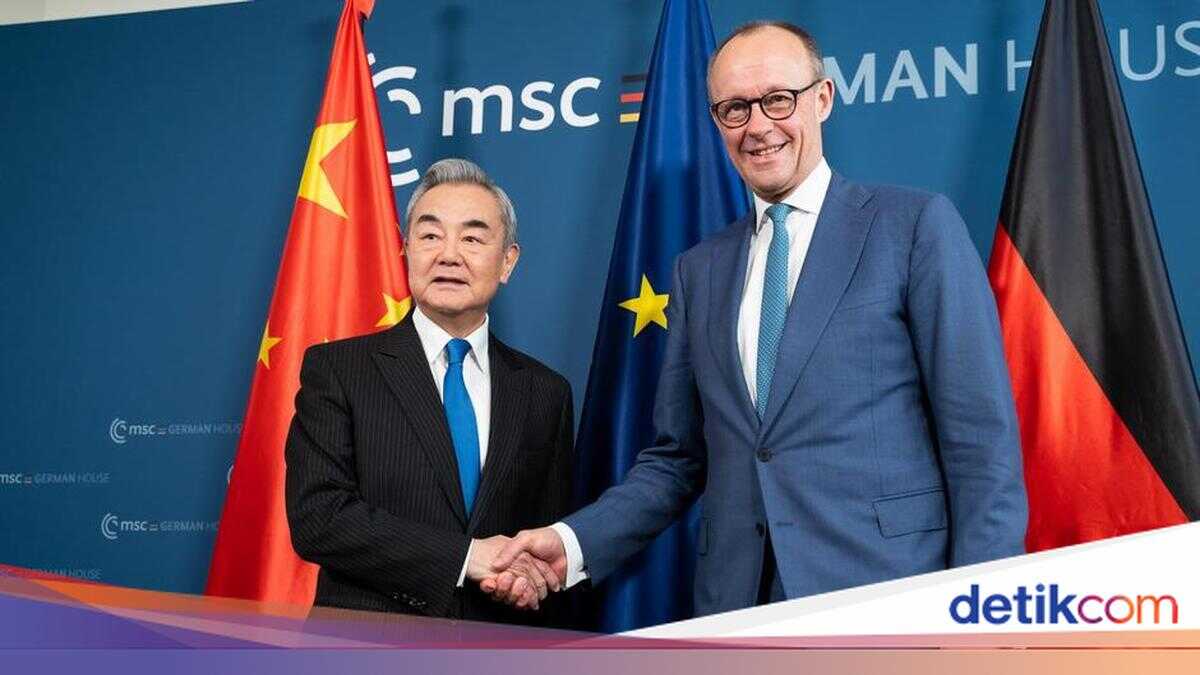
Amid this situation, Chancellor Friedrich Merz is preparing to make his first official visit to China. He is expected to walk a fine line: affirming China’s importance to German industry whilst pressing Beijing to address longstanding concerns over market access and overcapacity.
Bilateral relations have been strained since the pandemic exposed Germany’s dependence on Chinese-sourced components and raw materials. A policy of “de-risking” — reducing exposure — through supplier diversification has since emerged.
Managed stabilisation, not a total reset
According to Stefan Messingschlager of Helmut Schmidt University Hamburg, a full “reset” would be difficult. A more realistic target is “managed stabilisation”.
Berlin’s priorities in Beijing include reducing China’s leverage over rare earth minerals, as well as single-source dependencies for battery materials, chips, pharmaceutical precursors and key industrial software.
China controls approximately two-thirds of global rare earth production and 90 per cent of refining capacity. Last year, Beijing restricted exports of critical minerals to the European Union and the United States, disrupting automotive industry production on both sides of the Atlantic.
Rather than resolving all issues bilaterally — from overproduction to massive industrial subsidies — Merz is expected to rely on EU support through anti-dumping and anti-subsidy policies.
EU bolsters its economic firepower
At the competitiveness summit in Belgium last week, EU leaders agreed on a more aggressive industrial agenda, including a “Buy European” policy for public sector procurement and measures to counter unfair competition from China.
In January, the European Commission announced new investigations and trade protection measures to address market distortions linked to Beijing’s industrial policies.
The EU is also accelerating trade agreements with India and several major Latin American economies — which are expected to open new growth markets for German exporters.
However, Rhodium cautioned that whilst German industry still performs strongly in the EU, the United Kingdom and Türkiye — thanks to geographic proximity and preferential trade agreements — Chinese producers could soon take the lead in those markets if trade barriers are not enforced.
Consolidating like-minded partners
Andrew Small argued that diversification alone is insufficient without defensive measures. The EU, he said, needs to join forces with other countries that also wish to protect their industries from the onslaught of Chinese competitors. A robust response from multiple trading partners would send a clear message to Beijing.
Such steps, he noted, must be taken carefully to avoid the appearance of “forming a bloc” against China. Nevertheless, the appetite for building protections in strategic sectors is increasingly evident.
Some economists have even compared the pressure on German industry to the fate of Detroit — once the heart of the American automotive industry — which sank into a prolonged period of economic decline and depopulation.
Rhodium noted a sense of “panic” in parts of German industry over China’s rapid advance. The tough political rhetoric in Berlin has, thus far, not been matched by commensurate action.
Without a credible threat to restrict access to the European market, the report concluded, China has no incentive to restrain its export surge. Meanwhile, German industry will continue to grapple with far larger competitors that, in their view, do not always play by the same rules.