
Can Jakarta Overcome Its Unemployment Problem?
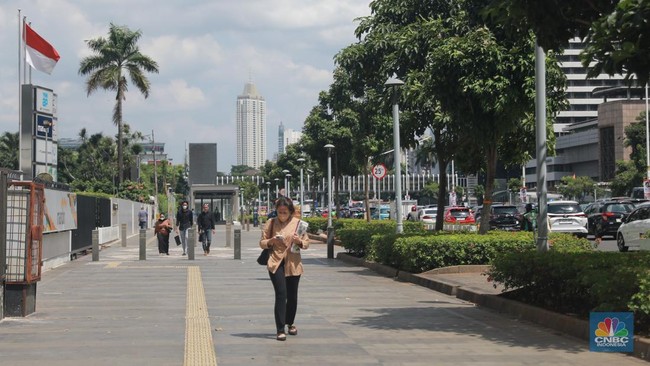
A glance at entertainment districts, shopping areas, and restaurants and cafes across Jakarta suggests that the public economy is faring well. In these places, people move from one restaurant to another cafe. Not a few still visit ‘branded’ shops to buy desired items. However, the dark cloud of unemployment is drawing ever closer as an early sign of a great storm if not addressed promptly.
Not long ago, the Central Statistics Agency (BPS) released a concerning survey. It found that Jakarta’s open unemployment rate (TPT) increased from 6.05% in August 2025 to 6.31% in November 2025.
Indeed, in terms of statistics, the change in figures may seem small compared to the real impact. That small change on the statistical chart means unemployment in the capital has risen by around 19,000 people, resulting in 349,000 Jakarta residents now unemployed (Antara, 2026).
This situation is lamentable, as it occurred shortly after the Governor of the Special Capital Region (DKI) of Jakarta, Pramono Anung, announced that unemployment in Jakarta had fallen in August 2025. He explained that this was the fruit of his 14 job fair programmes (Detik, 2025).
That claim also needs verification, as not a few job fair participants complained that they felt no results from the event (Inilah, 2025). Regardless of whether the Jakarta Provincial Government (Pemprov) DKI maximised its job fairs, one thing is clear: actual unemployment has risen again. This shows that the vulnerability persists.
Economic and Political Storm
The narrowing of job opportunities leading to increased unemployment will impact many aspects in both the short and long term, where the influence on public life worsens the longer the problem is not addressed.
One of the clearest effects is on public economic life, directly related to people’s ability—or inability—to meet their objective basic needs in life, such as clothing, food, and shelter. Fewer job opportunities mean more citizens who not only lack decent work but also decent income.
In this case, around 19,000 more Jakarta residents have fallen outside the Jakarta Regional Minimum Wage (UMR) umbrella of Rp5.7 million per month. An UMR that was actually rejected by the Jakarta labour union alliance for various reasons (Kontan, 2025).
One of them is that the UMR is still below Rp5.89 million per month to meet 100% Living Needs Standards (KHL) according to the Ministry of Manpower (Kemnaker) calculations. Once again, this can be interpreted as someone ceasing to receive wages at the UMR level will struggle to have a decent life.
What happens when society cannot meet decent needs is manifold, as warned by senior economist Chatib Basri in his phenomenal article titled ‘Affan Kurniawan and the “Chilean Paradox”’ in Kompas.
The article was published after the massive demonstrations in September 2025. Starting from labour group protests demanding improved working conditions, the demonstrations turned into large-scale rallies against broader political situations.
In it, Chatib discusses the ‘Chilean Paradox’ phenomenon where economic growth is not felt widely by society, even creating inequality. He also reflects on Affan’s death in those demonstrations, which peaked societal disappointment in social, political, and economic spheres.
But Chatib also addresses an ongoing bogeyman for both government and society: decent job opportunities and unemployment, and their impact on the weakening middle class.
Formal job opportunities are narrowing; people are not without options. Chatib discusses the informal sector that created 80% of new jobs throughout 2019-2024. These are the street vendors (PKL) who often trade from roadside carts facing rain and scorching sun. Then, young freelancers. Up to online motorcycle taxis (ojol) in the grey area between formality and informality.
The problem, as discussed by Chatib, is that informal work does not guarantee a decent life that could be better fulfilled by formal sector jobs. Citing BPS data, he reveals that the average income of informal workers in Indonesia was as low as Rp1.9 million in 2023.
Even using the Jakarta UMR benchmark for that year, which was Rp4.9 million, that wage is insufficient (Kompas, 2023). Especially to meet daily needs, along with family, and even children if already married and having their own household.
When people cannot live decently, what emerges is a sense of injustice, dissatisfaction, and disappointment that can quickly develop into political problems. In a meeting with the President of the Republic of Indonesia (RI), Prabowo Subianto, in Hambalang, Chatib explained the connection between the rise and fall of public protest waves in Indonesia and the shrinking middle class (Tempo, 2026).
Where this is also related to the reduction in formal job opportunities and many people ultimately relying on informal work that cannot provide certainty.
In that complex situation, the economic and political storm tri