
Can Indonesia Achieve Self-Sufficiency in Consumption Sugar Next Year? Sugarcane Farmers Say This
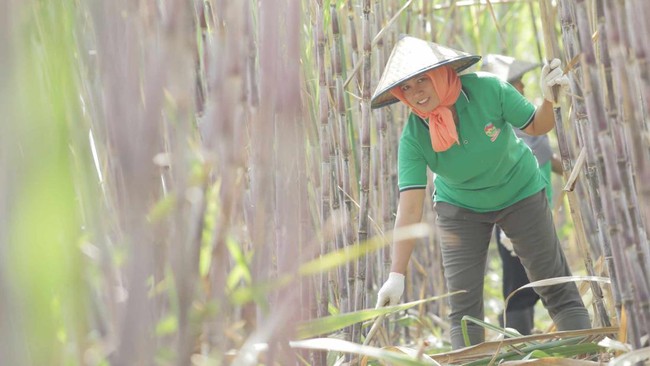
The target of self-sufficiency in consumption sugar in the near future still raises questions. Although production and demand figures are increasingly close, farmers assess that conditions on the ground do not fully support the claim.
APTRI Chairman Soemitro Samadikoen stated that the national consumption sugar needs are around 2.5-2.8 million tonnes per year, a figure also acknowledged by the government.
“Consumption sugar is at most 2.6-2.8 million tonnes. Unless Kalimantan sources sugar from Malaysia. So around 2.7-2.8 million tonnes (national annual needs). The Agriculture Minister is correct in saying 2.8 million tonnes for consumption; that’s right. Between 2.5 million tonnes and 2.8 million tonnes per year for national sugar consumption,” Soemitro told CNBC Indonesia on Friday (10/4/2026).
Meanwhile, on the production side, he said the national figure is already approaching that need, reaching 2.5 million tonnes per year.
“Approximately (national consumption sugar production) 2.5 million tonnes per year,” he revealed.
Furthermore, he added, Indonesia still has a stock reserve of consumption sugar from the previous year, amounting to 1.2 million tonnes.
Although the production and consumption balance appears increasingly even, Soemitro stressed that self-sufficiency cannot be judged solely by these calculations.
“Self-sufficiency must mean real self-sufficiency. Meaning, self-sufficiency is truly met from domestic production, right?” Soemitro emphasised.
He highlighted the presence of sugar supplies from abroad still entering the domestic market, particularly in border areas, so consumption is not entirely met from domestic production.
“For example, if West Kalimantan buys from Malaysia, from the border, from Entikong there. Then North Kalimantan also buys from there. East Kalimantan via the hills there also buys from our neighbours. They are fulfilled, but that doesn’t mean it’s self-sufficiency,” he explained.
Soemitro assessed that this situation needs to be addressed first before the government declares Indonesia truly self-sufficient in sugar.
“Clean up the elements or goods entering the consumption sugar market first. So there’s no fear from farmers,” he said.
Sugar Once Unsold in the Market
He also recalled that the issues in the sugar sector are not just about production, but also market absorption. In fact, there were times when farmers’ sugar was not absorbed even though Indonesia was not yet self-sufficient.
“Previously, we weren’t self-sufficient yet, but our sugar was already unsellable. How’s that? It means there’s other sugar entering us,” he said.
“The second month, July was the second month we sold sugar, the sugar was already unsellable, scary isn’t it,” he continued.
According to him, this becomes an indicator that there are still structural problems that must be resolved.
Nevertheless, Soemitro believes Indonesia is actually capable of no longer relying on imports and achieving sugar self-sufficiency, but it requires clear stages.
“It can (stop imports and achieve self-sufficiency). I even guarantee it can. Let’s say if we start now, self-sufficiency by 2030 is truly possible. But the stages must already be visible from now,” he stated.
Government Confident in Consumption Sugar Self-Sufficiency by 2027
On the other hand, Agriculture Minister Amran Sulaiman stated that the government remains optimistic that the target for consumption sugar self-sufficiency can be achieved soon. He said the gap between production and needs is now only around 100,000-200,000 tonnes.
“It’s just 200,000 tonnes left, insya Allah hopefully. Because now production is 2.7 (million tonnes) or 2.6 million tonnes, public consumption should be 2.8-2.9 million tonnes a year, so it’s safe,” Amran said when met at the Parliament Complex, Jakarta, on Wednesday (8/4/2026).
With various production enhancement programmes, the government targets consumption sugar self-sufficiency to be achieved at the latest in 2027.
“The clear production increase, at the latest by 2027 we will be self-sufficient in white sugar,” he concluded.